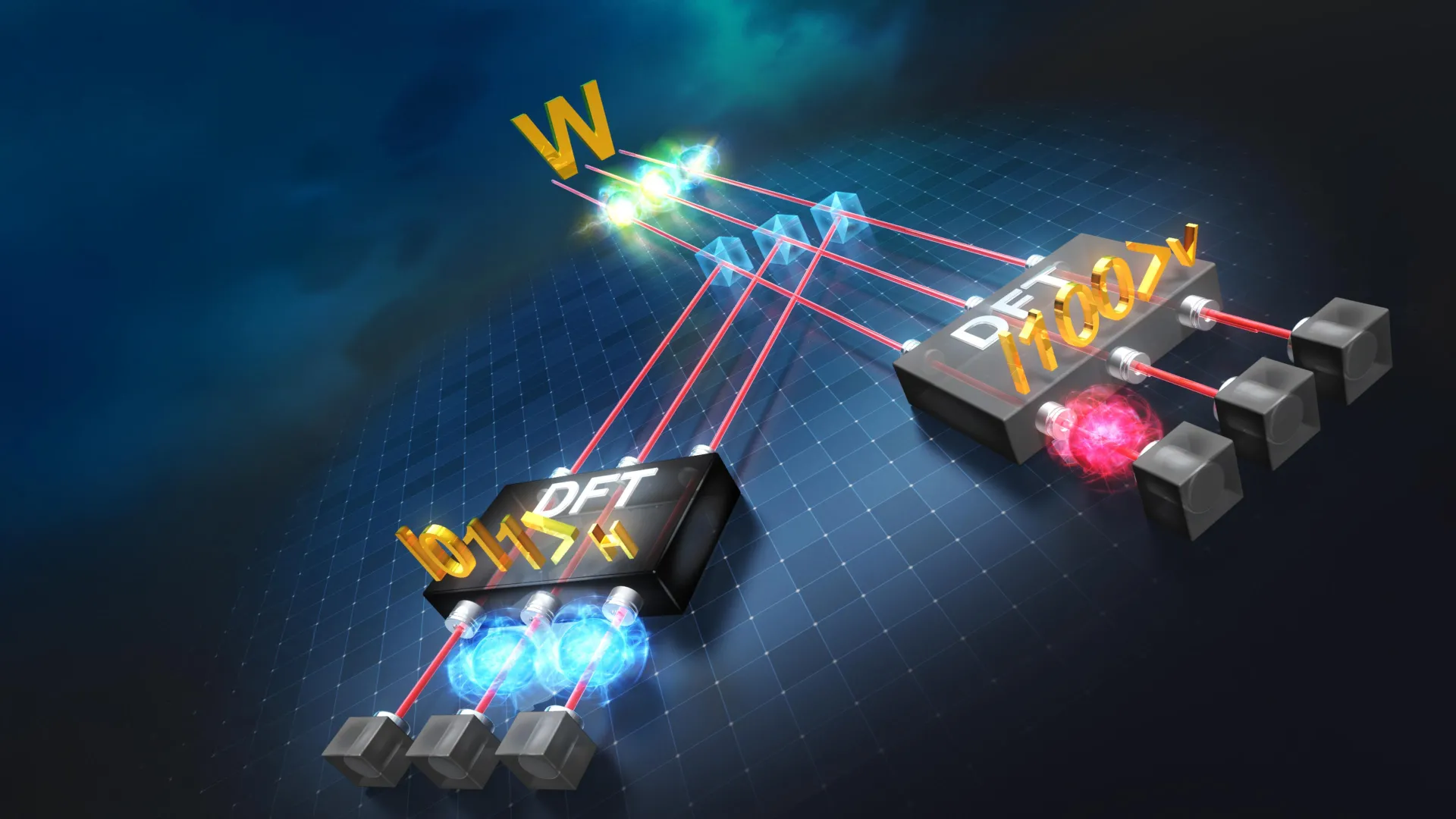
Unlocking Quantum Potential: Scientists Achieve Breakthrough in W State Entangled Measurement
Quantum entanglement, a phenomenon Albert Einstein famously termed “spooky action at a distance,” remains one of the most captivating and challenging concepts in modern physics. It describes a situation where two or more particles become linked together in such a way that they share the same fate, no matter how far apart they are. This interconnectedness, defying classical physics’ expectation of independant particle realities, is not merely a theoretical curiosity; it’s the cornerstone of emerging quantum technologies poised to revolutionize computation, communication, and more.
But harnessing the power of entanglement requires more than just understanding its existence. It demands the ability to create, control, and measure entangled states with precision.A key hurdle lies in characterizing these states – determining exactly what kind of entanglement is present.This is typically done through a process called quantum tomography, but its limitations become crippling as the number of entangled particles increases. The number of measurements required grows exponentially, quickly becoming an insurmountable data collection problem.
Fortunately, a more elegant solution exists: entangled measurements. These offer the potential to identify an entangled state in a single, efficient step. While an entangled measurement has been successfully demonstrated for the well-known Greenberger-Horne-Zeilinger (GHZ) entangled state, achieving the same for the W state – another basic multi-photon entangled state – has remained elusive… until now.
A New Era for W State Measurement
Researchers at Kyoto University and Hiroshima University have overcome this longstanding challenge, developing a novel method for entangled measurement specifically tailored to identify the W state. This breakthrough, published recently, marks a significant leap forward in our ability to manipulate and utilize quantum entanglement.
“More than 25 years after the initial proposal concerning the entangled measurement for GHZ states, we have finally obtained the entangled measurement for the W state as well, with genuine experimental demonstration for 3-photon W states,” explains corresponding author Shigeki Takeuchi.
the team’s success hinges on exploiting the unique cyclic shift symmetry inherent in the W state. By leveraging this property, they theoretically designed a photonic quantum circuit capable of performing a quantum Fourier transformation on the W state, irrespective of the number of photons involved.
This theoretical framework was then brought to life through the creation of a highly stable optical quantum circuit. Crucially, the device was engineered for long-term, stable operation without requiring constant active control – a significant advancement in practical quantum technology.
The researchers demonstrated the device’s capabilities by inputting three single photons with specific polarization states. The circuit successfully distinguished between different types of three-photon W states, revealing the non-classical correlations linking the photons. They rigorously evaluated the fidelity of the measurement – the probability of correctly identifying a pure W-state input – confirming the method’s accuracy and reliability.
Implications and Future Directions
This achievement isn’t just a technical feat; it unlocks a range of exciting possibilities. The ability to efficiently measure W states has profound implications for:
* Quantum Teleportation: Facilitating the reliable transfer of quantum information.
* Quantum Communication Protocols: Developing secure and efficient communication methods leveraging multi-photon entanglement.
* Measurement-Based Quantum Computing: Exploring new computational paradigms based on entangled measurements.
* Multi-photon Entangled State Transfer: Enabling the distribution of complex entangled states for advanced quantum applications.
“To accelerate the research and progress of quantum technologies,it is indeed crucial to deepen our understanding of basic concepts to come up with innovative ideas,” emphasizes Takeuchi.
Looking ahead, the team plans to scale their method to handle larger, more complex multi-photon entangled states. They are also focused on developing integrated on-chip photonic quantum circuits for entangled measurements, paving the way for more compact and scalable quantum devices.
Evergreen Insights: The Quantum Revolution – Beyond the Hype
The progress detailed above is part of a larger, ongoing revolution in quantum technology. While often shrouded in complexity, the core principle driving this revolution is the exploitation of quantum mechanics’ counterintuitive properties – superposition, entanglement, and interference – to solve problems intractable for classical computers.
It’s important to understand that quantum computing isn’t about building faster versions of our current computers. It’s about tackling different kinds of problems. Areas poised for disruption include:
* Drug Discovery & Materials Science: Simulating molecular interactions with unprecedented accuracy.
* Financial Modeling: Optimizing complex portfolios and risk management strategies.
* Cryptography: Breaking existing encryption algorithms and developing quantum-resistant security measures.
* Artificial Intelligence: Accelerating machine learning algorithms and enabling new AI capabilities.
However, the path to realizing the full potential of quantum technology is not without its challenges. Maintaining the delicate quantum states required for computation (known as decoherence) is