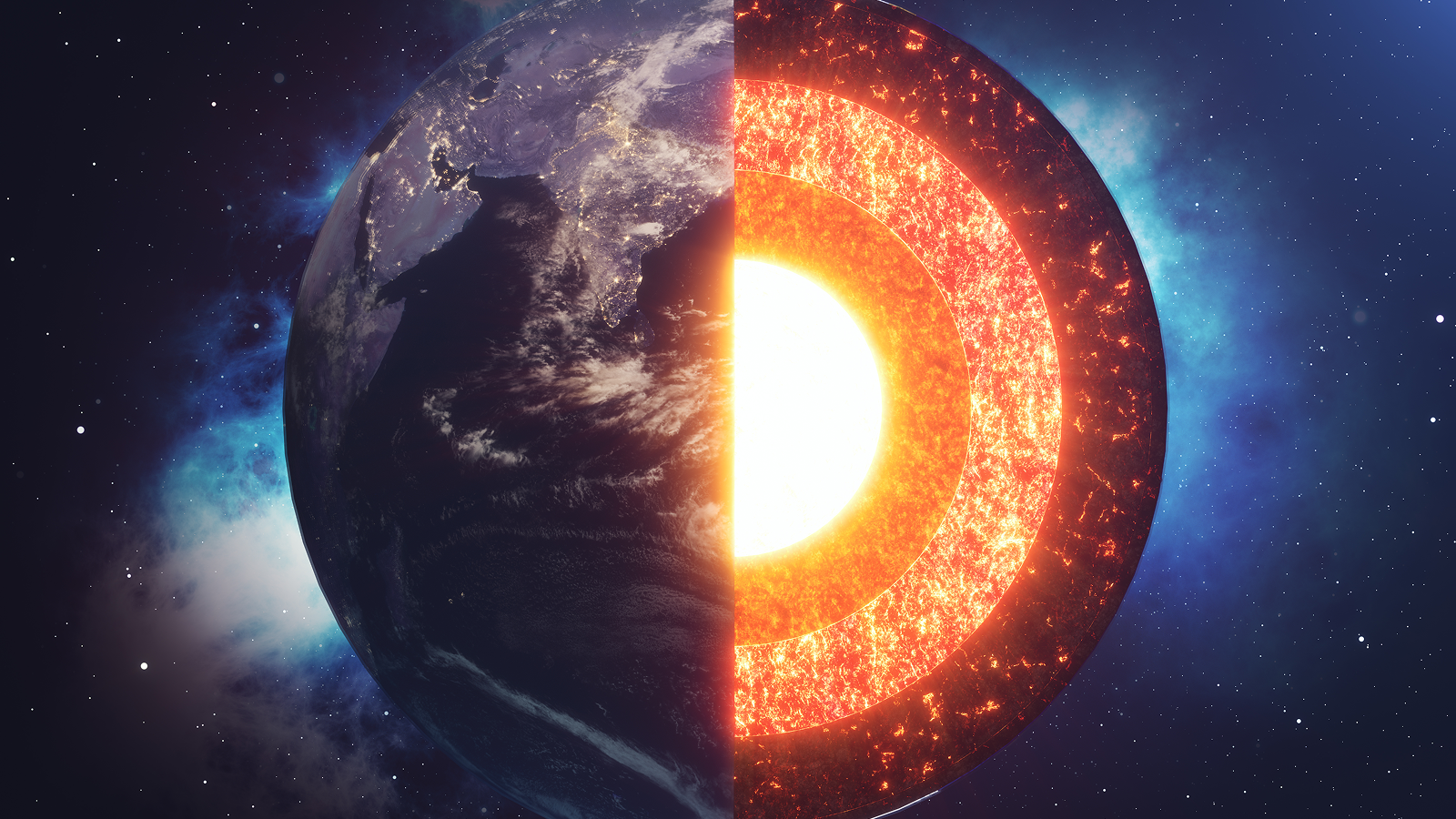
Unlocking Earth’s Deepest Secrets: The Composition of Our Planet’s Core
For decades, scientists have wrestled with a basic question: what exactly is Earth’s core made of? Understanding its composition is crucial, as the core drives many of the processes that shape our planet – from the magnetic field that protects us to the very continents we live on. Recent research is bringing us closer to a definitive answer, challenging long-held assumptions and revealing a surprisingly complex interior.
The Challenge of a Solid Inner Core
Traditionally, the core has been thoght to be primarily iron.However,calculations based on this assumption present a significant problem. If the core were solely iron, it woudl require an immense amount of “supercooling” – cooling below the freezing point without solidifying – to explain the existence of the solid inner core.
Adding elements like silicon and sulfur, suggested by both meteorite analysis and seismic data, only exacerbates this issue. These additions demand even more supercooling, making the scenario increasingly improbable.
Carbon: A Key to Unlocking the Mystery
Our latest investigations focus on the role of carbon within the core. Remarkably, incorporating carbon into the model dramatically reduces the required supercooling.
* If 2.4% of the core’s mass were carbon, approximately 420°C of supercooling would be necessary to initiate inner core freezing.
* Increasing the carbon content to 3.8% lowers this requirement to just 266°C.
This is the first time researchers have demonstrated a plausible pathway for the inner core to have solidified. While still ample,these levels of supercooling are far more realistic than previously estimated.
refining Our Understanding of Core Composition
This discovery doesn’t mean the core is simply iron and carbon. Seismological data – the way earthquake waves travel thru the Earth – indicates that at least one additional element must be present.
Our research suggests that oxygen is a likely candidate, with silicon also potentially playing a role. You can think of it as a complex alloy, rather than a simple mixture. This refined understanding helps reconcile seismic observations with the physical properties of potential core materials.
Implications for Earth’s History and Future
Determining the core’s composition isn’t just an academic exercise. It has profound implications for understanding:
* How the core began to freeze: the timing and mechanism of inner core formation are linked to the planet’s thermal history.
* The generation of Earth’s magnetic field: Convection within the liquid outer core, driven by heat release during inner core freezing, creates our protective magnetic field.
* The evolution of our planet: The core’s composition and dynamics have influenced plate tectonics, volcanic activity, and the overall habitability of Earth.
Unraveling the mysteries of Earth’s core is a continuing journey. Each new finding brings us closer to a complete picture of our planet’s inner workings and its remarkable evolution. This research represents a significant step forward, paving the way for future investigations and a deeper thankfulness of the dynamic world beneath our feet.
Related reading