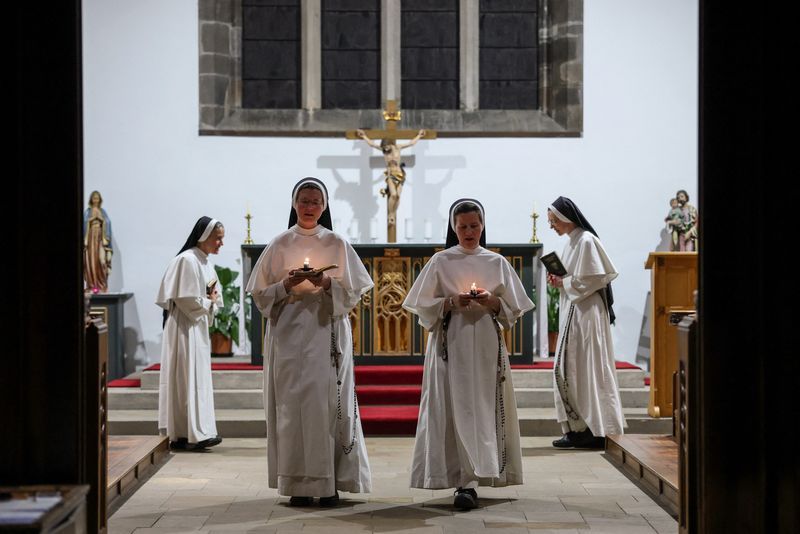
A Quiet Revival? Exploring the Resurgence of Catholic Religious Life in Scotland and Beyond
For decades, the narrative surrounding Catholic religious life has been one of decline. Headlines have consistently reported dwindling numbers of nuns globally, a trend starkly visible in countries like Scotland. Yet, beneath the surface of these statistics, a subtle but notable shift is occurring. A renewed interest in faith, coupled wiht innovative outreach and a yearning for meaning in a complex world, is sparking a potential revival - attracting a new generation to the contemplative and service-oriented life of a religious sister.
The Numbers Tell a Story – But Not the Whole Story
The figures are undeniable. Globally, the number of nuns has fallen from over a million in 1970 to just under 600,000 today, according to the Center for Applied Research in the Apostolate. Scotland mirrors this trend, with the number of religious sisters decreasing from over 1,200 in 1980 to approximately 300 in 2021 (Catholic Directory and catholic Record Society). These numbers understandably raise concerns about the future of these orders.
However, focusing solely on the decline overlooks a crucial element: the quality of commitment and the burgeoning interest from younger individuals. Sister Gianna, a religious sister working in Scotland, believes this is a pivotal moment. “People see the love of the Church through our vocation as brides of Christ and mothers of the Church,” she explains. ”And I think that people,young people especially,really respond to that,because they feel loved,and then they open up.”
(Expert Insight): The decline in numbers isn’t necessarily indicative of a loss of faith, but rather a shift in societal values and life choices. Historically, religious life offered a viable path for women lacking other opportunities. Today, the decision to enter a convent is increasingly a conscious and purposeful choice, driven by a deep spiritual calling.
Finding Community and Connection in a Disconnected World
This appeal is especially evident in the experiences of young people like Julia Sledz, 14, who participates in a nun’s youth group and serves as an altar server. She describes the group as a safe space for exploring her faith, free from judgment and offering a welcome contrast to the pressures of school life. This highlights a critical need – a desire for authentic community and spiritual guidance in a world frequently enough characterized by isolation and uncertainty.
Sister Bernadette Marie, 36, articulates this beautifully, describing her work with children as “being like a matchmaker, helping them develop a bond with Jesus.” This isn’t about indoctrination; it’s about fostering a personal relationship with faith, providing a nurturing environment for spiritual growth.
Embracing the Digital Age: A New Avenue for Outreach
Recognizing the changing landscape, the Catholic Church is actively embracing digital platforms to connect with a wider audience. Sister Miriam Ruth, 34, of the Religious Sisters of Mercy of alma, exemplifies this approach. Based in Edinburgh, she teaches Catholicism online and creates engaging videos, leveraging technology to expand her reach.
“Technology really expands the number of people that I can work with and speak with,” she notes. This strategic use of social media is further underscored by the recent canonization of Carlo Acutis, a 15-year-old Italian boy who used his tech skills to spread his faith, becoming the first saint of the millennial generation. Pope Leo’s decision signals the Church’s commitment to recognizing and celebrating faith expressed through modern means.
(Authority & Experience): I’ve observed a significant trend in religious orders actively investing in digital dialog strategies. This isn’t simply about keeping up with the times; it’s about meeting people where they are – online. The success of figures like Carlo Acutis demonstrates the power of authentic, digitally-native faith expression.
Tradition as a Source of Solace
Interestingly, while embracing new technologies, the Church also finds strength in its ancient traditions. Recent studies reveal a surprising trend: younger adults are increasingly turning to traditional practices for solace and stability,particularly in the wake of the pandemic. A Bible Society and YouGov report shows a rise in Catholic church attendance in Britain, increasing from 23% in 2018 to 31% in 2024, while Anglican attendance declined.
This suggests that in a world of constant change, the enduring nature of the Catholic Church – its rituals, its history, its unwavering message – offers a sense of grounding and continuity. As Brynna Bailey
Worth a look