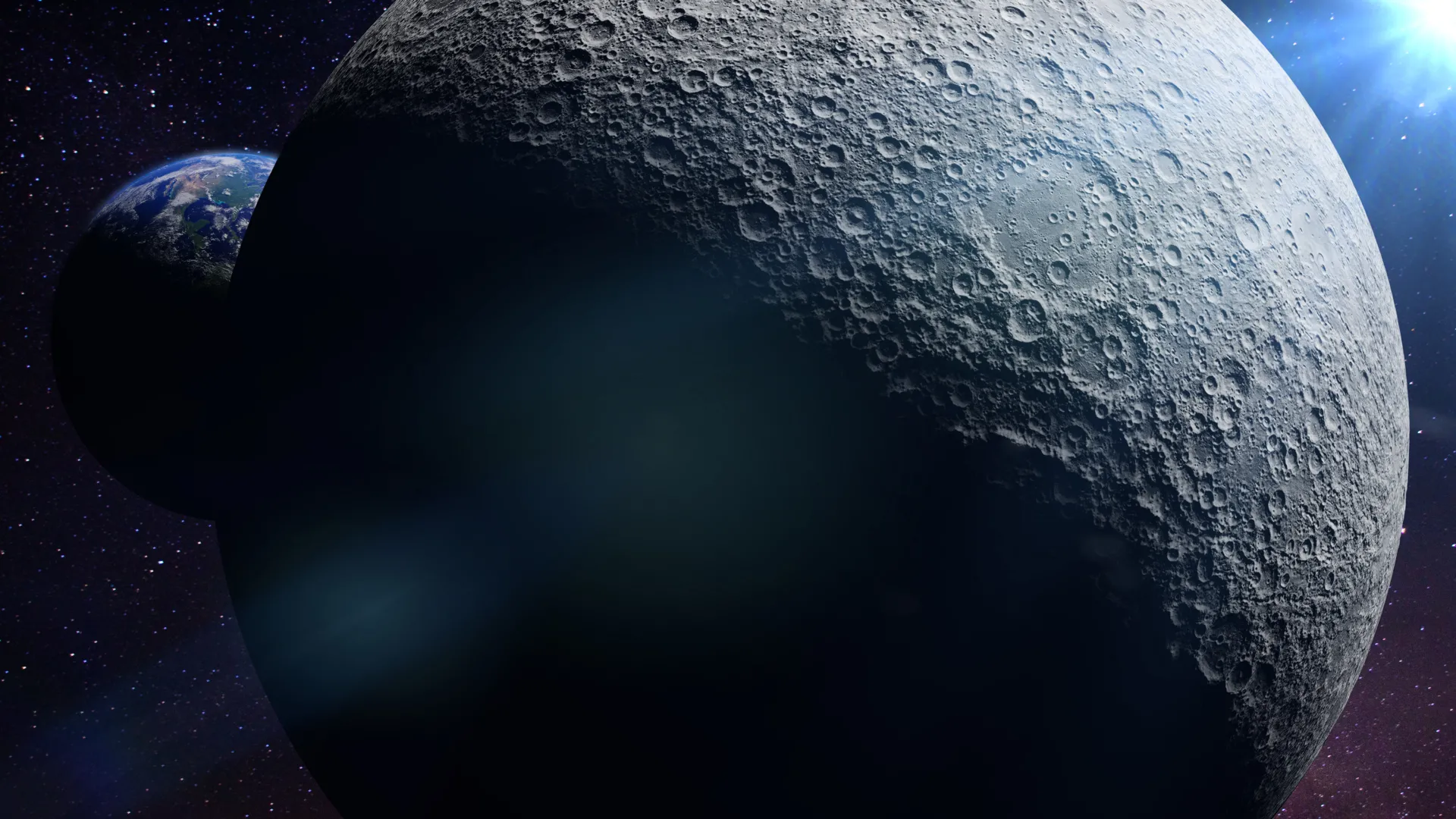
Lunar Far Side Reveals Thermal Mystery: New Data Supports Uneven Moon Interior
For decades, scientists have puzzled over a fundamental asymmetry of the Moon: its near side is markedly different from its far side. This disparity extends beyond visible features,manifesting as a significant temperature difference and a concentration of volcanic activity on the near side. Now, groundbreaking analysis of samples returned by China’s Chang’e 6 mission from the far side of the Moon is providing compelling new evidence supporting the theory of an unevenly distributed, heat-generating interior. This research, published recently, offers crucial insights into the Moon’s formation and evolution, and potentially explains why the two hemispheres developed so differently.
A Long-Standing Lunar Enigma
The Moon isn’t a homogenous sphere. The near side, facing Earth, is characterized by large, dark volcanic plains called maria, while the far side is dominated by heavily cratered highlands.This isn’t merely a surface-level difference. Geophysical data suggests the lunar mantle beneath the near side is significantly warmer than that of the far side. This thermal imbalance is believed to be driven by variations in the concentration of heat-producing elements – primarily uranium, thorium, and potassium – within the lunar interior.
But why are these elements distributed so unevenly? Several hypotheses have been proposed. One leading theory posits a cataclysmic impact event early in the Moon’s history.A massive collision, potentially with a large asteroid or even another protoplanet, could have violently reshuffled the Moon’s interior, concentrating denser, heat-producing materials on the near side. alternative explanations include a collision with a smaller moonlet, or the gravitational influence of Earth itself.
Chang’e 6: A First Look at the Lunar Far Side’s Composition
The Chang’e 6 mission, successfully retrieving 300 grams of lunar soil from the south Pole-Aitken Basin on the far side, provided the first chance for direct analysis of this previously inaccessible region. Researchers at the Beijing Research Institute of Uranium Geology, led by Sheng He, meticulously examined the sample, composed largely of basaltic grains.
Using advanced analytical techniques, including an electron probe to map elemental composition and an ion probe (Secondary Ion Mass Spectrometry – SIMS) to precisely date the rock at 2.8 billion years old, the team delved into the sample’s history. The dating process leverages the predictable decay of uranium into lead, providing a reliable timeline for the rock’s formation. Professor Pieter Vermeesch of UCL Earth Sciences contributed crucial data processing methods to refine the accuracy of these analyses.
Evidence of a 100°C Temperature Difference
The research team employed multiple approaches to estimate the temperature of the far-side sample at various stages of its geological history.
* Mineral Composition Analysis: By analyzing the composition of minerals within the sample and comparing them to computer simulations, they estimated the rock’s formation temperature. This revealed a difference of approximately 100°C compared to similar analyses of near-side rocks.
* “Parent Rock” Temperature Inference: Going further back in time,the team inferred the temperature of the molten “parent rock” from which the sample originated,again finding a roughly 100°C disparity with apollo mission samples from the near side.
* Satellite Data Correlation: Collaborating with Shandong University, researchers compared satellite data from the Chang’e 6 landing site on the far side with equivalent data from the near side, confirming a temperature difference of around 70°C.
These converging lines of evidence strongly suggest that the far-side mantle was, and likely remains, cooler than its near-side counterpart.
The Role of KREEP and the Moon’s Formation
The uneven distribution of heat-producing elements is closely linked to the presence of “KREEP” - an acronym for potassium (K), rare earth elements (REE), and phosphorus (P). KREEP-rich materials tend to concentrate these radioactive elements.
The prevailing theory of lunar formation – the Giant Impact hypothesis – proposes that the Moon formed from debris ejected after a collision between Earth and a Mars-sized protoplanet. In the initial molten state of the Moon,KREEP elements were incompatible with the forming crystals and remained concentrated in the residual magma. Scientists initially expected this KREEP material to be evenly distributed. However,the current evidence suggests it became concentrated in the near-side mantle,potentially explaining the observed thermal asymmetry and the greater volcanic activity on that side.
Future Research and Implications
While this study provides compelling evidence for a thermal imbalance, determining the current temperature difference between the far and near side mantles remains a key goal. The research team is actively working on refining their models and
Worth a look