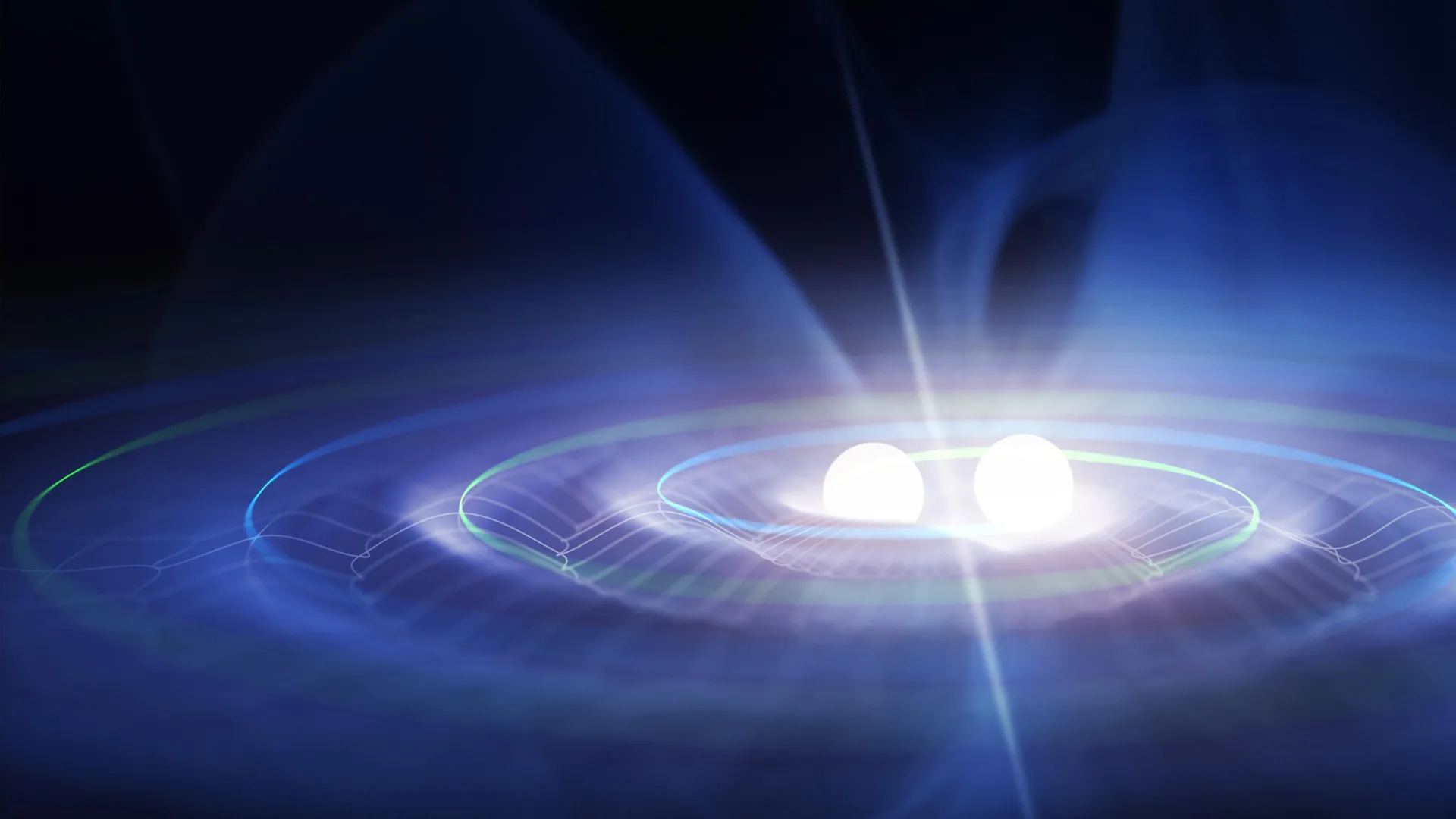
Unlocking the Universe’s Secrets: New Detector Bridges the Gravitational Wave Gap
For decades,scientists have listened for the whispers of the cosmos – gravitational waves,ripples in spacetime predicted by Albert Einstein over a century ago. While detections at high adn ultra-low frequencies have confirmed their existence, a crucial mid-range has remained stubbornly silent.Now, a groundbreaking new detector concept promises to fill this gap, opening a new era in gravitational wave astronomy. But what dose this mean for our understanding of the universe, and how does this technology work?
The Missing Piece of the Gravitational Wave Puzzle
gravitational waves aren’t just a theoretical curiosity; they’re a powerful new way to observe the universe. Ground-based detectors like LIGO and Virgo have successfully captured waves from cataclysmic events like black hole mergers.Pulsar timing arrays are probing the ultra-low frequency range, revealing the subtle effects of supermassive black hole binaries. however, the milli-Hertz frequency band (10⁻³ – 1 Hz) - the ”mid-band” – has remained largely unexplored.
This isn’t a minor oversight.The mid-band is predicted to be teeming with signals from a diverse range of astrophysical phenomena, including:
* Compact Binary Systems: The merging of white dwarfs and stellar-mass black holes.
* Intermediate-Mass Black Hole Mergers: Filling a gap in our knowledge of black hole populations.
* Stochastic Backgrounds: Echoes from the very early universe, perhaps revealing clues about the Big Bang.
Currently, accessing this frequency range relies on ambitious space missions like LISA, slated for launch in the 2030s. But what if we could begin exploring this territory now?
A Revolutionary Approach: Optical Cavities and Atomic clocks
Researchers at the universities of Birmingham and Sussex have unveiled a novel detector concept that could make this a reality. Published in Classical and Quantum Gravity, their proposal leverages cutting-edge advancements in optical resonator technology – initially developed for incredibly precise optical atomic clocks – to detect the minuscule phase shifts in laser light caused by passing gravitational waves.
Unlike the kilometer-scale interferometers like LIGO, these detectors are remarkably compact, potentially fitting on a laboratory table. This compact design offers several key advantages:
* Reduced Noise: Less susceptible to seismic and Newtonian noise that plague larger detectors.
* Cost-Effectiveness: Considerably lower construction and operational costs.
* Scalability: The potential to build a global network of detectors for enhanced sensitivity and source localization.
“By using technology matured in the context of optical atomic clocks,we can extend the reach of gravitational wave detection into a completely new frequency range with instruments that fit on a laboratory table,” explains Dr. Vera Guarrera of the University of Birmingham. “This opens the exciting possibility of building a global network of such detectors and searching for signals that would otherwise remain hidden for at least another decade.”
how Does It Work? A Deep Dive into the Technology
The core of this new detector lies in its use of ultrastable optical cavities.These cavities trap laser light, allowing it to bounce back and forth many times, effectively amplifying the signal. When a gravitational wave passes through, it subtly alters the length of the cavity, causing a measurable shift in the phase of the laser light.
The detector employs two orthogonal cavities,combined with an atomic frequency reference,enabling multi-channel detection. This configuration isn’t just about sensitivity; it allows scientists to determine the polarization of the gravitational wave and pinpoint its source direction.
Professor Xavier Calmet, from the University of Sussex, highlights the broader implications: “This detector allows us to test astrophysical models of binary systems in our galaxy, explore the mergers of massive black holes, and even search for stochastic backgrounds from the early universe.With this method, we have the tools to start probing these signals from the ground, opening the path for future space missions.”
Beyond the Horizon: Synergies with Existing and future Observatories
This new detector isn’t intended to replace existing gravitational wave observatories, but rather to complement them. Integrating these detectors with existing clock networks could even extend gravitational wave detection to even lower frequencies,further expanding our cosmic listening range.
While space-based missions like LISA promise unparalleled sensitivity, they are still years away.The proposed optical cavity detectors offer an immediate and affordable pathway to explore the milli-Hertz band, paving the way for future discoveries and refining the targets for space-based observations.
Are you fascinated by the search for gravitational waves? What questions do you have about this new detector technology? Share your thoughts in the comments below!
Evergreen Insights: The Future of Gravitational Wave Astronomy
the detection of gravitational waves has ushered in a new era of multi-messenger astronomy, where we can study the universe not just through light, but also through