Physicists Create Stunning Illusion of Near-Light Speed Travel
For decades, physicists have grappled with visualizing the effects of traveling at speeds approaching that of light. Now, a team led by Dr. Alexander Hornof has achieved a remarkable feat: creating a compelling visual illusion of an object moving at 99.9% the speed of light. This breakthrough, published recently, doesn’t involve actual near-light speed travel – a currently impossible endeavor – but a clever manipulation of light and timing.
The Challenge of Approaching Light Speed
Einstein’s theory of special relativity presents a basic barrier. As an object accelerates, its mass increases, requiring exponentially more energy to achieve further acceleration. “The faster something moves, the more its effective mass increases,” explains Hornof. Reaching even a fraction of light speed with a macroscopic object like a cube would demand an unimaginable amount of energy,far beyond our current capabilities.
So, how did the team overcome this hurdle? They didn’t try to move the object at near-light speed. Instead, they focused on mimicking the visual effects.
How the Illusion Works: A Slice-of-Time Approach
The team’s innovative approach centered around ultra-short laser pulses and a specialized camera. Here’s a breakdown of the process:
* Ultra-Short Pulses: They used laser pulses lasting just 300 picoseconds – a mere tenth of a billionth of a second.
* Gated Camera: A gated camera captured the light reflected from the object, opening onyl during the pulse’s brief duration, creating a “slice” of the object in time.
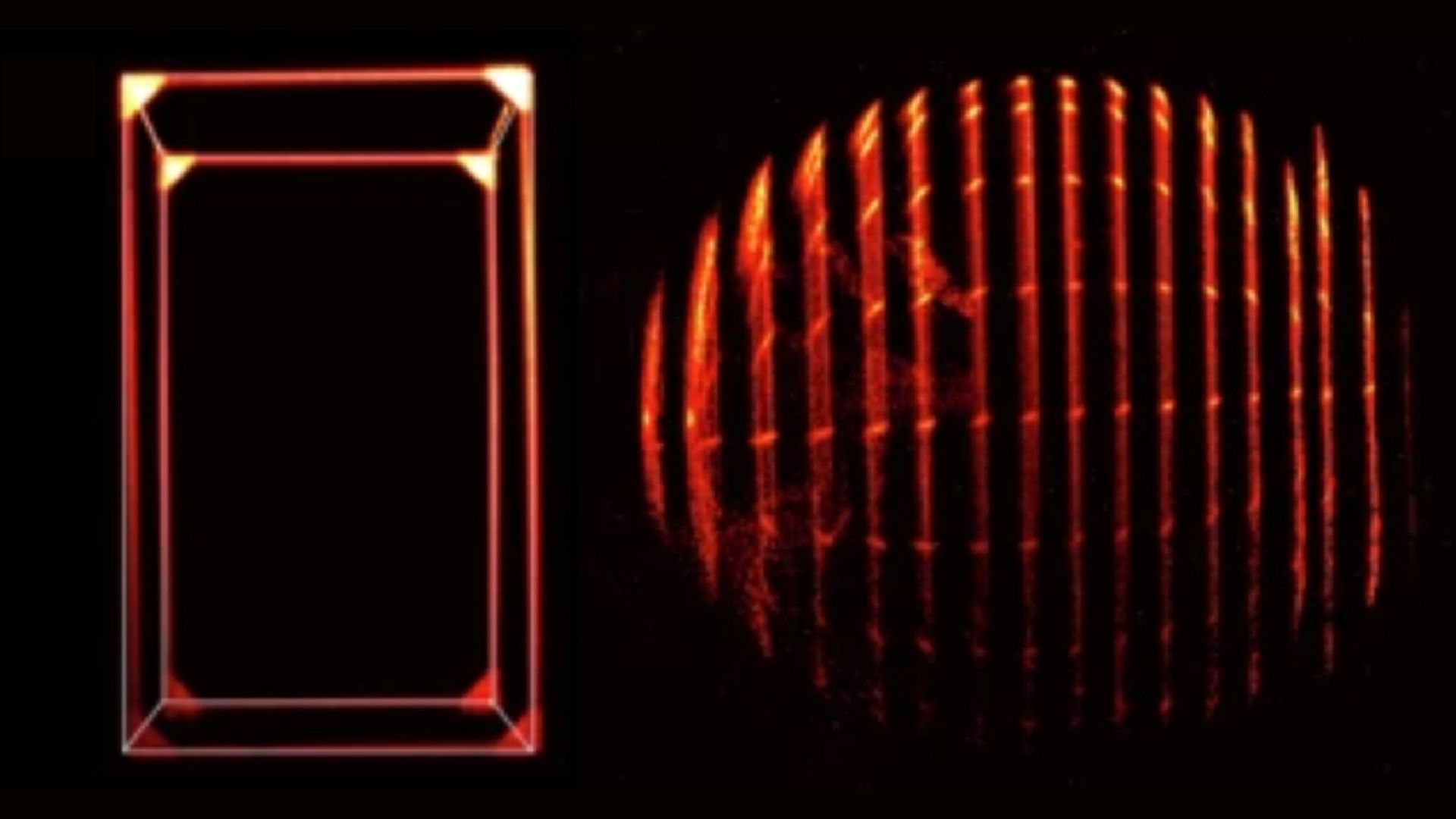
* Incremental Movement: After each slice, the object (a cube and a sphere) was moved forward a small distance – 1.9 inches (4.8 cm) for the cube and 2.4 inches (6 cm) for the sphere. This distance corresponds to the amount it would have traveled at 80% and 99.9% of the speed of light, respectively, during the time between pulses.
* Reconstruction: These individual slices were then combined to create a single image, simulating the object in incredibly rapid motion.
“When you combine all the slices, the object looks like it’s racing incredibly fast, even though it never moved at all,” Hornof states. ”At the end of the day, it’s just geometry.”
The Terrell-Penrose Effect and the Illusion of Rotation
The resulting images are striking. the cube appears rotated, and the sphere seems to allow you to see around its sides. This isn’t a physical distortion of the objects themselves, but a visual trick rooted in the Terrell-Penrose effect.
This effect explains how fast-moving objects appear to observers. According to special relativity, objects contract in the direction of travel. However, a standard camera doesn’t directly capture this length contraction. Instead, the difference in arrival times of light from different parts of the object creates the illusion of rotation.
“The rotation is not physical,” hornof clarifies. “It’s an optical illusion.The geometry of how light arrives simultaneously occurring tricks our eyes.”
Why This Matters: Validating Theory and Visualizing the extreme
This experiment doesn’t challenge Einstein’s theory; it beautifully demonstrates it. The team’s calculations confirmed that the observed distortions perfectly aligned with the predictions of special relativity.
“When we did the calculations, we were surprised how beautifully the geometry worked out,” Hornof recalls.”Seeing it appear in the images was really exciting.”
This work provides a powerful visual tool for understanding the counterintuitive effects of approaching the speed of light. it allows you,as a reader,to grasp concepts that are otherwise confined to mathematical equations and thought experiments. While true near-light speed travel remains firmly in the realm of science fiction, this illusion brings us a step closer to visualizing the universe as it appears to those traveling at extreme velocities.
Source: Hornof, A., et al. (2025). Physicists capture rare illusion of an object moving at 99.9 percent the speed of light. Nature.[https://wwwnaturecom/articles/s41586-02[https://wwwnaturecom/articles/s41586-02[https://wwwnaturecom/articles/s41586-02[https://wwwnaturecom/articles/s41586-02
Related reading