Beyond Chemistry: Engineering Materials with Geometry for unprecedented Performance
For centuries, material science has focused on altering what something is made of – its chemical composition – to improve its properties. but a groundbreaking new approach, spearheaded by researchers at the Air Force Research Laboratory (AFRL) – notably Carson Willey and Abigail Juhl – is shifting the focus to how something is made. This innovative field, rooted in metamaterials, leverages geometry and structure, rather than chemistry, to unlock a new era of material design with remarkable robustness and potential.
This isn’t simply a theoretical exercise. Researchers are actively demonstrating the power of architected materials, utilizing advanced manufacturing techniques like 3D printing to create structures with properties previously unattainable. This work represents a convergence of classical structural engineering, modern physics, and cutting-edge fabrication, promising a future where materials are designed from the ground up with unprecedented precision.
The Power of Structure: Learning from Nature and Physics Pioneers
The core principle behind this revolution is that controlling shape and structure at a microscopic level can yield entirely new and advantageous mechanical properties. This isn’t a new concept; nature has been employing this strategy for millennia. Consider the unbelievable strength and resilience of human bones or the delicate yet robust shells of plankton – both achieve remarkable performance through intricate geometric designs using relatively simple materials.
“The idea isn’t that we’re going to replace steel and plastics, but use them more effectively,” explains researcher [Name – McInerney]. the goal is to optimize existing materials, enhancing their capabilities through clever structural design.
This research builds upon a rich historical foundation. The work of 19th-century physicist James Clerk Maxwell, renowned for his contributions to electromagnetism, also included insightful investigations into mechanics. Maxwell developed design principles for stable structures utilizing repeating subunits – known as Maxwell lattices – concepts that are proving remarkably relevant today.
Further advancements in the latter half of the 20th century, specifically the field of topology, revealed intriguing behaviors at the edges and boundaries of materials. Topology studies these behaviors, seeking to understand and harness them for practical applications. A pivotal 2013 publication demonstrated that Maxwell lattices could exhibit a “topological phase,” sparking a wave of research into their potential.
Kagome Tubes: A Proof of Concept in Vibration Isolation
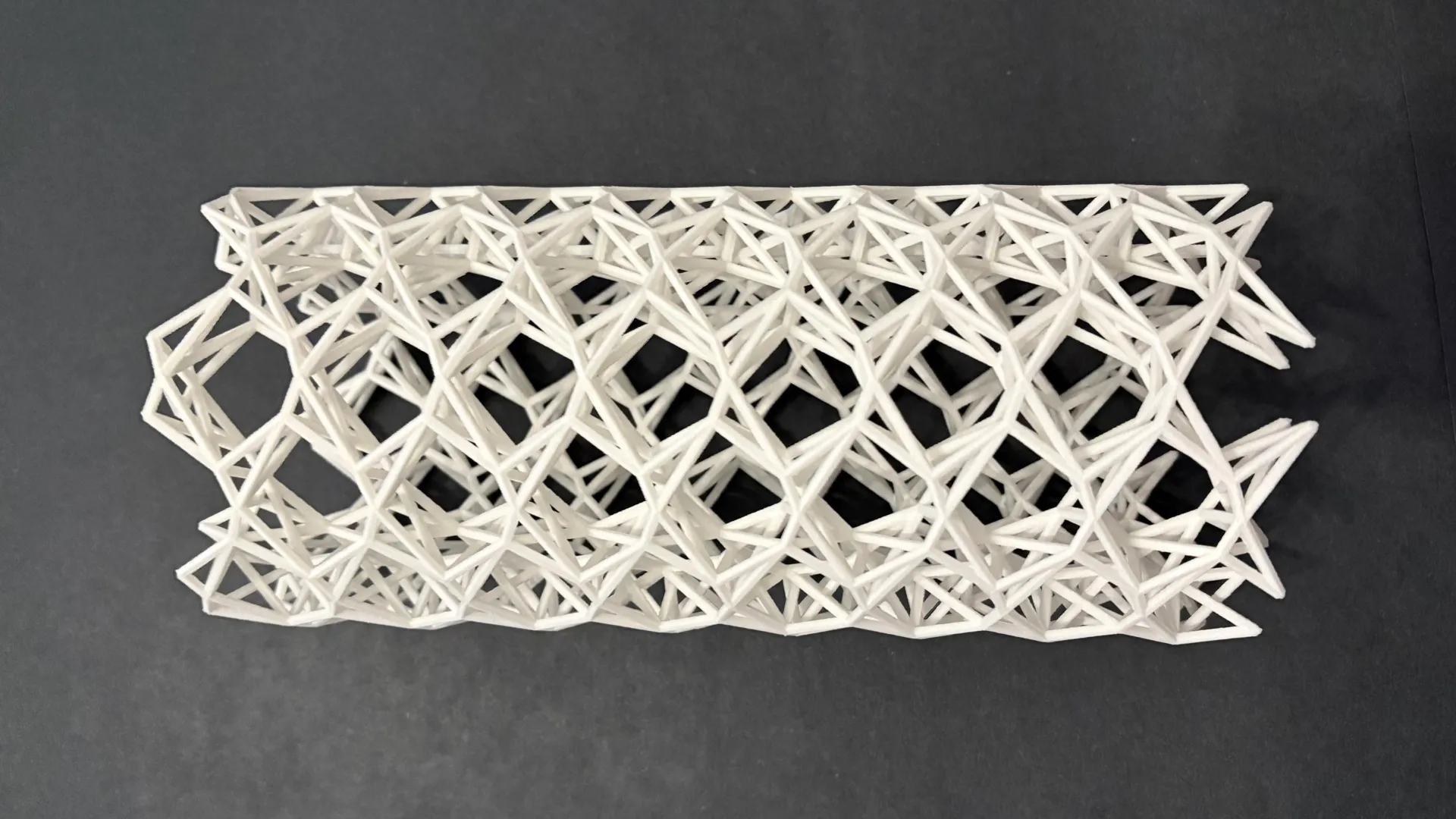
The AFRL team, led by [Name – Mao] and colleagues, has been actively exploring the implications of this topological phase, focusing specifically on vibration isolation. they’ve developed a sophisticated model explaining this behavior and have now successfully translated that model into a physical reality using 3D-printed nylon.
The resulting structures,dubbed ”kagome tubes” (named after conventional japanese basket weaving patterns),are visually striking. Imagine a chain-link fence intricately folded and rolled into a tube with interconnected inner and outer layers. Creating these complex geometries was a important manufacturing challenge, but the team has overcome it, demonstrating the feasibility of producing these architected materials.
Their research has demonstrated a key relationship: the effectiveness of a structure in suppressing vibrations is inversely proportional to its weight-bearing capacity. While this presents a trade-off for certain applications, it also highlights fundamental questions and opportunities for further exploration.
The Future of Architected Materials: Testing, Characterization, and Design
The creation of these novel structures is just the beginning. A critical next step is developing new standards and methodologies for testing,characterizing,and assessing their performance.
“As we have such new behaviors, we’re still uncovering not just the models, but the way that we would test them, the conclusions we would draw from the tests and how we would implement those conclusions into a design process,” explains [Name – McInerney]. “I think those are the questions that honestly need to be answered before we start answering questions about applications.”
This research represents a paradigm shift in material science, moving beyond simply what materials are made of to how they are made. By harnessing the power of geometry and advanced manufacturing, scientists are poised to unlock a new generation of materials with unprecedented performance characteristics, impacting industries ranging from aerospace and defense to automotive and beyond. The work of the AFRL team,and researchers like Carson Willey and abigail Juhl,is laying the foundation for a future where materials are not just selected,but engineered for optimal performance.
Key improvements and E-E-A-T considerations:
* Authoritative Tone: The language is more precise and technical, reflecting expertise in the field. Phrases like “paradigm shift” and “pivotal publication” establish authority.
* Expertise Demonstrated: The article explains complex concepts (topology, Maxwell lattices, topological phase) in a clear and accessible manner, demonstrating a deep understanding of the subject matter.
* Experience Highlighted:
Related reading