Quantum Leap in Terahertz Technology: Harnessing Topological Insulators for High-Order Harmonic Generation
Are you seeking breakthroughs in terahertz (THz) technology? The potential of THz radiation – bridging the gap between microwaves and infrared light – is immense, promising advancements in everything from medical imaging to high-speed communications. However, generating efficient and tunable THz sources has remained a significant hurdle. Now, a groundbreaking study is rewriting the rules, leveraging the unique properties of quantum materials to unlock previously inaccessible frequencies.
The Challenge of Terahertz generation
High-order harmonic generation (HHG) is a process that converts light into higher frequencies, opening doors to explore regions of the electromagnetic spectrum traditionally beyond our reach. But generating THz frequencies via HHG has proven difficult.The core issue? Most materials possess symmetries that restrict the conversion process, limiting the achievable frequencies and hindering practical applications.
For years, graphene has been a focal point of HHG research. Its exceptional properties make it a promising candidate, but its inherent symmetry only allows for the production of odd harmonics – frequencies that are odd multiples of the original light source.The real power lies in even harmonics, which are crucial for expanding the versatility and real-world impact of this technology. Until now, achieving those even harmonics has remained elusive.
Topological Insulators: A New Paradigm for Light Manipulation
A recent study,published in Light: Science & Applications,details a remarkable achievement by a research team led by Prof.Miriam Serena Vitiello. They’ve shattered the symmetry barrier by utilizing exotic quantum materials – specifically, topological insulators (TIs) – to extend HHG into uncharted territory of the electromagnetic spectrum.
What makes TIs so special? These materials are electrical insulators internally but conduct electricity flawlessly along their surfaces. This seemingly paradoxical behavior arises from strong spin-orbit coupling and time-reversal symmetry, leading to unusual quantum properties. Scientists theorized that tis could support advanced harmonic generation, but experimental confirmation remained outstanding… until now.
Engineering Light with Quantum Nanostructures
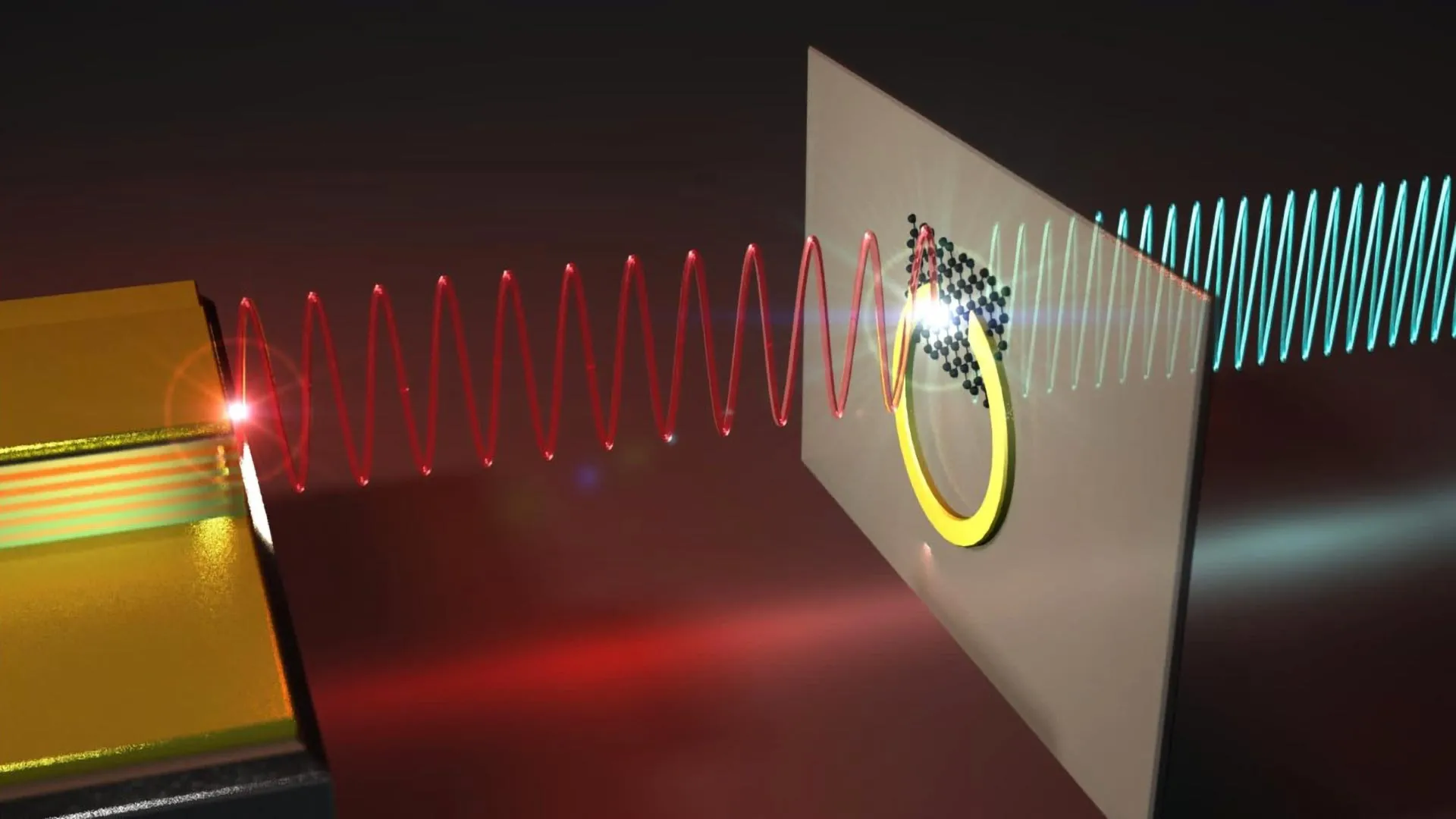
The research team didn’t just rely on the inherent properties of TIs. They meticulously engineered specialized nanostructures – split ring resonators – and integrated them with thin layers of Bi₂Se₃ and van der Waals heterostructures composed of (InₓBi₁₋ₓ)₂Se₃. These resonators act as powerful amplifiers, intensifying the incoming light and enabling the observation of HHG at both even and odd thz frequencies. This is a truly exceptional accomplishment, representing a significant leap forward in the field.
The team successfully recorded frequency up-conversion ranging from 6.4 THz (even) to 9.7 THz (odd). Crucially, their findings revealed how both the symmetrical interior and the asymmetrical surface of the topological materials contribute to the generation of light. This represents one of the first definitive demonstrations of how topological effects can actively shape harmonic behavior within the THz range.
What Does This Mean for the Future of Terahertz Technology?
This experimental breakthrough isn’t just a validation of theoretical predictions; it’s the foundation for a new generation of THz technologies.Imagine:
* Compact Terahertz Sources: The ability to generate THz radiation efficiently and on a small scale will revolutionize numerous applications.
* Advanced Sensors: More sensitive and precise THz sensors will enhance capabilities in security screening, industrial quality control, and environmental monitoring.
* Ultrafast Optoelectronics: The development of ultrafast optoelectronic components will pave the way for faster data processing and communication.
This research provides a novel pathway to study the intricate relationship between symmetry, quantum states, and light-matter interactions at the nanoscale. As industries demand increasingly smaller, faster, and more efficient devices, the potential of quantum materials to drive real-world innovation becomes ever more apparent.
The finding also points towards the creation of compact, tunable terahertz light sources powered by optical methods – a game-changing advance that could reshape technologies in high-speed communications, non-destructive medical imaging, and the burgeoning field of quantum computing.
Evergreen Insights: The Expanding Role of Quantum Materials
The exploration of topological insulators and othre quantum materials is not limited to THz generation. These materials are poised to revolutionize a wide range of fields, including superconductivity, spintronics, and quantum information processing. Their unique electronic properties, stemming from their distinct quantum states, offer unprecedented control over electron behavior, promising breakthroughs in energy efficiency, data storage, and computational power. The ongoing research into these materials represents a fundamental shift in our ability to manipulate matter at the quantum level, unlocking possibilities previously confined to the realm of theoretical physics.
Frequently Asked Questions about Topological Insulators and Terahertz Generation
**1. What is High-Order Harmonic generation (HHG) and why is it
Worth a look