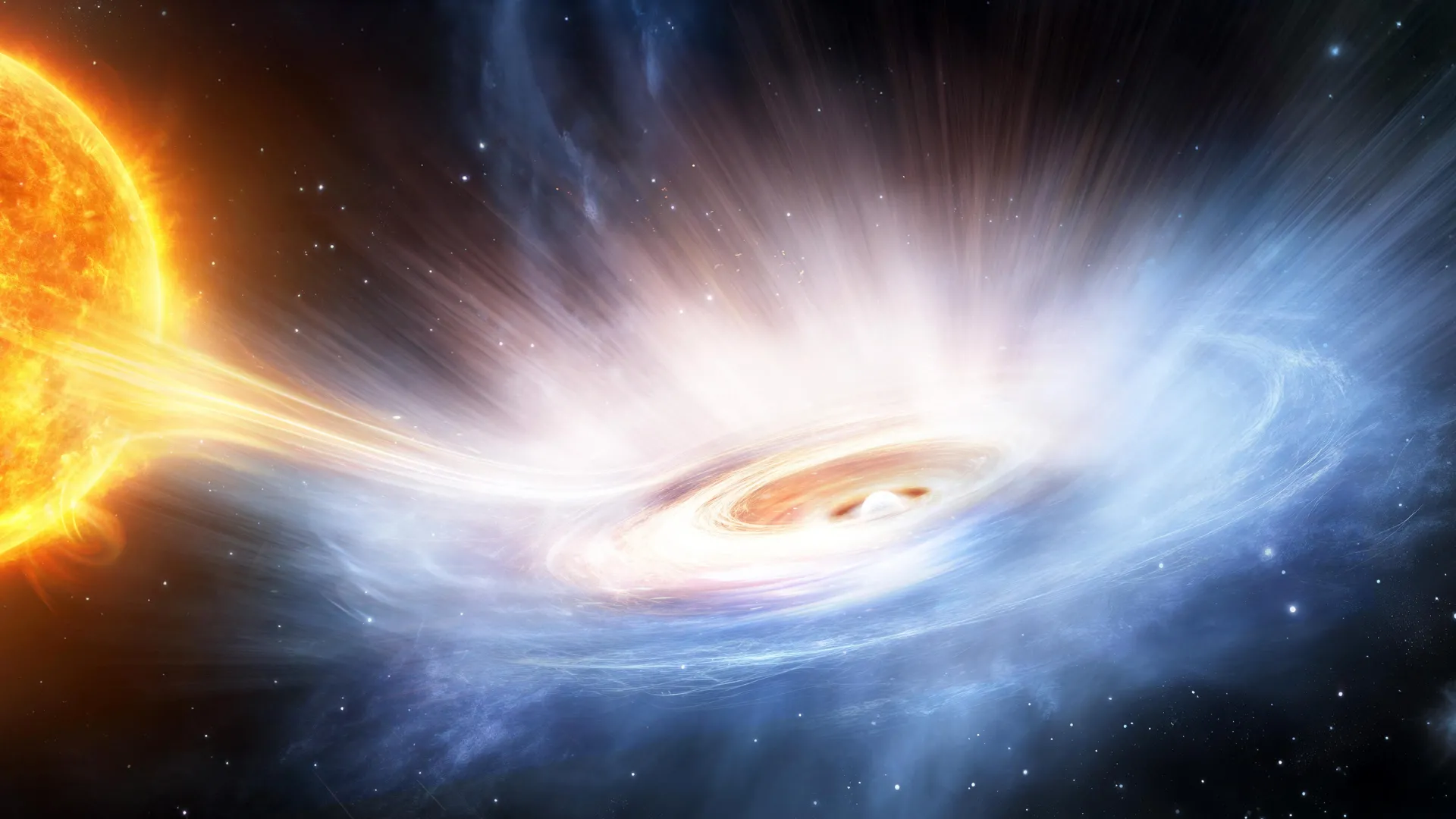
unveiling the Secrets of Neutron Star Winds: XRISM Observations Challenge Black Hole models and Illuminate Galaxy Evolution
For decades, astronomers have sought to understand the powerful outflows – or winds – generated around some of the universe’s most extreme objects: black holes and neutron stars.These winds play a crucial role in regulating the growth of these objects and influencing the evolution of their host galaxies. Now, groundbreaking observations from the X-Ray Imaging and Spectroscopy mission (XRISM) are challenging existing models and offering a new perspective on the physics governing these energetic phenomena. A recent study, focusing on the neutron star system GX13+1, has revealed a surprisingly slow and dense wind, prompting a re-evaluation of the essential processes at play.
A Fortuitous Observation: Catching a Neutron Star at its Peak
The team, led by Dr.Chris Done of Durham University, strategically selected GX13+1 as a prime target due to its relative proximity and brightness, promising a detailed view of the physics involved. However, the universe had a surprise in store. Just prior to the planned observations, GX13+1 unexpectedly surged in brightness, reaching - and perhaps exceeding – the Eddington limit.
The Eddington limit is a critical threshold in astrophysics.It represents the point where the outward radiation pressure from an accreting object balances the inward pull of gravity. As matter spirals towards a black hole or neutron star, it heats up and emits intense radiation. Beyond the Eddington limit, this radiation becomes so powerful that it effectively halts further accretion, driving material away in a powerful outflow.
“we could not have scheduled this if we had tried,” explains Dr. Done. “The system went from about half its maximum radiation output to something much more intense, creating a wind that was thicker than we’d ever seen before.” XRISM’s Resolve instrument was perfectly positioned to capture this dramatic event.
A Paradoxical Wind: Slow Speed, High Density
What XRISM observed defied expectations. While the system was operating at or near the Eddington limit - a condition typically associated with incredibly fast outflows – the wind emanating from GX13+1 was remarkably slow, clocking in at approximately 1 million km/h. This is a meaningful contrast to the ultrafast winds observed around supermassive black holes,which can reach speeds exceeding 200 million km/h – a ample fraction of the speed of light.
“It is still a surprise to me how ‘slow’ this wind is,” Dr. Done notes, “as well as how thick it is. It’s like looking at the Sun through a bank of fog rolling towards us. Everything goes dimmer when the fog is thick.” This combination of slow speed and high density presented a puzzle: if radiation pressure is the primary driver of these winds, why the discrepancy?
Neutron Star vs. Black Hole: A Tale of Two Winds
The contrast with previous XRISM observations of a supermassive black hole further deepened the mystery. That earlier study revealed an ultrafast, clumpy wind, a stark difference from the smooth, slow outflow observed from GX13+1.
“The winds were utterly different but they’re from systems which are about the same in terms of the Eddington limit,” Dr. Done points out. “So if these winds realy are just powered by radiation pressure, why are they different?” This question spurred the team to investigate the underlying physical properties of the systems themselves.
The Accretion Disk Temperature: A Key to Understanding
The team’s analysis suggests that the temperature of the accretion disk - the swirling disk of gas and dust surrounding the central object – holds the key. Surprisingly, accretion disks around supermassive black holes tend to be cooler than those around stellar-mass systems like GX13+1.
This counterintuitive finding stems from the size of the disks. Supermassive black holes have vastly larger accretion disks. While these disks can be incredibly luminous,that energy is spread over a much larger area,resulting in peak emission in the ultraviolet (UV) spectrum. Stellar-mass systems, on the other hand, radiate more intensely in X-rays.
The crucial difference lies in how these different wavelengths of light interact with matter. UV radiation interacts more readily with material than X-rays, allowing it to more efficiently push matter outwards, generating the faster winds observed around supermassive black holes. The team proposes that the hotter, X-ray dominated environment around the neutron star in GX13+1 results in a less efficient transfer of momentum, leading to the slower, denser wind.
Implications for Galaxy Evolution and Future Research
This finding has
Related reading