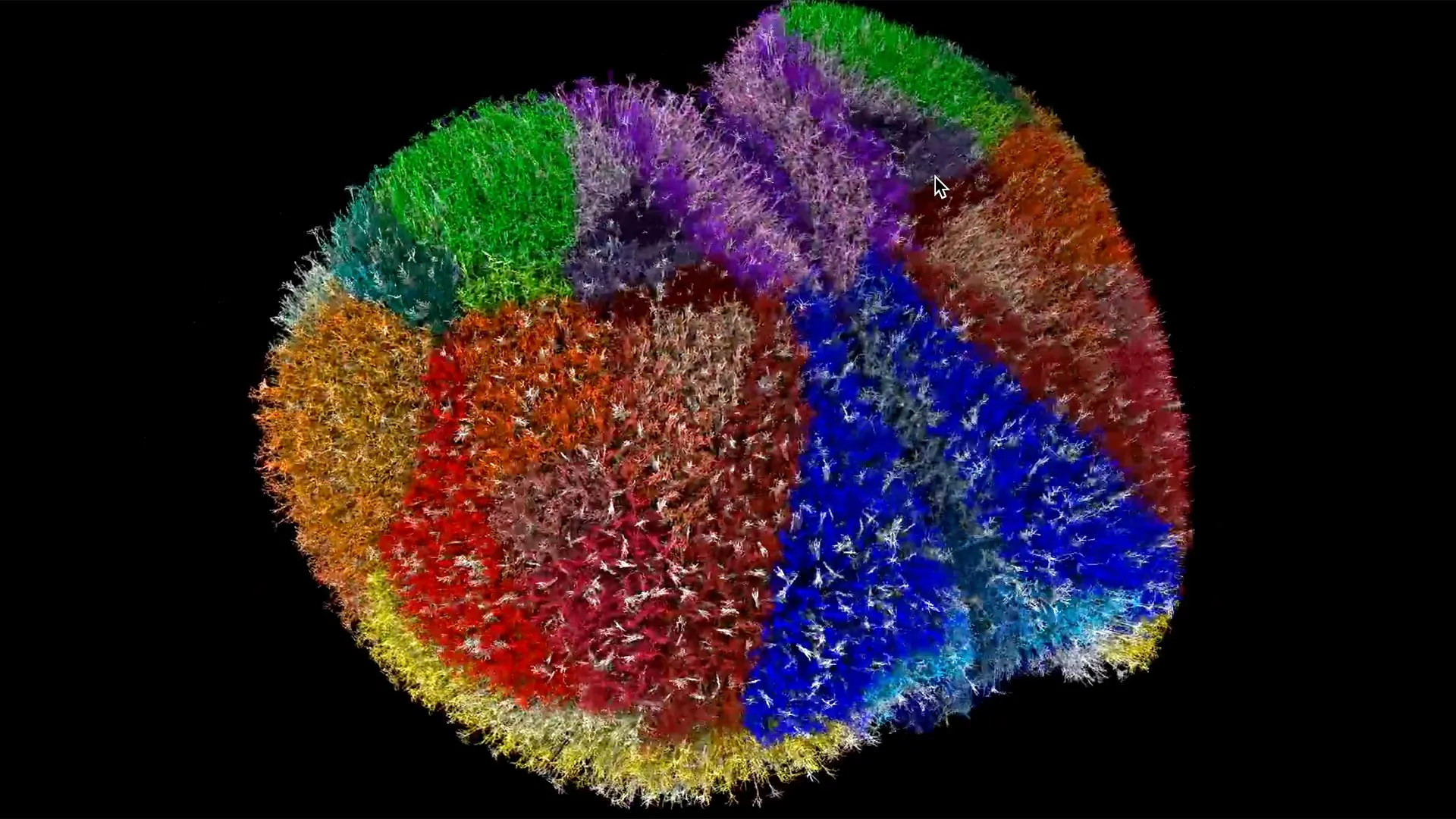
Scientists Create the Most Detailed Virtual Cortex to Date, Ushering in a New Era of Brain Research
for decades, unlocking the mysteries of the brain has been hampered by the limitations of studying living tissue. Now, a groundbreaking international collaboration has shattered those barriers, creating the most detailed and thorough virtual model of a mammalian cortex ever achieved.This digital brain, boasting nearly ten million neurons, 26 billion synapses, and 86 interconnected brain regions, promises to revolutionize our understanding of neurological disorders, cognitive processes, and even the very nature of consciousness.
A Quantum Leap in Neuroscience – Powered by Supercomputing
This monumental achievement, spearheaded by scientists at the Allen Institute and Japan’s University of Electro-Communications (led by Dr. Tadashi Yamazaki), alongside contributions from three other Japanese organizations, was made possible by Japan’s Supercomputer Fugaku. Fugaku,a world-leading high-performance computing system capable of 400 quadrillion operations per second,provided the unprecedented processing power required to simulate the intricate complexity of the brain. (To put that into perspective, counting to 400 quadrillion at a rate of one per second would take over 12.7 billion years – longer than the age of the universe!). The full details of this research will be presented at SC25,the premier global supercomputing conference,in mid-november.
Why This Matters: A New Frontier for Disease Modeling and Therapeutic advancement
Traditionally, investigating brain function and disease relied on invasive studies of brain tissue, limiting the scope and scale of research. This new virtual cortex offers a paradigm shift.Researchers can now:
* Model Neurological Disorders: Simulate the formation and progression of diseases like Alzheimer’s, Parkinson’s, and epilepsy in a controlled digital environment.
* Investigate Cognitive processes: Explore the neural basis of attention, learning, memory, and other complex cognitive functions.
* Track Damage Pathways: Observe how damage propagates through neural circuits, offering insights into the effects of stroke, traumatic brain injury, and neurodegenerative diseases.
* Accelerate drug Discovery: Safely and efficiently evaluate the potential efficacy of new therapies before clinical trials, significantly reducing development time and costs.
* Understand Brain Waves: Decipher the role of brain waves in cognitive functions like attention and consciousness.
“This shows the door is open. We can run these kinds of brain simulations effectively with enough computing power,” explains Dr. Anton Arkhipov, an investigator at the Allen Institute. “It’s a technical milestone giving us confidence that much larger models are not only possible, but achievable with precision and scale.”
The Building Blocks of a Digital Brain: Data, Algorithms, and Computational Power
The creation of this virtual cortex was a masterful integration of biological data and cutting-edge computational techniques. The Allen Institute provided the foundational biological data, leveraging its extensive Allen Cell Types Database and Allen Connectivity Atlas – comprehensive resources detailing the characteristics and connections of brain cells.
Fugaku, developed by RIKEN and Fujitsu, then took center stage. Its architecture, comprised of 158,976 interconnected processing nodes, enabled the team to translate this biological data into a functioning digital reconstruction. The Allen Institute’s Brain Modeling ToolKit and a specialized tool called Neulite were instrumental in this process, converting mathematical equations into virtual neurons capable of realistically spiking, signaling, and communicating. The resulting simulation faithfully reproduces the intricate details of neuron structure, synapse activity, and electrical signaling.
Looking ahead: Towards Whole-Brain Modeling and Beyond
This achievement isn’t an endpoint, but a crucial stepping stone. Researchers are already setting their sights on even more ambitious goals.
“Our long-term goal is to build whole-brain models, eventually even human models, using all the biological details our institute is uncovering,” states Dr.Arkhipov. “We’re now moving from modeling single brain areas to simulating the entire brain of the mouse.”
Dr.Yamazaki echoes this sentiment, emphasizing the importance of biophysical detail: “God is in the details, so in the biophysically detailed models, I believe.”
this collaborative effort, involving experts like Dr. Laura Green, Dr. Beatriz herrera, Mr. kael dai, Ms. Rin Kuriyama,and dr.kaaya Akira, represents a pivotal moment in neuroscience. With the continued advancement of computational power and the growing wealth of biological data,the possibility of a complete,biologically accurate brain model – and a deeper understanding of the most complex organ in the universe - is rapidly becoming a reality.
Resources:
* Allen institute: https://alleninstitute.org/
* RIKEN: https://www.riken.jp/en/
* Fujitsu: [https://wwwfujitsu[https://wwwfujitsu[https://wwwfujitsu[https://wwwfujitsu
Related reading