Beyond Survival: How Inclusive Camp Redesign is Restoring Dignity for Displaced People with Disabilities in Nigeria
the rain in Gbajimba camp isn’t just water falling from the sky; it’s another obstacle in a life already defined by them. for Shiminenge, a resilient woman living with a mobility impairment, each downpour transforms the already challenging landscape into a near-impassable barrier. Toilets and water points, essential for survival, become distant goals, requiring assistance she doesn’t always have. Yet, every morning, she perseveres, driven by a fierce determination not too be erased in a place that wasn’t built for her.
Shiminenge’s story is not unique. She is one of over 480,000 Nigerians displaced by escalating intercommunal conflict in Benue State,as reported by the Displacement Tracking Matrix (DTM) of the International Institution for Migration (IOM). Fleeing her village in Guma in 2018, she sought refuge in Gbajimba camp, carrying with her only the hope of safety. But her struggle for inclusion began long before displacement – a struggle deeply rooted in systemic inaccessibility.
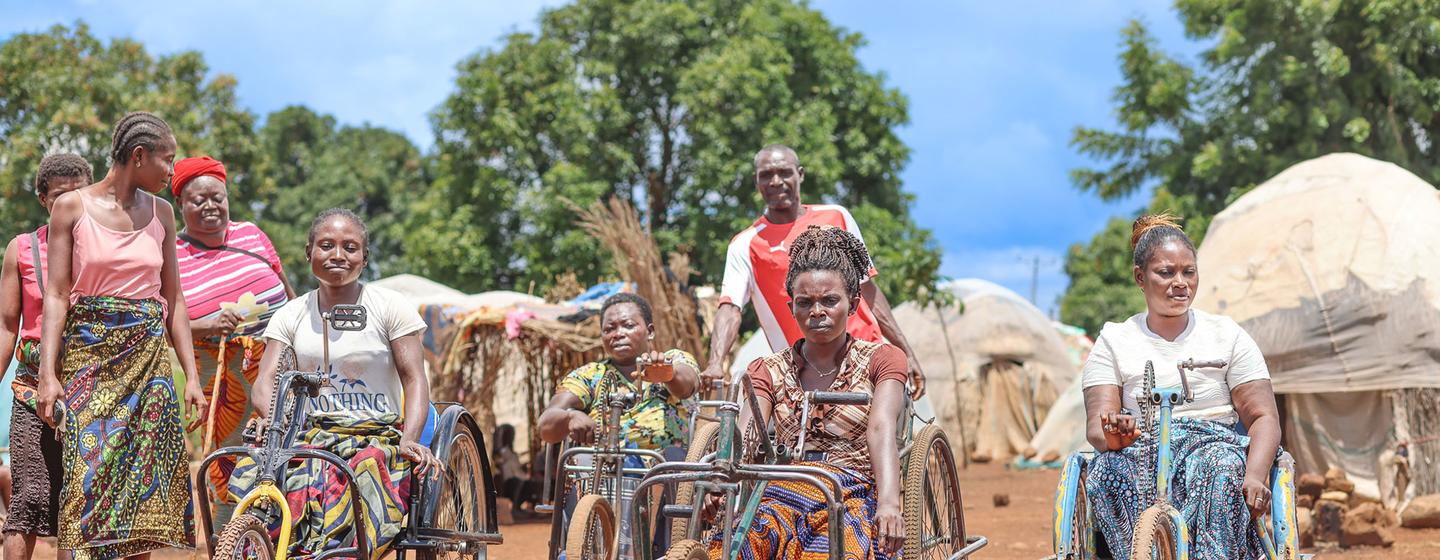
(Image: © IOM/Elijah Elaigwu – Shiminenge (right) has received support from the IOM and other humanitarian agencies.)
Diagnosed with a mobility impairment at just nine months old, Shiminenge learned early on to navigate a world that wasn’t designed with her in mind. Growing up required constant adaptation and a profound understanding of the challenges faced by those with disabilities. Displacement, however, amplified these challenges exponentially. The camp environment presented a new layer of hardship: inadequate shelter, inaccessible sanitation, and a terrain that actively hindered independence.
“In the camp, every step outside my tent was a struggle,” Shiminenge shared, speaking ahead of the International Day of Persons with disabilities (December 3rd). “It’s not just the physical obstacles; it’s the feeling of being invisible, of being forgotten in a place where survival is already so hard.”
The invisible crisis Within a Crisis: Why Disability Inclusion is Critical in Displacement Settings
shiminenge’s experience highlights a critical, often overlooked reality: people with disabilities are disproportionately vulnerable within internally displaced populations. They face unique and compounding barriers to accessing essential rights – shelter, healthcare, sanitation, and essential services. This isn’t simply a matter of convenience; it’s a matter of dignity, safety, and survival.
As humanitarian experts with decades of experience working in displacement settings,we at[YourOrganization/Expertise-[YourOrganization/Expertise-[YourOrganization/Expertise-[YourOrganization/Expertise-Critically important to insert your authority here]have consistently observed that inaccessible infrastructure and a lack of targeted support significantly increase the risk of neglect,exclusion,and even abuse for people with disabilities. These barriers exacerbate the trauma of displacement and undermine their ability to rebuild their lives. Ignoring their needs isn’t just unethical; it’s a failure of humanitarian principles.
From Resilience to Advocacy: A Community Finds its Voice
Despite the overwhelming challenges, Shiminenge refused to succumb to despair. Demonstrating remarkable resourcefulness, she began selling mosquito repellent within the camp, generating a small income while concurrently contributing to the health of her community. This initiative blossomed into something far greater: advocacy.
Recognizing the collective power of shared experience, shiminenge spearheaded the formation of a disability association in Gbajimba. This group, comprised of 18 individuals living with various disabilities, united to demand mobility aids, equitable access to resources, and the creation of truly inclusive facilities. Their persistent voice, however, initially went unheard.
A Turning Point: IOM-Led Camp Redesign Prioritizes Accessibility and Dignity
In August 2024, a team from the International Organization for Migration (IOM), in collaboration with the Benue State Emergency Management Agency, conducted a comprehensive assessment of living conditions in gbajimba camp. This visit, however, felt different. “For the first time here, I felt someone was listening,” Shiminenge recalls.
Responding directly to the association’s articulated needs, IOM initiated a complete camp redesign, prioritizing accessibility and dignity for people with disabilities. This wasn’t a superficial fix; it was a fundamental shift in approach, recognizing that inclusive design is not an afterthought, but a core component of effective humanitarian response.
The redesign resulted in the construction of nearly 4,000 upgraded emergency shelters, built to withstand the region’s harsh seasonal rains and provide safer living conditions for all displaced families. crucially, a dedicated section of the camp was specifically designed for people living with disabilities, featuring:
* Disability-kind toilets:
Worth a look