the Mystery of Fomalhaut b: A Planet Lost to Collision, But Perhaps Not Entirely Gone
The star Fomalhaut, located 25 light-years away, has captivated astronomers for decades. It’s a relatively young star surrounded by a debris disk – remnants of planetary formation. Recent research suggests a dramatic event unfolded within this system: the collision of two planetesimals, rocky bodies smaller than planets. But the story doesn’t end there; the ghost of a planet once thought to exist may still be influencing the system.
A Impressive Collision Captured
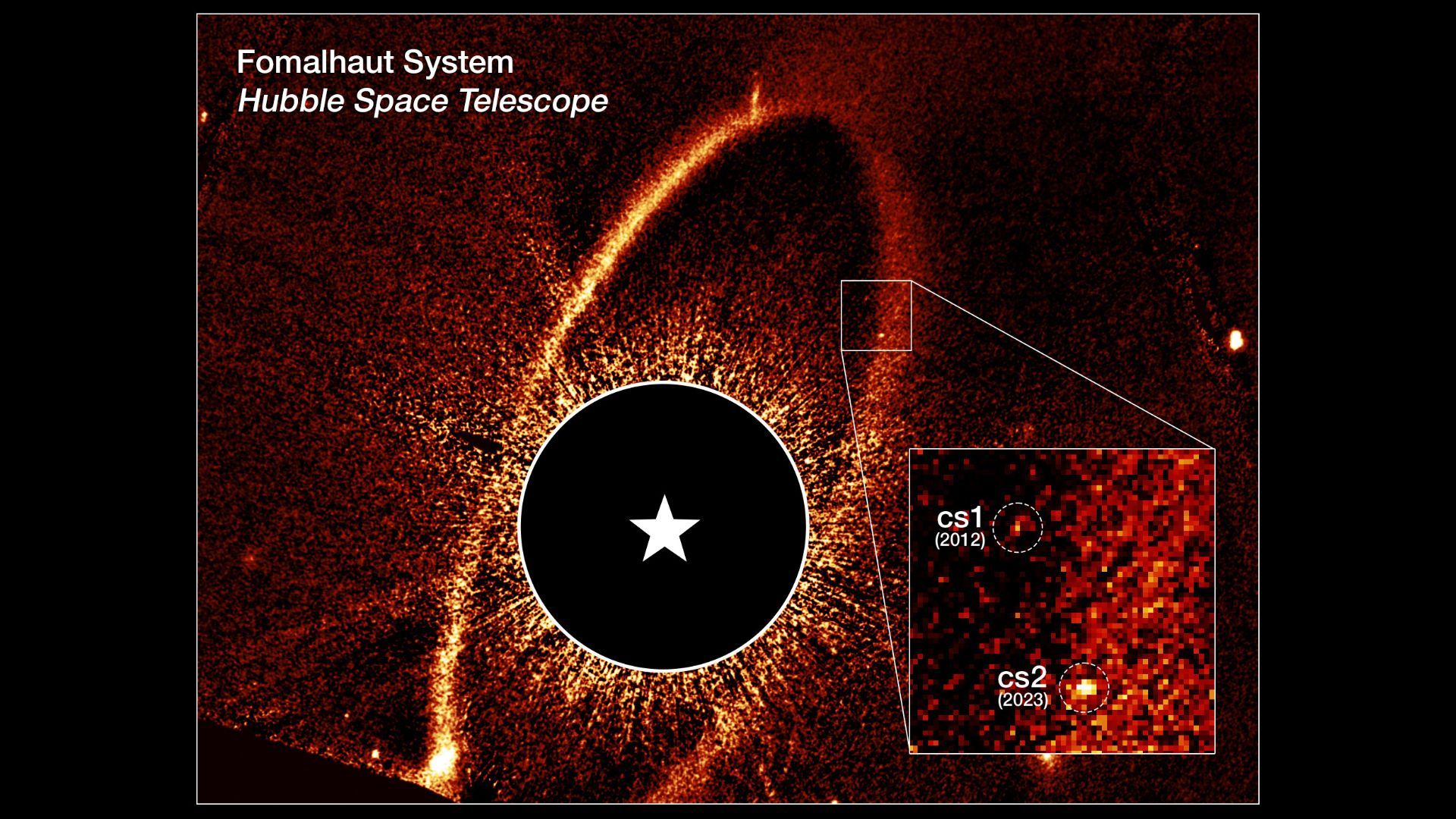
Initially, astronomers believed Fomalhaut hosted a planet named Fomalhaut b. Though,observations revealed this “planet” was actually a massive dust cloud created by a colossal impact. Detailed analysis, utilizing data from the James Webb Space Telescope adn other observatories, confirmed this collision.
* Two distinct impact sites, dubbed cs1 and cs2, were identified within the debris disk.
* These impacts occurred relatively recently, astronomically speaking, within the last few centuries.
* The resulting dust cloud is still expanding, offering a unique window into the aftermath of a planetary-scale collision.
[Image of collision between two planetesimals orbiting Fomalhaut]
The Planet That Never Was – Or Did It?
even though Fomalhaut b, as a fully formed planet, no longer exists, the possibility remains that a hidden planet is still present.Researchers calculated a roughly 10% chance that the timing and location of the cs1 and cs2 impacts aren’t random. This suggests an unseen gravitational force at play.
Consider this: something must be shaping the debris disk into the structure we observe. Furthermore, the proximity of the impact sites could be driven by a planet subtly directing planetesimals into collision courses.
Planetary Peek-a-Boo: the Challenge of Exoplanet Detection
This situation highlights a critical challenge for planet hunters. Distinguishing between a planet and the debris from a collision can be incredibly challenging. Fomalhaut cs2, for exmaple, closely resembles an exoplanet reflecting starlight.
This is notably relevant as we prepare for next-generation telescopes like NASA’s Habitable Worlds Observatory. These facilities are designed to directly image exoplanets in habitable zones. Understanding the potential for “false positives” – like dust clouds mimicking planets – is crucial for accurate detection.
Implications for Planetary Formation and Future Discoveries
This unique study offers valuable insights into planetary formation. It helps refine our understanding of collision rates within young planetary systems and the dynamics of debris disks. More importantly, it provides a crucial lesson for astronomers.
By learning to differentiate between true planets and the aftermath of collisions, we can more accurately identify planetary bodies amidst the dazzling array of celestial objects in the universe. this will ultimately bring us closer to answering the essential question: are we alone?
Keep reading