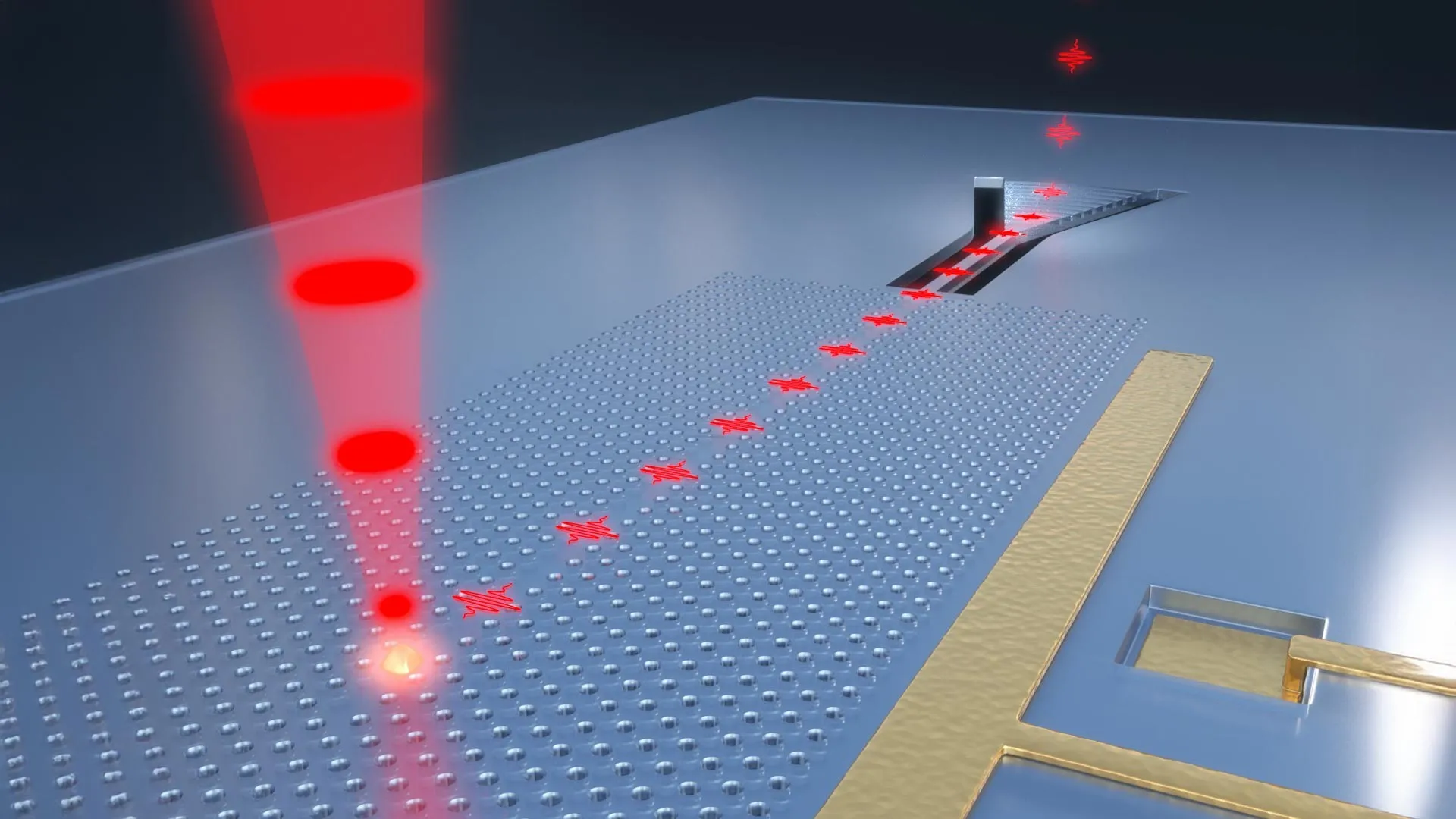
Breakthrough in Quantum Photonics: University of Iowa Researchers Achieve Photon Purification for enhanced Quantum Technologies
Iowa City, IA - December 23, 2025 – A team of researchers at the University of Iowa has announced a meaningful advancement in the field of quantum photonics, demonstrating a novel method for “purifying” single photons. This breakthrough addresses critical limitations in current optical quantum systems, paving the way for more powerful and secure quantum computers and communication networks. the findings, published in the peer-reviewed journal Optica Quantum, represent a potential paradigm shift in how single-photon sources are engineered and utilized.
For years,the development of practical photonic quantum technologies has been hampered by inherent challenges in generating consistently reliable streams of single photons - the essential building blocks of these systems. Unlike classical bits representing 0 or 1, quantum computers leverage qubits, often embodied by single photons, to perform calculations with exponentially greater complexity. Maintaining the integrity of these qubits is paramount, and imperfections in photon generation can severely degrade performance and compromise security.
Addressing the Core Challenges of Single Photon Generation
The University of Iowa team, led by Assistant Professor Ravitej Uppu of the Department of Physics and Astronomy, focused on two primary obstacles: laser scatter and multi-photon emission.
“Generating truly single photons is surprisingly difficult,” explains Uppu. “When a laser is used to stimulate an atom to release a photon, it doesn’t always work perfectly. You often get unwanted ‘noise’ in the form of additional photons, a phenomenon we call laser scatter. Furthermore, atoms can occasionally emit multiple photons simultaneously. Both of these issues disrupt the precise, one-by-one flow of photons essential for quantum operations.”
Laser scatter acts as interference, analogous to stray electrical current in a conventional circuit, reducing efficiency. Multi-photon emission, conversely, breaks the delicate quantum order required for complex calculations. The challenge has been finding a way to mitigate both simultaneously.
Harnessing Laser Noise for Photon Purification: A Counterintuitive Solution
The team’s innovative approach, spearheaded by graduate student Matthew Nelson, lies in a surprising finding: the unwanted signals generated by laser scatter and multi-photon emission share remarkably similar characteristics to the laser light itself. This realization opened the door to a counterintuitive solution – using the “noise” to cancel itself out.
“We found that the wavelength spectrum and waveform of the unwanted photons closely mirror those of the laser,” says Uppu. ”By carefully adjusting the laser parameters, we can effectively create destructive interference, suppressing the multi-photon emissions and purifying the stream of single photons.”
This technique essentially transforms a long-standing problem into a powerful tool. Instead of fighting the inherent imperfections of the process, the researchers have learned to harness them for a positive outcome.
Implications for quantum Computing and Secure Communication
The implications of this breakthrough are far-reaching. A stable, highly controlled stream of single photons is crucial for realizing the full potential of photonic quantum computing. Photonic platforms are increasingly viewed as a leading contender in the race to build practical quantum computers, offering advantages in speed, efficiency, and scalability.
Beyond computing, purified photon streams are vital for secure quantum communication networks. The ability to transmit information encoded in single photons with minimal interference dramatically reduces the risk of eavesdropping and data interception. Uppu draws an analogy: “It’s like guiding students through a cafeteria line one at a time, rather than letting them move as a chaotic crowd. A neat, orderly stream of photons is far more secure and manageable.”
Precision Control: The Key to Implementation
The success of this method hinges on precise control of the laser beam.”By meticulously controlling the angle, shape, and other characteristics of the laser beam, we can engineer the interference necessary to cancel out the unwanted photons,” explains Uppu. “The result is a stream of photons that is considerably purer than anything achievable with current methods.”
the research team is now focused on experimentally validating their theoretical findings. If accomplished, this technique could accelerate the development of advanced quantum computers, ultra-secure communication systems, and a new generation of quantum sensors.
Study Details & Funding
The research, titled “Noise-assisted purification of a single-photon source,” was published in Optica Quantum. Funding for the project was provided by the Office of the Under Secretary of Defense for Research and Engineering within the U.S. Department of Defense, and a seed grant from the university of Iowa Office of the Vice President for Research via the P3 program.
About the University of Iowa department of Physics and Astronomy:
The Department of Physics and Astronomy at the University of Iowa is a leading centre for research in quantum science and technology. Dedicated to pushing the boundaries of knowledge, the department fosters a collaborative habitat for groundbreaking discoveries and the training of the next generation of scientists.
Related reading