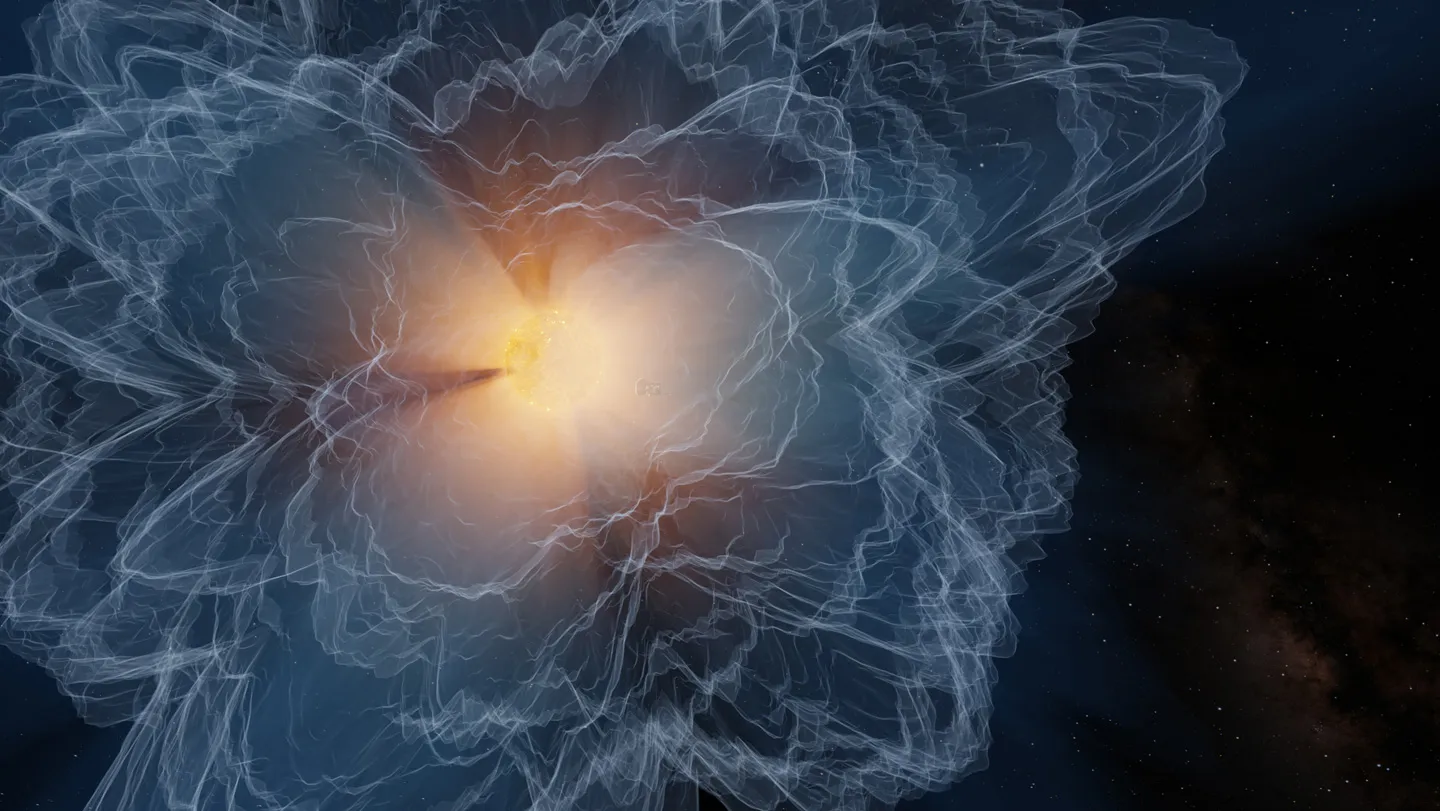
The sun’s outer atmosphere resembles a pufferfish.
That’s what scientists have gleaned from the first verified maps of the shifting boundary between the sun and the rest of the solar system.“The structure is basically this kind of corrugated, spiky shape,” says heliophysicist Sam Badman. As the sun gets more active, the boundary gets larger and spikier, Badman and colleagues report in the Dec. 20 Astrophysical Journal Letters.
Maps of this boundary, known as the Alfvén critical surface, could help scientists better predict how solar activity affects satellites, human and animal health and atmospheric phenomena such as auroras.
the invisible Alfvén surface marks a point of no return for plasma and particles that leave the sun to become the solar wind. It roughly delineates “the boundary between the corona, which is the thing you’re seeing during an eclipse, and the solar wind,” says Badman, of the Harvard-Smithsonian Center for Astrophysics.
Previously, scientists had estimated the size and shape of the alfvén surface using observations from spacecraft located about as far from the sun as earth.But in 2021, NASA’s Parker Solar Probe ventured below the Alfvén surface for the first time as it soared about 13 million kilometers from the sun’s surface. As then,the spacecraft has dipped into the corona 15 more times,swooping to within 6.1 million kilometers of the sun in December 2024.
Badman and colleagues combined Parker’s direct measurements of the Alfvén surface with remote data from other sun-watching spacecraft to create detailed maps of the boundary’s shape and the density, speed and temperature of the plasma within it.
The team also tracked how the surface changed over half of the sun’s 11-year magnetic cycle. As the sun whent from solar minimum, characterized by relatively few sunspots and flares, to solar maximum, the Alfvén surface expanded and grew more disordered and less spherical. The researchers hope to watch Parker repeatedly dip into the surface while the sun returns to solar minimum over the next five years.
Understanding the sun’s Alfvén surface could have implications for planets outside the solar system. Some planets orbit right next to their stars,some of which are much more magnetically active than the sun,leading to Alfvén surfaces that extend farther out. A close-in planet orbiting an active enough star could spend its entire life within the Alfvén border.
“That probably won’t be good news for habitability,” Badman says.
Keep reading