Stewart Gandolf
2026-01-15 22:49:00
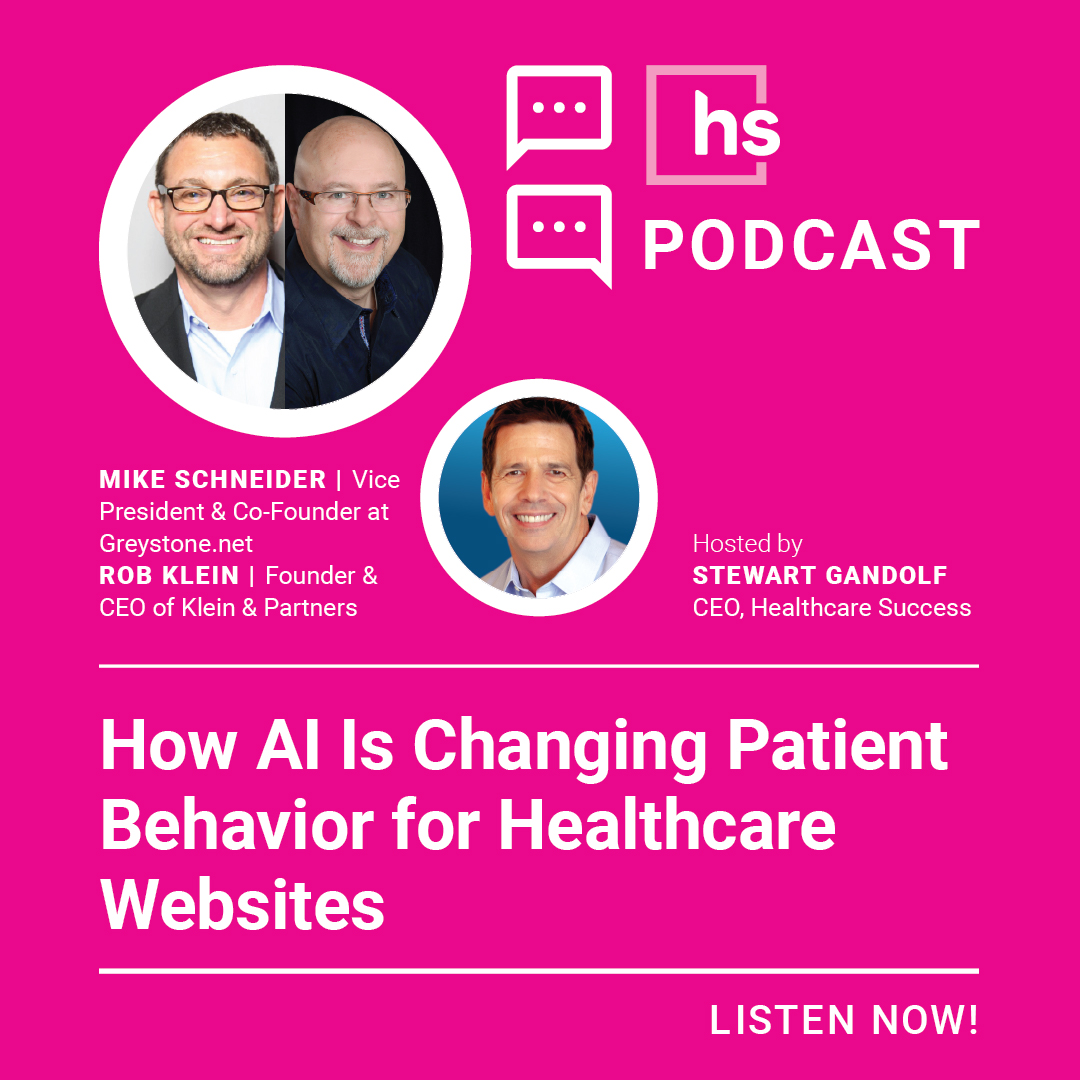
New Insights from gSight’s 10-year, 400,000-survey dataset on real visitor journeys reveal how AI is changing everything for hospital and health system websites.
Together, they dig into how AI is changing who shows up on healthcare websites, what those visitors are trying to do and where many organizations are unintentionally creating friction. Drawing from more than a decade of real-world gSight survey data and nearly 400,000 completed surveys, they share why many health systems are seeing dramatic shifts and how leaders can respond strategically.
If you’re responsible for growth, access or patient experience across your healthcare website, this episode will provide actionable insight and a clearer path forward.
To support this discussion, the episode includes two companion slide decks providing actionable insights healthcare leaders:
Note: The following AI-generated transcript is provided as an additional resource for those who prefer not to listen to the podcast recording. It has been lightly edited and reviewed for readability and accuracy.
Stewart Gandolf
Hello, everyone! Welcome to the Healthcare Success Podcast, and today, I’m super excited about today, because I have some old friends on this that I’ve known for years now, on both of them. And we’re going to talk about a really cool topic, so I hope you’re as excited as I am. So, the title today is what we’re Learning from gSight and Other Research Tools About AI’s impact on website traffic. And I’ll, set this up in just a moment, but along with me, I have Rob Klein, who’s founder and CEO of Klein and Partners. And Mike Schneider, who’s VP and co-founder of Greystone.net, and Mike and Kathy Divis also, founded, the Healthcare Interactive Conference, which I just got back from. And Mike, you must be exhausted.
Mike Schneider
Yeah, it was a lot, I’ll tell you. You know, I think we started on a Sunday with the awards program, and then we went 3 days after that, so it was non-stop for multiple days, but it’s a good kind of exhausted.
It was a good conference, a lot of folks were there, a lot of great topics, so yeah, we were excited, it was successful, and we’re—believe it or not—we’ve already had our first meeting for HCIC 2026.
Stewart Gandolf
I love it, and Rob, I saw you there, too. I’m tired, you guys. I flew in on Monday morning, and that was non-stop for me. Like, it was a race from the beginning, from the moment I got there, and of course, the Caesars is so easy to get around. I got 20,000 steps in 2 days.
Rob Klein
We stayed at Bellagio, so we were measuring our steps in miles.
Mike Schneider
I can’t even imagine.
Stewart Gandolf
Yeah, it’s crazy. Anyway, if you haven’t been to HCIC, it’s available at HCIC.net, that’s a great program. Today, we’re talking about a topic that is near and dear to my heart, and if you’ve been following our content and webinars, we’ve done a couple webinars Healthcare Success has about, the rise of Google AI overviews, and right about March this year, everything changed. And so we saw that Google AI overviews became much more prominent, especially in healthcare, and a whole lot of healthcare systems saw their traffic decline by about 35-50% almost overnight. Also, the rise of ChatGPT and the other large language models is having a huge bite out of traffic. It’s fun, when we were preparing for today’s webinar.
Rob and Mike were saying, hey, we’re seeing this too, so we’re seeing it from the other end, from data from actual hospital and healthcare systems, so I’m not just making this stuff up, neither are they, so we’ve got lots of data. Now, keep in mind, if you’re listening today, we do have a deck on healthcaresuccess.com if you want to see the actual source data. Rob is going to share the deck while we’re talking, so that’ll be available to the YouTube visitors, but it’ll also be available to people that have streamed it by audio. You can go back to our site. So, Rob will do his best to try to speak to what he’s pointing to, so you’re not totally lost if you’re on audio, but we’ll do the best we can. We have great data here, so I wanted to make sure that we did show it visually, and we’ll talk about it as well. So, with that said, Mike, why don’t you set this up a little bit more? I kind of gave the quick overview, but I’d love you to talk a little bit more about gSight, what it is, you know, what you guys do, all those things.
Mike Schneider
Yeah, definitely. First of all, thanks, Stewart, for having us on. I mean, it’s just always a pleasure to be on the podcast. You do a great job, so I appreciate you teeing up the topic, and it is something that’s timely. I mean, back to the whole HCIC thing. AI and the impact AI is having on everything: search, content, you name it. That was a hot topic, and so we’ve all been talking about it. And we’re seeing a lot of the data, kind of bear out the impact of AI. And to kick us off, I just want to talk a little bit about some of the data that we’re getting from gSight. So gSight is a survey that goes on a hospital or healthcare system website, and the primary reason that we built gSight, and Greystone did this together with Klein and Partners is that we had a research interest in understanding what visitors to the website thought about their visit to the website, and how it had an impact on their perception of the organization or brand.
So, you go to a hospital or healthcare website, and you’re not a hospital or healthcare system person, you’re a regular run-of-the-mill layperson looking for information about a disease or a disorder, or trying to get care for your parents, or trying to get something taken care of yourself. And you’re looking for information. And then sometimes you’re also trying to conduct some sort of transaction with the organization. Could be making an appointment, could be paying a bill, could be any number of things. Could even be applying for a job. But the idea is that somebody goes to the hospital website for a reason.
And then they have an experience, and then that experience gives them an impression or some feedback about the organization that we use the survey to collect, and then that allows them to be able to express their opinion.
So this survey pops up, and we ask them some questions, and we collect that feedback on behalf of the hospital or healthcare system. And then the hospital or healthcare system marketing team and digital team has some data that they can use to understand which patient journeys are going well, and which ones aren’t going so well, and where there are opportunities to make some tweaks on the website or in the web experience.
And what we do is, as an organization that provides gSight, we give real-time feedback on this data. So, clients go in, they can pull up a dashboard, they can see what people are saying about their website, and then they can see how that compares to others in the marketplace. So, we have benchmarks, we have peer groups that they can compare themselves to, and we even have a leaderboard where we pull out the top 10%, and they can see how they compare to that, or if they’re even close to that leaderboard. It was designed entirely by folks in the industry. In particular, Rob and the folks at Klein and Partners have been research experts in our industry for over 30 years. He started a company that was focused entirely on hospital and healthcare system research, and so Rob’s got a lot of experience with that, and on our Greystone side of things, we do a lot of research related to the digital experience, and we’ve been doing that for almost 30 years as well.
We started gSight roughly 10 years ago, and in our database, we have about 400,000 completed surveys, which is a lot of data, about a lot of different user experiences. And we look at that data over time, so looking at 10 years’ worth of data, you can draw some aggregate conclusions, but the really interesting thing is how it changes over time. So, what’s happening in the market today that’s different than it was 6 months ago or a year ago? And that’s why we’re here today, is to kind of talk a little bit about that.
What the data allows clients to do is look at information and feedback about the website in a continuous loop. So, these days, we don’t build a website and then we’re done. It’s forever changing and forever needing a tweak here and there, and that’s just the nature of anything that we do related to digital. The digital ecosystem is changing all the time, and then what patients and consumers and folks that are coming to the website want is changing all the time, too. So, we’re continuously collecting this data, we’re continuously providing the hospital or healthcare system with feedback, and then they make changes to the website, and then we look at the data based on some of those changes and give them feedback as to whether the changes have been good or bad, and what’s happened, and what’s changed over time.
So, it’s a continuous loop that keeps on going, and we work together with another partner at times called Corporate Insight that can even give us a deeper level of understanding, and we’ll talk about that a little bit as we go along. But today, we want to talk a little bit about how the data has changed over time. And Rob, I want to turn it over to you, and maybe you can talk a little bit about how this marries with some of the other research that you’ve been doing as well.
Rob Klein
Absolutely. Thanks, Mike. So, just real quick background on the demographic profile. Almost two-thirds of our respondents in our gSight database for 2025. As Mike alluded to earlier, we’re closing right in on 400,000 completes across our entire database.
For 2025, it’s probably around a miniscule 25 or 26,000 completes, which, if anybody’s a researcher on the call, you know, that’s music to our ears. I love lots of data to play with, because we can cut it so many different ways. So even though we’re just looking at 2025, and it’s actually Q1 to Q3, because we’re still in Q4. So, this is just a quick background. We’re also able to, we, without asking the respondents, we know what, what device they were on and what browser they were using.
So, let’s get into the findings. We’re just going to talk about a couple of things here to kind of whet your appetite on what’s going on. This, I have never seen a cliff like this. This is a data cliff, as I call it. So, what we do is we ask people to kind of identify who are you coming for this visit? Are you just looking? Are you a potential patient, a current patient? Are you a caregiver, a student, looking for a job, a healthcare professional? We want to kind of know how they self-identify, if you will. That helps us understand what they’re doing there, and how it went for them. So, it really helps us with journey mapping, because not all visitors are created equal. They come from a different place, depending on why they’re there.
So, we’re going to focus on the three categories that are the most prevalent. That’s the “just lookers”, potential patients and current patients. They represent the vast majority of visit types, if you will. So, these are the folks that said, I was just looking. And I only went back a year to Q1 2024, but I could have kept going back. And it was a flat line in the mid-teens for years. Now, look what happened starting in Q2 of this year, we’ve seen it drop off to less than half. It’s down to 7%. And that is just October of Q4. I want to get as much current data as I possibly could.
Stewart Gandolf
Sorry to interrupt you for a second, but that’s exactly what we were talking about. Right around Q1 is where the algorithm changed, and you’re, kind of steady, it looks like it’s 17-16% if you’re listening, you can’t see this. And then all of a sudden, this impact started to happen in Q1, 15, 12, 10, 7. But what’s news to me is that it’s continuing to drop so precipitously, so continue—I didn’t mean to interrupt you, but, like, making sure that people who can’t see this know that, but that’s a big drop, and it’s continuing to drop.
Rob Klein
Absolutely, and as a market researcher, we just don’t see movement. You know, healthcare, it’s like a steamship. It’s a slow-moving boat. When I used to work in packaged goods with Procter & Gamble, things could change weekly. And so that’s a speedboat type of a category. We are not that. But AI is creating movement and disruption unlike anything else. So, the speed of change, as you mentioned earlier, Stewart, that it’s changing daily, and Mike, you said the same thing, our ecosystem is changing so quickly. It’s like trying to hold on to the merry-go-round, and it keeps going faster and faster. So, this number shocked me, but there’s a huge amount of opportunity with this. So, Mike, what are your thoughts on this?
Mike Schneider
We’ve all been around for a year or two in healthcare, so what we know is that in the past the whole idea of how we show up in search as a hospital or healthcare system has been so important. And so, I can’t tell you how many, whether it’s HCICs or webinars, we’ve talked a lot about, as an industry, how can I make sure that I’m up higher on the list, or how can I make sure that when you type in these words, that our hospital or healthcare system shows up prominently and has good information? And for a long time how we did that was fairly consistent. There were always little tweaks. There were always little things we had to learn about the Google algorithm and how it changed. But to your point, Stewart, like, there was a seismic shift in quarter one, and it all comes back to how AI started to create the previews in Google. Understanding that mechanism is going to be incredibly important. It’s what we’re going to talk about over the course of the next couple of slides, but it has monumentally changed how we look at search and how we evaluate how well we’re doing in search, and it’s going to monumentally have an impact on how we build our sites and what we should be doing in the future to make sure that we show up. So, when someone goes into ChatGPT, or someone is using Google and gets an AI answer. That they get an accurate answer about your organization and the topic that they’re looking at.
Stewart Gandolf
Very good.
Rob Klein
So, let’s take a little deeper dive into our three primary categories. The 12, 16, and 48% of just-looking, potential, and current, that’s for the first 9 months, Q1 to Q3. So, these 3 numbers are changing as we’re speaking, by quarter, and by month. So, in 2025, 12% said, I’m just looking, and we know from the prior slide. Currently, it’s down to 7%. Potential patients are 16. Almost half, 48%, said I’m a current patient. So, what we’re seeing, and I think as we’ve talked earlier, you’re seeing too, is that people are entering as what I kind of call the sales funnel here, of just looking potential and current, people are entering healthcare websites farther down the sales funnel. They’re getting their information elsewhere. Now, it still could be content from your site that AI is picking up and presenting outside your website. And then that could drive people into you farther down. That’s the real interesting change that I’m seeing, is that content is even more important, not necessarily they’re learning your content on your website, but your website content now has to get outside your ecosystem and noticed by AI, so people read it outside the purview of your website, and then they come into your website, if they like what they read, farther down the sales funnel. So, it is changing the dynamics of when and where and why they’re coming to your website. So, before I kind of get to the right side, Mike and Stewart, what are your thoughts on that shift in when they’re hitting the website?
Stewart Gandolf
It’s 100% consistent with what we’re seeing, too, Rob. The interesting thing is, and the content part is so much more important, and not just content on your site, but off-site, too, which is a separate topic, but the idea that you’re feeding content so that the LLMs know you is so critical, and the authority. And what’s great with hospitals is you have so many authority sources if you’re leveraging it appropriately, right? But the other thing that I think you’re going to talk about later, and I’m going to defer to Mike for the next comment on this, but what we’re seeing across the board is that they’re coming in later in the funnel, and they’re also more qualified, even for our own business. People call us.
And they were like, yeah, I just found you. ChatGPT said you’re the greatest. I asked this, like, paragraph-long question of who’s the best agency for this kind of situation, exactly, and they said, you’re number one by far. I want to do business with you. Like, what? Hi, my name is Stewart. How are you? But they’ve done all that homework before even talking to us, and we see the exact same thing for our clients. Mike, what insights do you have on that?
Mike Schneider
Well, this is what I was going to say about it. When you think about, you know, in the past, let’s say prior to the first quarter of this year. When you looked at the hospital website, that was a primary entry point for people that were exploring.
So, what they were doing is they were looking for information, and they would use the web as the tool to be able to answer a question that they had, and what we were trying to do as hospitals and healthcare systems is drive them to our website to answer the question. Well, we’ve been disintermediated, because AI is now answering the question, and you don’t have to use a website even to be able to get the answer. So, what the website has become is the feeder tool for information that then drives that AI. So, it’s not going away. I have heard people say the doom and gloom about the website, and I don’t see that happening, but what I do see happening is that the way that we use the website is different. It’s a different strategy than we’ve had in the past. So now the website is multiple things. It’s the transactional base to be able to make the appointment or pay the bill, and that’s why we see people falling to the bottom of the funnel. And then for the top of funnel things, what we’re doing is we’re feeding information to the World Wide Web, basically where AI is scooping up that information and answering questions. So that data is still super important, and you’ve got to have it out there on your website, because that’s how you’re feeding the database, where AI is giving the correct answers. But they’re not coming through your website, necessarily. The data is being used by AI to answer the question, “If you’re just looking, how do I get the best care in Minneapolis for hip replacement surgery, or whatever?” So, you need to start to think about it differently.
Stewart Gandolf
Yeah, for sure, and I would just add that if you’re thinking, like, well, my website isn’t important anymore, I would argue voraciously the opposite. In other words, think about: here’s my new metaphor. I think in metaphors like Rob does, it’s just how I think. And I’m looking at AI as your concierge. Your concierge that you’re going to and saying, like, of all the hospitals or all the, you know, healthcare providers out there in the world. What’s my shortlist? Well, that shortlist that ChatGPT or Google AI overviews is informed by the content on your site. Other things too, but largely your content on your site. If you don’t want to be on the shortlist, don’t do any content. But if you want to be on the shortlist, you really need to keep that concierge informed.
Rob Klein
I just wanted to quickly add, Stewart, that AI is almost democratizing content, and it’s the great arbiter of what’s good content and what’s not. So, I think it’s actually causing us to be just more authentic and genuine, and make content that will truly, honestly serve patients without trying to say, oh, make sure we throw in the keywords, so the SEO picks it up. I think it’s freeing up
marketers to be good writers of content that is authentic and genuine, because that’s what AI seems to be valuing now, and that’s how you get seen. So, I think we’re seeing a renaissance of brand building.
Stewart Gandolf
Yeah, and it is, absolutely. We see that, too. We break it down into, like, some of the things that have always mattered, just quickly, is, like, the brand matters, the reputation matters, the content matters, the technical stuff, all these things matter. And maybe another way to look at this is, you know, the other metaphor I was playing with is a curator. Essentially, it’s the LLMs are a curator. They’re deciding what’s good content and bad, so you kind of need to care what they think. All right, let’s continue.
Rob Klein
But yeah, just to finish up on this chart to show you, so for the folks that are just, playing at home on the phone, so for each of the just-looking potential and current, we asked them, did you have difficulties doing your task? Only 4% of the 12% that were just looking, only 4% said, I had problems getting done what I wanted to. They were predominantly looking for medical condition information and wellness information. So, it went well for almost all of them. The potential patients, that 16%, they were there to either choose a doctor, schedule their first appointment, look what services you offer, get medical condition information, or learn about you. Classic, I’m ready to put things in the shopping cart, to use an Amazon analogy. But 18% of them said I had a problem. 1 in 5 potential got turned off.
Think about it, if I’m Amazon, I spend most of my time trying to make that add to cart and, you know, check out as easy as possible, or frictionless as possible. We are creating friction for 1 in 5 potential customers in general. That’s too much of a loss, and we know once people get frustrated with a website, they may never come back.
Mike Schneider
And I was just going to say, Rob, it adds fuel to a long-ranging debate, long-going debate, ongoing debate that we’ve had in healthcare, and that is, on the transactional side, often, as digital marketers, we have to have allies. I mean, digital marketing doesn’t allow people to be able to schedule an appointment. Digital marketing doesn’t allow people to be able to pay their bill or apply for a job, but you’ve got to work with internal partners to be able to do that. And in the past, I feel like that’s, to some degree, we’ve been swept under the rug. People make excuses. We can’t make an appointment, you know, and then it turns out, well, you know, our doctors really don’t like it, or it’s kind of complicated here, and some of our doctors just don’t want anybody to be able to go in and, whatever the excuse is, suddenly, that’s where the rubber meets the road. I mean, if what we’ve got is, you know, 48% of current patients and 16% are potential patients, and so that’s, you know, what is that, 64% that are coming in, or 74% that are coming in, and they literally expect to be able to make a transaction, or they’re going to have a bad brand experience. So, it’s incumbent on our organizations to figure out ways to break down these barriers and give our patients the ability to be able to do it, because the people who are providing that and making it easier and not creating difficulties for the visitor are the organizations that in the future are going to get the business.
Rob Klein
And here’s what’s important for everybody listening to understand if you’re involved with website development and content. If the website says, oh, call this number to schedule the appointment, or go do something outside the website, if it doesn’t go well, you get blamed. The website gets blamed. Even if it was a clearly the phone number, the people were awful in the call center, doesn’t matter. You get blamed. It’s like a relay race. If you’re running, you have the baton. You run a world record leg, you hand the baton off to operations, if they drop the baton, you all lose. But you get blamed for a bad handoff. So that’s really important to understand as web people involved with the web. You are brand managers. You are carrying the weight of the brand on your shoulders. What do leaders say? Give me the ball, coach.
Stewart Gandolf
Yep, totally.
Rob Klein
So, next slide here, we’re moving on. We asked people, how did you end up at the website? We like to understand what’s driving them. Just so everyone knows, we’re going to be changing this question because of AI. Right now, the answers are, I typed in the name, I knew I wanted to go there. It showed up in search, so I clicked on it. That’s what we’re going to change because of AI. I clicked a link in email or text. A lot of times that’s coming from my chart. I clicked an online ad. I responded to an offline ad. Sometimes you’ll have a print ad that says, go to our website. Or I responded to a social media post. Where patients are, if they’re just looking, those 12%, 78% of them said you showed up in search. It’ll be interesting once we change the question in January to include an AI response, how that changes. But the just lookers at the top of the sales funnel, they are almost all getting to you because you showed up in some type of search, which now we know is we’ve got to change how we word that.
Current patients and even potential, they knew they wanted to get to you. 64% of potential patients said, I knew I wanted to go there. So, the question is, how did they know? If they’re potential, what drove them to know they wanted to come to you. It’s probably an AI search a little farther up the journey, if you will. And then, obviously, current patients are mostly typing in, or they got an email or text. It’s most likely coming from MyChart, or possibly an email campaign.
Stewart Gandolf
Makes sense.
Rob Klein
Yeah. Mike, what are… any additional thoughts on that?
Mike Schneider
No, I agree, and the other thing that I didn’t want us to forget to say on this, too, is that when the answer is, I typed in the name of the organization, and someone is a potential patient, it goes back to branding again. Like, your brand awareness and your marketing is really driving that top-of-mind awareness. So, again, just underscores some of the things that we do on a regular basis that have nothing to do with AI, or may have less to do with AI, it still reinforces the need to have that brand awareness in your marketplace, and to have a good brand that’s associated with positive things.
Rob Klein
Yep.
Stewart Gandolf
Oh, and the algorithms now favor bigger brands, so the great democratization, where… when I started getting, like, heavy into this was, I did it before, but especially around 2006 when I founded the company, you know, like, we were nobody, we were a startup, and we dominated search for the terms we wanted, because we knew what we were doing, right? And then, over time, you know, for our own agency and for our clients, we built our brand, we built their brand, the brand became more important, but in the old days, it was really easy to dominate with no brand. But now, the algorithms do care about the brand, so, the more you’re building brand equity, the more you’re building brand value, the more likely you are to show up. And that’s a fuzzy metric, but it’s very real. It’s very, very real. So most, you know, large health systems have that brand, but you’re always either gaining or losing in terms of your brand equity, and so it’s just really important.
Rob Klein
You know, one of my Robisms, you know, is a brand has to invest in people before people invest in the brand. We’re getting to the point where we’re begging for business before we’re even establishing a relationship. Again, another silly analogy I have, you’d never ask someone to marry you on the first date.
Stewart Gandolf
Yeah.
Rob Klein
You’ve got to build affect in your brand before you go for the close. We’re starting to ask people to come and use us before they even have a feeling about us. And that over-rotating to performance marketing, I mean, I think it was the part of the downfall of the auto industry in Detroit, where I’m from.
You know, they taught people, don’t buy a car unless we give you money back. They weren’t to build a brand; they were just throwing money at people. Please buy our car, please buy our car.
Stewart Gandolf
Hey, Rob, it doesn’t work in dating, it doesn’t work in healthcare, Mark. Exactly.
Just saying. Yeah.
Mike Schneider
Getting that put on a t-shirt.
Rob Klein
Thank God we’re all married.
Stewart Gandolf
Yeah, for sure.
Rob Klein
Alright, so, this last chart, and then we’re going to move on to some other cool research, but this is a question we ask people. It’s my chicken or egg question. I love this question; I’ve been asking it in various forms for 20 years. We basically ask folks, okay, think about this most recent website experience. Did it reaffirm existing positive or negative feelings you already had for the brand, or did it create new positive or new negative feelings towards the brand that you didn’t have before? That’s why this is a digital brand experience. Or did it not impact at all? So…
The one number I’m going to focus on right now, 8% across our database said, this experience I just had created new negative feelings towards the brand I didn’t have before I visited.
So multiply 8% times the number of annual unique visitors you have to your website, wherever you are. Let’s just, you know, it varies by client but just take 8%. Is that number big enough to scare you? That’s how many people are turned off to your brand. So again, you are brand managers. That number is huge. It’s 10% for current patients, 9% for potential, and it’s 1% for the just lookers. The just lookers, they’re fine. They don’t have any skin in the game yet, they’re just looking. But once they have skin in the game, and get down that sales funnel, potential or current, then 1 in 10. are turned off. And those potential may never convert.
People again, all the COVID research that I’ve done, people get scared off of a brand much quicker and easier than they did before. You know, it’s like, again, it’s that first date. If one quirky thing happens on the first date, there’s probably not a second. But once you’re married, the quirkiness is just quirky.
Stewart Gandolf
Some of us more than others, but yeah.
Rob Klein
Exactly. My point is, timing is everything with how you present your brand during that
learning process, that development process. You’ve got to look at brand building just like dating, because we all get dating. Good and bad, we all get it. We know when it goes bad, and when it… how to nurture it, and then when to make the ask. We don’t follow those same brand rules in many cases.
Stewart Gandolf
So, I would just add to hear, Rob, it doesn’t… it’s not broken down this way, but my guess is strongly that a lot of those negative feelings are coming up, or surrounding
the user experience, not so much content, but user experience, and especially making appointments. That’s always such a thing that patients want seamless and easy, and you know, healthcare providers often make it hard and difficult, and I’m sure you probably have data on that as well.
Rob Klein
Yeah, well, the three big things that are irritating people most are scheduling an appointment, because they’re like, why can’t I do OpenTable, but I have to call and argue with someone at the office to get an appointment? And that’s the words I use; I have to call and argue. They’re loaded for bear when they’re calling. They’re ready for a fight. Or, I’m paying a bill, that’s one of the troubled bookend children, you know, upfront pricing and back-end billing. If we don’t figure those two things, everything in the middle, in terms of experience, is… we’re never going to get anywhere.
Because we’re losing trust on the front end and the back end. The other thing that’s irritating people, but it’s only, like, maybe 4% or 5% of people that visit the website for, but it’s requesting medical records. People get so irritated on how hard that is. They’re like, this is my info, why is this so hard for me to get my records and take them somewhere else? So that’s an interesting little side note. But, yeah, there’s a lot of things that they don’t accept our excuses for anymore.
Mike Schneider
The other thing that I wanted to say is the weight of or the impact of new negative feelings. The weight of that one is so important, because we’d all like for it to be zero. You’d always like to be tweaking your website or doing things that you can be able to produce a 100% positive customer experience. But that’s probably unrealistic. But what should that number be? It should be as low as you can possibly get it. Because you want to turn off as few folks as you can. And when you talk about 10%, that’s a pretty big number. I mean, it… you know, when you look at the data overall, you might pat yourself on the back and say, hey, it’s only 10%. But back to the analogy that you made, Rob, like, if you multiply that by the number of people that visited your website, and you’re pissing off 10% of the people that came, and you’ve got 200,000 visitors, you know, that’s 20,000 folks that visited your site that turned around and said, I have a new negative feeling about this organization. And to make another analogy, I mean, imagine you’re a restaurant, and every 1 in 10 folks that walked in the restaurant said, I’m never coming back here, this place sucks. The power of those people, those are the people that talk about their experience. You know, if I had a great experience, I might or might not tell some people about that great experience. But if I had a terrible experience. I’m going to sit down at the dinner table on Friday night and be like, you know what? I went to…
that healthcare system website, and I could not find what I was looking for. I clicked on Make an Appointment. And the make an appointment thing popped up and said, if you’d like to make an appointment, you’ve got to pick up the phone and call 1-800- and then I was on the phone for 20 minutes. So that’s not an online experience, that’s a, you know, lesson in frustration. I get on my soapbox about this kind of stuff, but that’s why create new negative feelings is really important, because you’ve got to think about what that really means, and how many people they’re making upset, and knowing that those people are not going to be quiet about what happened to them.
Rob Klein
Healthcare companies are good at clinical. They’ve got to become a tech company. You’ve got to think like tech. You’ve got to behave like tech. Especially younger people. The digital highway is only getting wider and wider, especially with the younger, you know, the Gen Z and the like. That’s where they want to do a lot of their healthcare, and we’ve got to be there with them. They just, they assume That all doctors are good. They’re looking for convenience and access and doing things online. They are impressed by the MD.
You know, Dr. Smith, they’re just as happy going to a nurse practitioner, a PA, so our world is changing on what legitimizes, you know, brand loyalty for them. Alright, last section here, we’re going to pull in a couple of extra slides. This is outside of GSight, but it really pairs well with what we’ve been talking about. I recently did one of my National Consumer Insight Studies, NCIS. That I do every year, and I did it with our friends at AHA Media, and we asked questions about the impact of AI on search. And so, we just want to kind of show how, even though it’s a different type of survey, it’s giving us the same answers. We’re really triangulating what’s going on. The first, slide here is my COVID brain that I’ve been… I’ve been tracking for, you know, since COVID started. It’s not clinical, it’s… we ask questions like, do you agree or disagree? I’m having trouble remembering things. I find it harder to concentrate and pay attention. I find myself losing my patience easier than before. 38% said I’m losing my patience quicker. That’s a scary number. Brand linkage. Even if I remember an advertisement, I find it harder to remember who the company was. 42% said that. So, for marketers. They’re seeing the ads; they just can’t remember who it is. So, we are really struggling as marketers and communicators, whether it’s an ad or a website. Things have to be simple, repetitive, catchy, and the brand has to be the star. So, this COVID brain is not going away. That we have to recognize the new consumer mindset is having trouble remembering things. What do we call it? CRS? Can’t remember. You know what? Their attention span. We’ve, you know, I mean, I have OCD and ADHD, so I get it, I’ve always had that, but everybody’s catching up to me now with lack of attention span.
Stewart Gandolf
I call it acquired ADD syndrome.
Rob Klein
There you go.
Stewart Gandolf
Just by being stressed out all the time, it’s like it happens.
Rob Klein
Look at lack of patience. I mean, flight attendants carry duct tape now, because they have to duct tape unruly passengers before they can land. I mean, this is insane times that we’re living in. And then brand linkage, so that’s not going anywhere. So how we communicate, whether it’s advertising or, as what we’re talking about, websites. Websites have to be simple, clean, they have to be able to get to where they want to go in maybe 2 or 3 clicks, or they’re out of there.
Stewart Gandolf
Yes.
Rob Klein
The next slide, we ask folks, when you get a result from… and I apologize, guys, you know, Stewart, Mike, are you guys seeing, you know, that people’s brains have kind of rewired the past 5 years?
Mike Schneider
I mean, I would say absolutely. The other thing that I just would always add to this is I really feel like it started because COVID coincided with, whatever, 2020, and that makes a lot of sense. But there are other environmental factors that are not making this any better. I mean, the amount of time that we spend on these devices. And, you know, I mean, I look at the younger generation, and again, I’m not picking on them or judging them, I’m just saying that they can’t be separated from this. It’s entirely how you communicate and how you make an appointment, and how you do everything all the way up to when you go to bed at night, and the first thing when you wake up in the morning. So back to the attention span and patience and memory thing, I think that, you know, some of those external factors have an impact on that as well. Our world is just becoming a place where we’re feeding some of this, so I don’t see it getting better. I see it continuing to move in this kind of spiral that we’re in, and we’re going to have to, like you said, Rob, I mean, it seems like it’s here to stay, so we’re going to have to figure out how to deal with it.
Stewart Gandolf
So, I’ll just add a couple of thoughts. One is, I remember reading Future Shock back in high school, and the premise of that book, it was by Toffler, I think, was that the pace of change is going to increase and increase and increase over time to the point where people can’t absorb it.
Rob Klein
That was pretty prescient, and I remember that book. I thought, that’s an interesting idea, and I’ve seen that play out in my life.
Stewart Gandolf
Number two, I think the idea of COVID brain is, it’s, you know, partly, probably from, you know, just side effects of COVID, but the other part of it that maybe might be, more of an explanation, is I mentioned the stress a minute ago, and the stress we’re in just seems to keep… it’s information overload and then stress. And I did an article in our blog, I think last year. And the year before that, it was essentially, it’s like, are people really angry now? And it turns out, yes, they are. Like, there’s actual data that people are angrier. So, it’s like, it’s… it’s not good. It’s like… and these numbers are a little scary, so it is what it is, but it’s definitely… it’s not your imagination. People are just angrier than they used to be. Yep. That’s too bad.
Rob Klein
And then we, we asked a question, and again, this was an online survey, so people could see things, not a phone survey. So, we asked them, when you get a result from your health-related search.
what do you typically do? So, we created a search to show them, and then we said, do you typically stop with the AI-provided answer? Do you click on the AI-provided links? Do you scroll down to the results below AI, or are you not sure? 23% of folks said, when I do a healthcare search. I stop with the AI, provide an answer. One in four are done. Right there, 1 in 4. What’s interesting is they tend to be younger. So, Gen Z, 30% said they stopped. Boomers, it’s only 12%. So, zero click declines with age. We could have, I mean. We didn’t need to do research to know that. So, but 22% said they click on the links provided in the AI, and 31% are still scrolling down. We’re going to do this survey every 6 months for a while, because it’s moving that quickly, and we want to be able to track this movement in behavior. It’s going to be fascinating, to see how this changes.
Stewart Gandolf
Rob, it’ll be really interesting if you start looking at browsers, too. Like, on my, so for me, personally, I have a Perplexity app on my phone, and I go to… that’s my go-to now over Google, which is scary, because I go there first and only, typically. And it also means I’m just researching a lot more things. Anything I’m interested in, like, I can look up in a second. And on my web browser, on my computer, my desktop. I have, Perplexity as a, saved tab, and I also even have Comet, the new browser that I use for special cases, so it’ll be interesting, because this is really talking more about Google AI overviews, but as ChatGPT, Perplexity, the other alums become more prominent, like, they don’t even have the option to go to the other search results. There are none. So, we’ll see how that goes over time.
Rob Klein
And that’s one of the questions we asked folks in the survey, is what, you know, what… if you use an AI, which one do you use? And so, it’ll be interesting to see, is a Claude going to make it?
They’re advertising like crazy on TV now. So, it’ll be interesting, you know, we’ve, you know, you talk to some investors, and they’re like, there’s going to be a great shakeout like there was with the dotcom bust. You’re going to have an AI bust coming up.
Stewart Gandolf
ChatGPT has a big lead, but the numbers for our listeners are still small. I’ve seen between 2% to 10% share of searches on ChatGPT compared to Google, which has, like, 80.
So, the numbers are fungible depending on who’s doing the survey, but it’s still tiny compared to Google, but the importance is enormous, and the momentum is huge, the acceleration is huge, so it’ll be really interesting, Rob to see your data over 6 months’ periods is going to change night and day every time I’ve been through it for the next few rounds. Absolutely.
Rob Klein
And then this chart, we asked folks, if you see a hospital or health system show up in an AI overview that you’re familiar with, but you haven’t used, what… how would you react to seeing that? 43% said, oh, I would visit their website to learn more. I’ve got another chart to talk a little bit more detail about the impact of, if they know the brand, like the brand, and have used the brand, are they going to go to that website? But again, if they know the hospital that shows up, or health system, in an AI overview. So that stresses the importance of how do you get into
the AI Overview. That’s the hurdle that you can get past, but if they know your brand, 43% are… basically what they’re saying is, I trust. I trust that if it shows up in AI Overview, they’re kind of the guardians of the data, and they’re like a neutral, AI doesn’t have skin in the game. That, you know, that consumers think. They’re like, it’s a neutral knowledge seeker, and it deemed your hospital to be worthy for it to pull in. And so that’s changing people’s mentality. Here’s the other thing. 38%, in the other question, have you ever made a healthcare decision based on an answer from an AI tool or AI overview? 38% said yes. Now, here’s the kicker. With all the AI questions we asked, the demographics were consistently different, meaning anything that I used AI, I trust it, I made decisions based on it, they were significantly more likely to be men.
younger, and have a higher socioeconomic status, meaning college-educated, higher income. No matter what question we asked, that was the pattern. So, what that means is we know that women are predominantly the healthcare decision maker. They are more skeptical towards AI. So that means when we communicate and we want to bring people along with AI,
We’ve got to have a different message to women, older, lower socioeconomic status. They are much more skeptical. Their adoption curve is much farther out than younger men, higher socioeconomic.
Stewart Gandolf
Great, great insight.
Rob Klein
And the last chart here we have, what we did is we asked our respondents, if you were searching for a health-related topic and a digital ad popped up. And you found the information to be interesting in that ad would you click on that ad if you didn’t know the brand? 24% said yes, so the information is making them curious to learn more. What if you were familiar with the brand, but you really didn’t have any strong opinion, positive or negative? You just knew the name? 36%, or an increase of 12 percentage points, was said I’d click on that ad. Now, here’s where it gets interesting. How about if you haven’t used the brand, but you have a very positive opinion of it? 52% said, I would click on that ad. That’s an increase of 16 percentage points. And then finally, what if you’ve recently used that brand? Now it’s 62%, but that’s only a 10% increase off the 52%. So, the point is, the biggest lift comes from affect, not learning about the… just having a knowledge of the brand, or using the brand. So, how they feel about you. People have to like you. And that’s where that brand building comes into play. You know, as opposed to, again, you can’t ask people to marry you on the first date. We’ve, you know, the golden ratio with all the research as an ad research guy, I read all the research around the world. The research is showing it’s 60-40. 60% brand building, 40% call-to-action or performance marketing. We’re like 1090 in healthcare. So, and a lot of industries are. We’re trying to get butts in beds as quickly as possible, but we’re short-circuiting the brand building, which takes, like, maybe 3 years. And I know it’s easy for me to say it’s hard to do with CEOs and CFOs breathing down your neck. I get that. But we’re doing ourselves a long-term disservice. We’ve got to get back to creating a reason for people to like us, and then they’re much more open to wanting to use us.
Stewart Gandolf
That’s a great comment. So, we’re almost out of time here. Mike, Rob, do you guys have any, I guess you can flip over to the final slide where people can get ahold of gSight, if you’re interested in, the product, it’s a terrific product. I recommend it often. Rob, Mike, any final questions or comments about what we’ve talked about today?
Rob Klein
Mike, go ahead.
Mike Schneider
Well, I just say, I mean, a couple of summary things. One is that, you know, our ecosystem in the healthcare digital world is changing and is being impacted by AI, and I would just say, if I were a digital marketer. I would be absolutely on the edge of my seat, following what’s happening, looking at data about where it’s going, and staying abreast of how that’s having an impact on how people are utilizing tools. So, data research like this is important. There are other sources for it, too, but if I had to think about how I sort out my day as a digital healthcare marketer. I’d be making sure that I square off time on a regular basis to kind of look at how it’s changing, because we’re in a period of time where it’s changing dramatically, and it’s changing quickly. And then the other thing that I would just add, and Rob talked about it a lot, is just how important the strategy of building and creating brand awareness and building a good brand really is, because that at this time, when there’s so much change going on, that’s just really one of the most important and effective things that we can be doing as healthcare marketers.
Stewart Gandolf
Awesome, Mike. Rob, last comment?
Rob Klein
Yeah, I was just going say, make sure you keep your brand hat on, because like never before, brand building is so important now, because we’ve lost a lot of trust in healthcare over the past several years. My trust meter that I have in my on the bus, it’s below 7. On a 0 to 10 scale, the average trust for healthcare is, like, a 6-7, something like that. That’s not good, because we have scale creep, and people are giving 10s for everything. But they really are not trusting us in healthcare, and we’ve got to build that trust back. And strong brands build trust, not constantly just asking for business.
Stewart Gandolf
Okay, and so hopefully we’ve built a little trust with this brand building here today, so I’ll do the call to action with, like, 5 seconds left. So, if you’re interested in gSight, that website, if you’re listening, is gSight.net, G-S-I-G-H-T dot net.
And so, if you’re looking for this research, you can reach Rob Kline and Mike Schneider as well, they’re pretty easy to find. And then if you’re interested in solving some of these problems with your website, in terms of the technical side, the content side, the branding side, of course, I’m CEO of Healthcare Success, and you can find us pretty easily, too, at healthcaresuccess.com.
Anyway, Rob, Mike, how fun! Que bueno. I knew this was going to be good.
Mike Schneider
When we get together, we can just talk and talk forever.
Stewart Gandolf
I know, it was exactly what I suspected it’d be. Thanks, my friends, we’ll see you next time.
Rob Klein
Thanks so much, Stewart. Take care, everyone.
Stewart Gandolf
Bye-bye. Bye-bye.
I’ll be in touch. Thanks, bud.
Mike Schneider
Okay, thanks, Stewart, have a good one.
Stewart Gandolf
You bet.
Keep reading