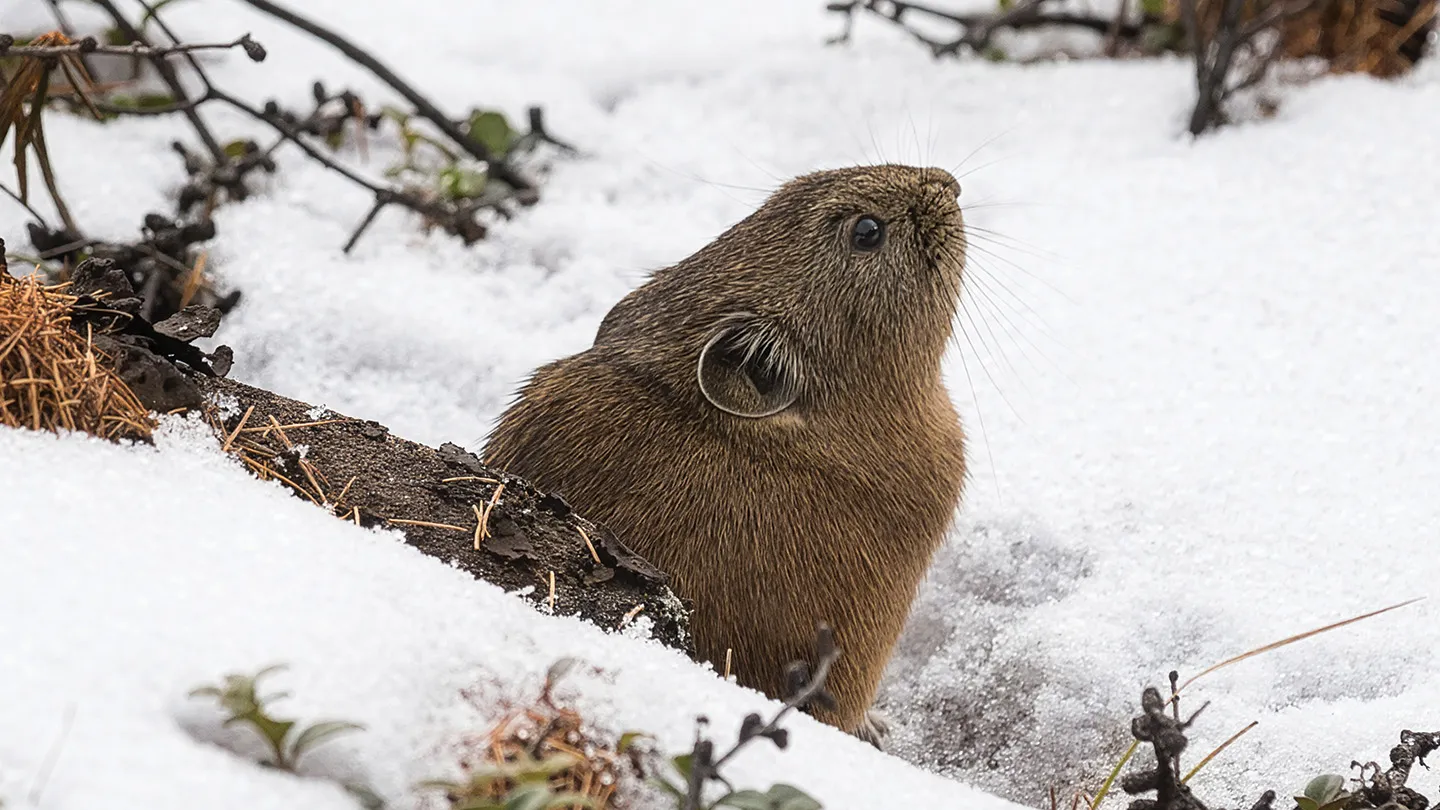
A soft, thick coat of snow makes a lot of the world seem to slow down or even stop — at least temporarily. The fluffy piles absorb sound and make the world quiet and still. But deep underneath, in pockets between the snow and the ground, life goes on. This is the subnivium, a tiny ecosystem all its own.
Here under the white stuff,roots,small mammals,microbes,insects and even birds thrive. They use the subnivium to make the most of the winter months — hunting, breeding, breaking down leaves and more. All those cold-weather activities help determine which plants and animals will thrive during the snow-free seasons.
But this seasonal ecosystem is in danger. Climate change is making winters warmer. much of the precipitation that used to fall as snow now pours from the sky as rain. In the Northern Hemisphere, snow cover has decreased by 2.2 percent per decade from 1979 to 2012.Compared with 2016,2020 had 2.5 fewer days of snow cover. No snow means no subnivium. And as it shrinks, a host of organisms might pay the price.
Their loss could change the way forests function year-round, not just in winter, scientists have found. Several groups are working to understand what is going on below the snow and how this ecosystem is responding to our warming world.
A natural igloo
As snow falls, it can accumulate in layers that compress under their own weight, forming a snowpack. Once that snowpack gets deep enough — about 15 centimeters — the subnivium emerges, says community ecologist Jonathan Pauli of the University of Wisconsin–Madison. Shallow hollows just a few centimeters high collect around fallen trees and rocks and link up like a maze.
The thick snowpack acts like a natural igloo, insulating the labyrinth underneath, Pauli says.Above-snow temperatures might range anywhere from –20° to 4° Celsius. But when the snow is deep enough, it doesn’t matter how cold the air is: The ground will remain a consistent 1° C, just above the freezing point of water.
That one degree makes all the difference, says ecosystem ecologist Alix Contosta of the University of New Hampshire in Durham. It has changed the way scientists think about life in cold winter environments. when Contosta developed her captivation with the subnivium as a student in the late 1990s, winter was thought to be “a dormant season and there wasn’t a whole lot happening,” she says. But in the subnivium, where soil is warm enough for liquid water, life goes on.
Diverse denizens
Bacteria and fungi that can stay comfortably unfrozen in the subnivium munch all winter on dead plant material that accumulated in autumn. As these microbes eat, they breathe — taking up oxygen and pumping out carbon dioxide in a process called soil respiration. Some of the carbon from leaf litter gets stashed in the microbes’ cells. “As long as those microbes stay alive, the carbon that’s in their biomass is part of soil,” Contosta says.
Snowpack depth seems to influence microbial populations and, in turn, soil respiration. Deeper snowpacks lead to larger, more diverse and more active populations, researchers in China reported in 2020 in Scientific Reports. More active microbes mean more respiration, which means more carbon-rich soil.
As the snow melts and spring arrives, the microbes die and release nutrients into the soil — right when plants start to resume growing.“All of these nutrients, all of these carbon molecules, it’s ready for [plants] when they wake up,” says soil scientist kaizad Patel of Pacific Northwest National Lab in Richland, Wash. “In that sense, the microbes help regulate that [nutrient cycling].”
Meanwhile,hungry arthropods regulate the microbes. Springtails, centipedes, rove beetles and more are “down there feeding, moving around, searching for mates, breeding,” says Chris Ziadeh, a New Hampshire–based ecologist with the U.S. Department of Agriculture Natural Resources Conservation Service.
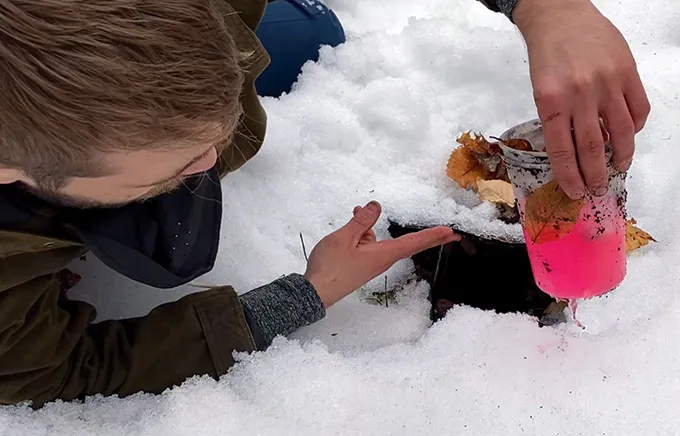
Ziadeh and Contosta are part of a team identifying exactly which arthropods call the subnivium home. The researchers set out pitfall traps, preservative-filled cups partially buried in the ground, over two winters and one summer in a forest in New Hampshire. Whatever wandered along fell in the traps.
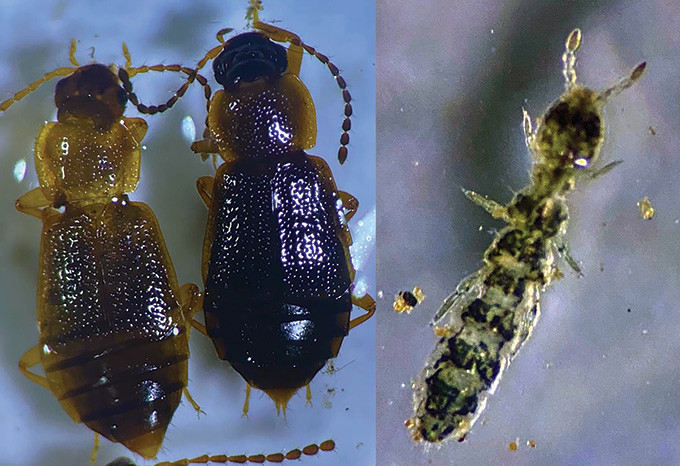
Unsurprisingly, winter traps collected one-sixth as many arthropods as summer ones per day. But some species were found mostly or only in winter, including meshweaver spiders (Cicurina brevis) and three types of rove beetles (Arpedium cribratum, Lesteva pallipes and Porrhodites inflatus), the team reported in 2024 in Environmental entomology. These subnivium specialists could have an impact on the ecosystem all year by putting nutrients back into the soil and keeping down certain pest populations, Ziadeh says.
What’s more, the arthropods are critically important prey for larger animals that hide under the snow, such as lemmings (genus Lemmus). Those mammals, in turn, attract their own predators. Take American martens (Martes americana). About the size of a house cat, these fluffy, ferretlike predators “[slink] in and out of that subnivium space,” Pauli says. “They’ll find an opening, and they’ll kind of go down and disappear and presumably hunt … then pop up at another spot.”
Even birds use the subnivium. Though ruffed grouse (Bonasa umbellus) and willow ptarmigans (Lagopus lagopus) live above the snow, they dig or even dive into drifts to roost. In New York’s Adirondack Mountains,as a notable example,“grouse would kind of explode out of the snow,” recalls climate change ecologist Benjamin Zuckerberg of the University of Wisconsin–Madison. “Just out of nowhere, this big bird suddenly appears!”
an ecosystem at risk
Climate change, though, is coming for the subnivium.
Greenhouse gas emissions from human activities are driving up the average global temperature. At the current rate of warming, the presence of the subnivium worldwide is projected to drop from 126 days per year on average in 2014 to just 110 days by the end of this century, researchers reported in 2019 in Nature Climate Change. With less snow to insulate the ground, there would be 10 more days every winter where the ground is frozen.
That’s bad news for subnivium dwellers. Plant roots can burst in frozen ground. Microbes can too.If they explode, they’ll spill their nutrients into the soil months before the plants need it for their spring awakening.
Dying roots plus fewer nutrients add up to a “double whammy” for trees, Patel says. Weakened trees may grow poorly or be more vulnerable to diseases or insect pests.
Arthropods will suffer too. subnivium specialists like the meshweaver spider and the rove beetles are “probably going to become locally extinct or just disappear altogether,” Ziadeh says.
Even insects that normally lie dormant through the winter might be harmed. A warming of 5 degrees C relative to the current conditions would leave them exposed to killing cold. but if the planet warms 3 degrees C, computer models suggest that cold-hardy species might survive, the researchers reported in 2025 in Diversity and Distributions. Currently, the world is on track to warm 1.5 to 2 degrees C in the 21st century.
Larger animals that rely on the subnivium, such as pikas and marmots, could find their numbers plummeting too.
In the winter between 2014 and 2015, North Cascades National Park in Washington state experienced low snow and extremely dry weather. After the winter, the number of cold-loving pikas (Ochotona princeps) dropped at the lowest elevations, wildlife ecologist Aaron Johnston of the U.S. Geological Survey Northern Rocky Mountain Science Center in Bozeman, Mont. and colleagues reported in 2019 in Ecology. Those areas, stuck with no snow, left the rodents too cold. Less snow also meant less water for grasses that they rely on for food come springtime, and the underfed pikas reproduced less in response.
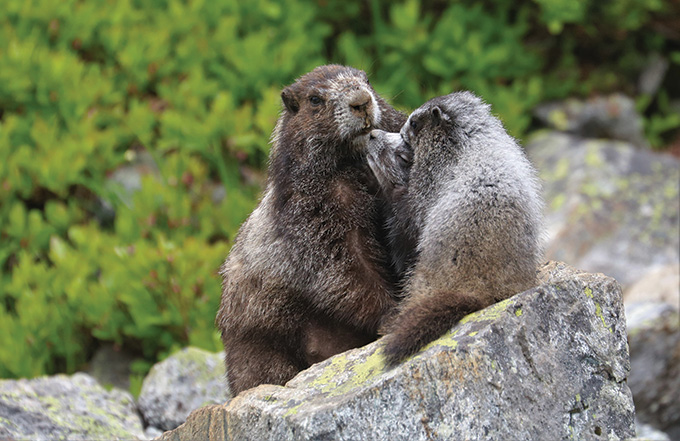
Unlike pikas, marmots hibernate underground in winter. But a lack of snow is stressful for them too, Johnston says. The subnivium and other snuggling marmots keep the animals’ energy expenditure to a minimum. Without snow, temperatures may drop further in the burrow. At 0° C, the large ground squirrels would need to use four times as much energy to stay warm as they do at 5° C. After the winter of 2014–2015, the national park’s marmot population, stressed from using extra energy to stay warm, dropped 74 percent in 2016 from the number in 2007, Johnston and colleagues reported in 2021 in Ecology and Evolution.
Finding refuge for the cold
Saving the subnivium requires limiting climate change’s impact enough to keep winters truly cold.“Fundamentally, at the end of the day, that requires reducing our carbon emissions to zero,” says climate scientist Elizabeth Burakowski of the University of New Hampshire in Durham.
High areas, like the summit of New Hampshire’s Mount Washington, give her hope. “It’s not warming at the same rate as lower elevations,” she says. “Rare alpine plants that live up there are a little bit more resilient to the changes of climate.”
Burakowski is hunting for more climate refuges: “small pockets of really unique, protected climate zones that preserve snowpack,” she says. These colder areas could be on the north slopes of mountains or behind large boulders, where there’s less sunlight. By warming more slowly than other areas, they might allow patches of subnivium to persist, Burakowski says.
she’s also interested in how we might alter forest management to make more patches where subnivium is safe. “At the end of the day, we are beholden to Mother Nature,” Burakowski says. “More of that precipitation is going to fall as rain instead of snow.”
But where there is snow, she says, “it would be great to keep it as long as we can, and to have it stick around.” Burakowski is trying to understand what in a forest keeps snowpack present. The right number of trees in a forest seems to be key for snow buildup, for instance. “We think that there’s this Goldilocks zone,” she says. There needs to be “a thin enough forest canopy that more of the snow is reaching the forest floor, but thick enough that it’s also shading the forest floor.”
In some places, thinning forest canopy just a little might help snow build up, helping the fleeting subnivium — and its residents — stay just a little longer.
Related reading