Mario López-Goicoechea; as told to Emma Loffhagen
2026-01-24 07:00:00
Throughout my childhood and teenage years growing up in 80s Cuba, Fidel Castro’s presence, and the overt influence of politics, was everywhere – on posters, on walls, in speeches that could last four hours at a stretch. The sense of being hemmed in, politically and personally, was hard to escape.
I had been raised to believe in communism, and for a long time I did. I even applied twice to join the Young Communist League, only to be rejected for not being “combative” enough: code for not informing on others. Friends were expelled from university or jailed for speaking too freely and my family included people in the military and police, so I had to be careful not to endanger them. But amid that stifling conformity, something else had begun to take hold.
When I was 13, my first girlfriend’s father, a sailor, brought back LPs from abroad. Through those records, I discovered rock’n’roll. In Cuba at the time, that was no small thing. Western music arrived years late, passed hand to hand through a black market of cassette tapes copied and recopied.
By the time I reached my fourth year of secondary school, music had become an obsession. Four or five of us made an unspoken pact to seek it out wherever we could. We held listening sessions in each other’s homes and gathered at an arts centre every Saturday night, where local bands played or taped rock blared from speakers. It wasn’t without risk: I know people who went to jail just for listening to the Beatles or the Rolling Stones. Long hair, bracelets, necklaces – any hint of “western proclivities” – could land you in the back of a van for the night.
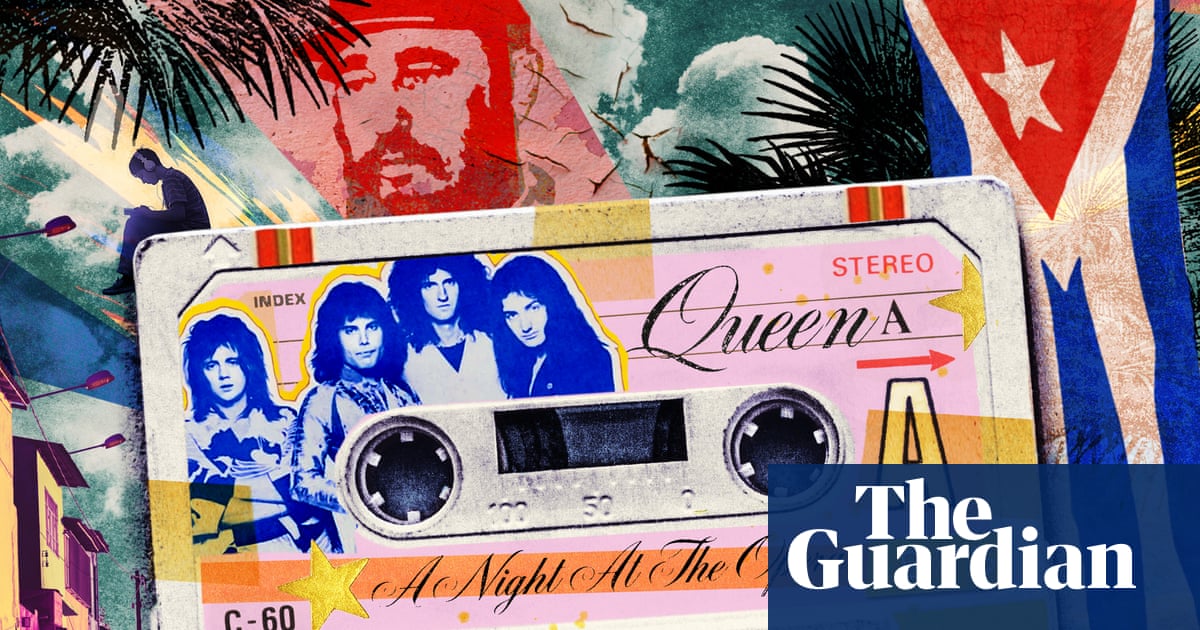
I was 15 in 1986, living in a one-bed flat in Havana that I shared with my mother, grandmother, aunt and cousin, when I discovered The Prophet’s Song by Queen. I’d heard of the band, but I had never listened to them properly. A friend had sourced A Night at the Opera for me, photocopying the inlay with the lyrics included. I listened to it on a battered mono cassette player with a single speaker, hardly ideal for an album so carefully constructed.
And yet, from the opening notes, it stopped me cold. The song begins gently, with soft guitar chords, before shifting into something more frenetic. Then Freddie Mercury’s voice arrives: possessed, prophetic, as if rallying an unseen crowd; his voice had this beautiful urgency, singing about a vision he had.
Then came the moment that changed everything. Brian May’s delay effect multiplies Mercury’s voice – “Now I know, now I know” – so it echoes into itself, ghostlike and disembodied. Even through that tinny speaker, it was otherworldly. For eight minutes, the noise of Havana fell away. In that cramped flat, surrounded by family and surveillance, a crack opened.
What moved me wasn’t just the sound, but what it represented. A Night at the Opera was Queen’s first album after falling out with their management. They were given creative freedom. Until then, my world had been bound by “socialism or death”, words still painted on Havana’s walls. Suddenly, I too felt the freedom to imagine something different. The inspiration for the song, written by Brian May, was a fever dream he had while recovering from an illness. In a way, the track became my own personal convalescence.
I didn’t immediately become a dissident. But I kept that kernel of rebellion inside me. Rock music pulled me through the late 80s, through the fear of conscription, through the brutal 90s when friends drowned trying to leave Cuba on homemade boats. I went on to study English and ran a successful, but risky, black-market translation business (if caught, I would have ended up in jail unless I bribed my way out of it). This business also included city tours, not only in English but in French and German too. Eventually I made my way to the UK in 1997: I met my British (now ex-) wife in Havana and we were married for more than two decades. It was the early years of New Labour, and being in a relationship with a British citizen made moving here easier. I live in London now, a writer, teacher and cycling instructor, with grownup children of my own.
I still listen to The Prophet’s Song. It opened my ears not only to rock, but genres such as jazz. Most importantly, it spurred my curiosity, and the idea that life could be lived in a way that didn’t conform. In the middle of all that noise, it was the one thing that cut through.
Related reading