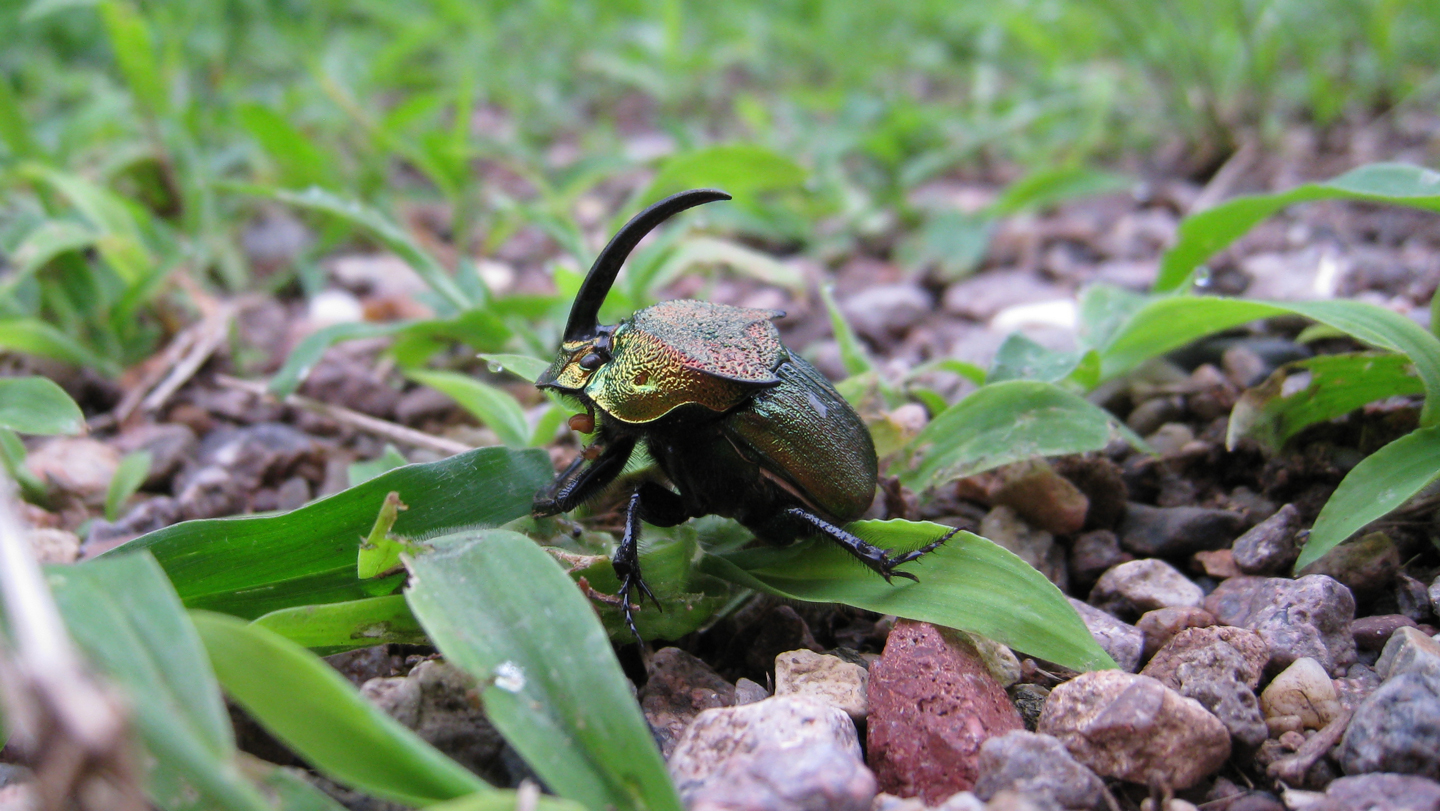
In the face of global warming, some dung beetles may already have a survival strategy.
As temperatures rise, temperate rainbow scarabs bury their dung deeper, keeping developing young inside dung cool enough to survive, ecologist Kimberly Sheldon reported January 6 at a meeting of the Society for Integrative and Comparative Biology in Portland, Ore. Preliminary field experiments show that their tropical cousins lack this behavioral flexibility and thus might potentially be more vulnerable to climate change.
Rainbow scarabs (Phanaeus vindex) are a type of tunneling dung beetle. Rather than roll gigantic dung balls along the ground as incubators for their young, these grape-sized beetles dig tunnels and carry dung below ground before shaping it into a hard ball and laying one egg inside.
To see whether rainbow scarabs ever take advantage of cooler, more stable temperatures deeper down, Sheldon and her team placed “greenhouses” — plastic cones with a hole at the tip — over buried buckets filled with soil in a field. The cones concentrated the sun’s warmth, raising the temperature inside about 2 degrees Celsius above ambient. Beetles under cones were warmer than those in buckets without cones but, thanks to the hole, still experienced weather fluctuations.
Sheldon — of the University of Tennessee, Knoxville — began this work more than six years ago. She had previously found that, compared with dung beetles not living under greenhouses, the females buried their eggs an average of five centimeters deeper — about 21 centimeters from the surface, lowering the incubating temperature about 1 degree. But because floods destroyed the study site,she didn’t no if the behavior helped the insects survive.
In 2023, her team repeated the experiment. Despite the heat, just as many young emerged as adults from the deeper dung balls as young buried less deep in the cooler buckets, Sheldon reported at the meeting.
Others have discovered that some sweat bees and tree frogs may be coping with climate change by changing their behavior. But not all animals seem so predisposed, not even close relatives of this beetle. In similar experiments, Sheldon’s team tested a tropical cousin (Oyxternon silenus) in Ecuador. These beetles did not change the depth of their dung balls despite the simulated global warming.It’s not yet clear if, or how, that affected the eggs.
Tropical climates tend to be less variable than temperate ones, which means ther’s been no evolutionary pressure on this beetle to be flexible. So their ability to beat the heat “is concerning,” Sheldon says.