
Los Angeles Considers Delaying Landmark Housing Bill Implementation Through Upzoning Measures
Los Angeles city officials are weighing options to potentially delay the full implementation of Senate Bill 79 (SB 79), a landmark California law aimed at streamlining housing development, particularly near public transit. The debate centers on a plan developed by the city’s Planning Department to utilize local zoning adjustments – specifically, upzoning – to postpone the bill’s effects until 2030. This move comes after the Los Angeles City Council directed the department in November 2025 to explore ways to mitigate the immediate impacts of the legislation, which Governor Gavin Newsom signed into law last year. NBC Los Angeles reported on the ongoing discussions.
SB 79 aims to increase housing density near transit corridors throughout California, potentially allowing for the construction of more apartments and condominiums in areas previously zoned for single-family homes. The law’s proponents argue it’s a crucial step towards addressing the state’s severe housing shortage and affordability crisis. However, some local leaders in Los Angeles express concerns about the potential impacts on neighborhood character, infrastructure capacity, and existing zoning regulations. The proposed delay tactics are intended to allow the city more time to prepare for and manage these changes.
Potential Delays and Transit Oriented Development Zones
According to the Planning Department’s report, Los Angeles has over 100 designated transit-oriented development (TOD) zones centered around bus and rail stops. A review conducted with the consulting firm Psomas suggests the city could delay the implementation of SB 79 for up to 88 percent of these eligible sites until 2030. This delay would be contingent on meeting specific criteria, including potential impacts from climate change, location within areas designated as having limited opportunity, and the preservation of historic resources. Crucially, a zone would qualify for a delay if at least 33 percent of its sites already permit half the density allowed under SB 79, and the entire station area provides at least 75 percent of the capacity the bill would enable.
However, certain transit hubs would be ineligible for the delay. These are primarily located in the San Fernando Valley and the Westside of Los Angeles, and include stops along the G Line (Tampa, Woodman, Valley College, Sepulveda, Reseda, Pierce College, Balboa), the E Line (Westwood/Rancho Park, Expo/Sepulveda), the Glendale Metrolink station, the K Line (Westchester/Veterans, and stops along the La Brea Avenue alignment of its proposed northern extension). These areas are considered prime locations for increased housing density under SB 79, and a delay would be more difficult to justify.
Upzoning as a Citywide Delay Strategy
Beyond the zone-by-zone approach, the Planning Department has outlined three options for potentially delaying SB 79’s implementation citywide through strategic upzoning. Each option centers on permitting the redevelopment of single-family homes, a concept initially proposed within the Citywide Housing Incentive Program (CHIP) but later removed due to political opposition. The focus is on 55 “opportunity stations” located in census tracts identified by the California Tax Credit Allocation Committee as having higher opportunity levels – areas with access to better schools, jobs, and amenities.
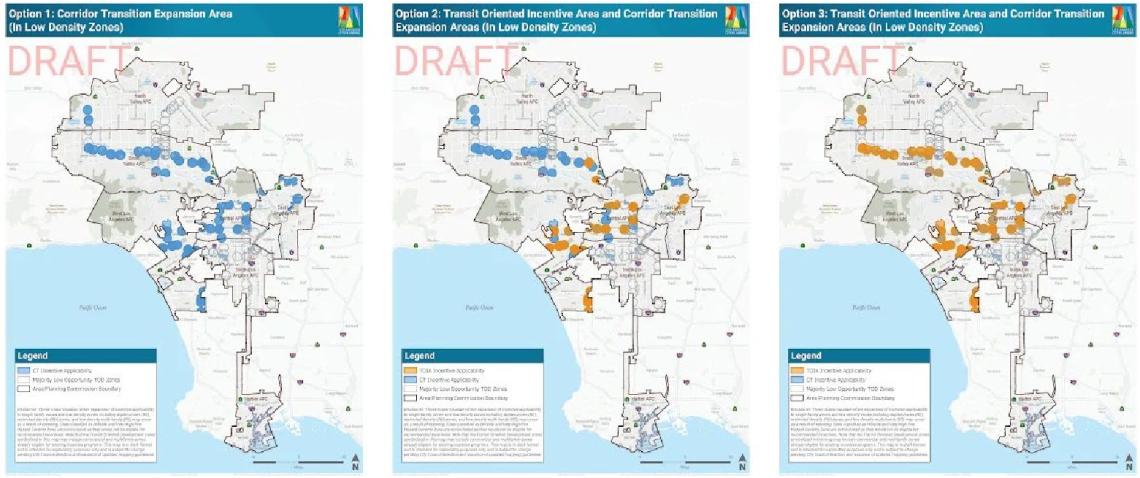
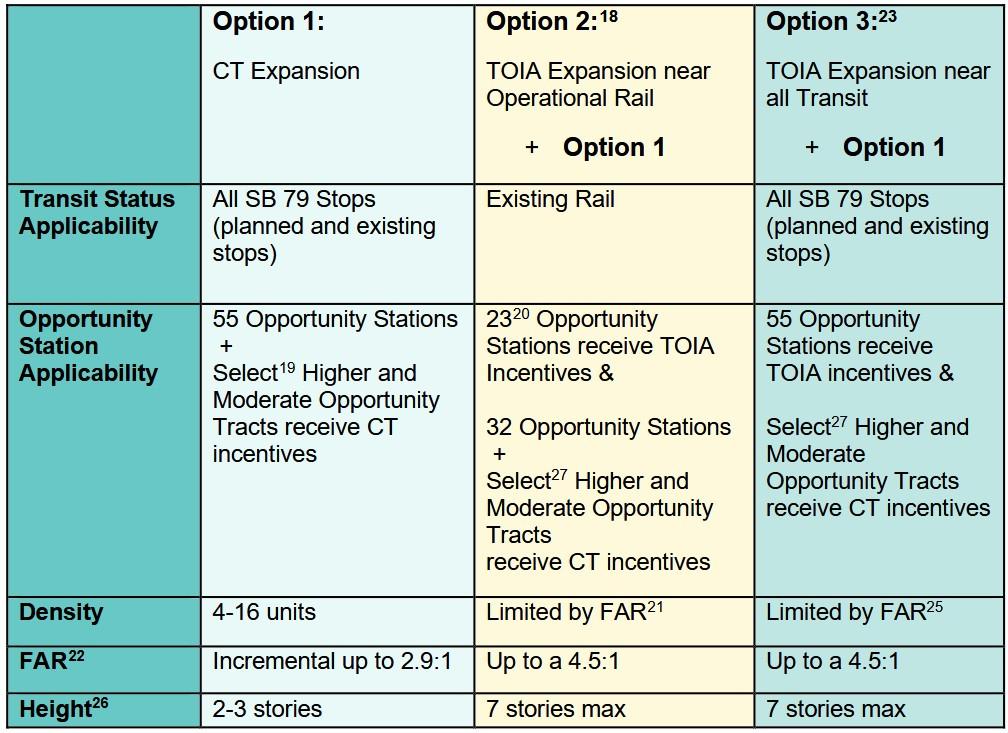
Option 1 proposes extending the CHIP’s Corridor Transition incentives to single-family and low-density zones near these 55 stations, located in parts of Central and West Los Angeles, the South Valley, and the Eastside. Even as this would delay SB 79’s effect, the Planning Department acknowledges that further rezoning would likely be necessary to fully comply with the bill’s regulations in the future. Option 2 builds on this by also expanding Transit Oriented Incentive Area (TOIA) benefits to sites near existing rail lines, but excluding bus rapid transit stops and planned routes. This would concentrate higher-density incentives near rail corridors in Central Los Angeles, with more modest incentives in the South Valley, Northeast Los Angeles, and parts of the Westside.
The most aggressive option, Option 3, combines Option 1 with an expansion of TOIA incentives to all single-family and lower-density parcels near all 5 opportunity station sites. All three options require approval of a code amendment by the City Council and updates to the CHIP ordinance. The incentives offered under each option vary in scope and intensity, as detailed in the Planning Department’s report.
Broader Implications and Potential Legislative Changes
Los Angeles is not alone in grappling with the implementation of SB 79. Neighboring cities, such as Beverly Hills, are also exploring strategies to navigate the new regulations. CalMatters reports that many jurisdictions are struggling to understand how to best implement the law through a local alternative plan. Recognizing the challenges, state legislators have recently indicated a willingness to consider delaying the implementation deadline to provide cities with more time to prepare. Senate Bill 908 (SB 908) has been introduced to address this issue, potentially pushing the effective date of SB 79 back.
The debate over SB 79’s implementation in Los Angeles highlights the complex interplay between state mandates and local control in addressing California’s housing crisis. The city council is expected to further discuss these options in the coming weeks, with a decision anticipated before the summer of 2026, when the law is currently scheduled to take full effect. The next step involves a public hearing where residents and stakeholders can voice their opinions on the proposed plans.
Key Takeaways:
- Los Angeles is considering strategies to delay full implementation of SB 79, a state law aimed at increasing housing density near transit.
- The city is exploring upzoning options near 55 “opportunity stations” as a means of achieving this delay.
- Three potential options have been proposed, ranging in scope and intensity of incentives.
- State legislators are considering a bill (SB 908) to potentially delay the implementation deadline for all jurisdictions.
- A public hearing is scheduled to allow for community input on the proposed plans.
The future of housing development in Los Angeles remains uncertain as these discussions unfold. Stay informed about the latest developments by following updates from the Los Angeles City Planning Department and the California State Legislature. We encourage readers to share their thoughts and perspectives on this important issue in the comments below.