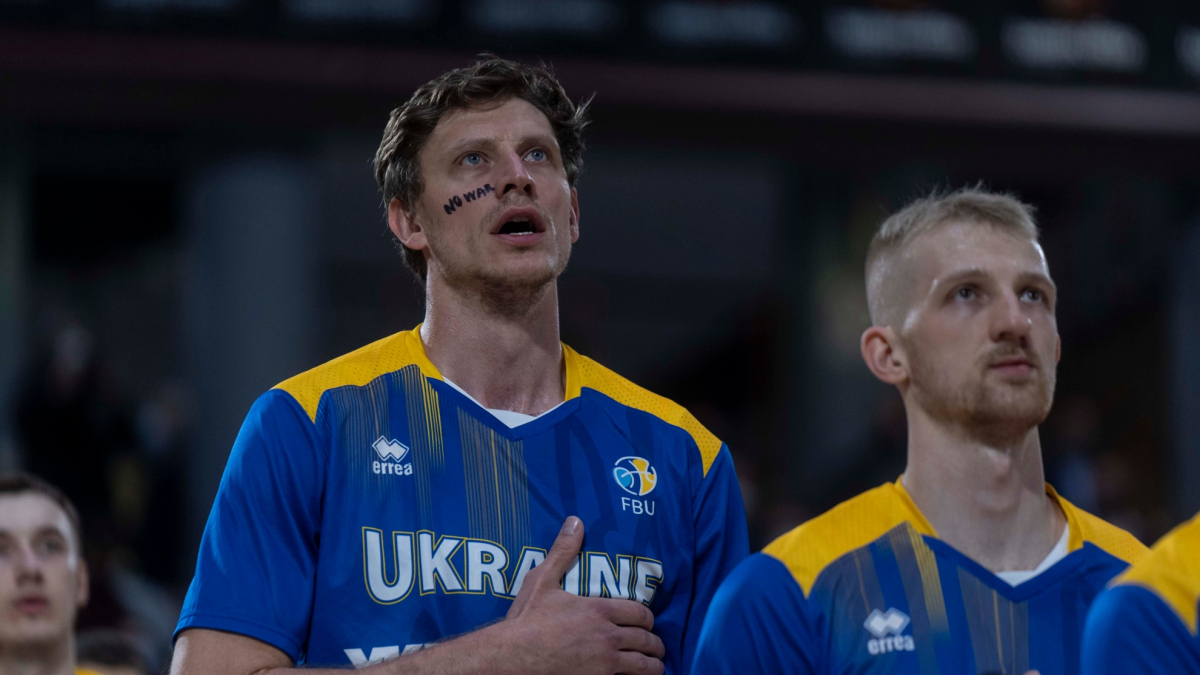
Riga, Latvia – The echoes of war reverberate far beyond the battlefields of Ukraine, reaching even the basketball courts where its national team continues to compete. For Artem Pustovyi, a center for Morabanc Andorra and a key player for Ukraine, each game is played under the shadow of a conflict that has uprooted lives and forced a nation to fight for its survival. The ongoing Russian invasion, now well into its third year, has transformed Ukrainian athletes into symbols of resilience, carrying the weight of a nation’s hopes on their shoulders whereas grappling with the constant worry for family and friends back home. Ukraine’s basketball program, like many of its sporting institutions, has been forced to adapt, playing “home” games in locations across Europe, including Riga, as they continue their pursuit of qualification for international tournaments.
Pustovyi, 33, embodies this duality. With a distinguished career in the Spanish Liga ACB – having played for Obradoiro, Barça, Gran Canaria, Joventut, and Murcia – he brings a wealth of experience to the Ukrainian national team. But his professional life is inextricably linked to the personal anguish of the war. The invasion began on February 24, 2022, a date that holds particular significance as it was the day before a scheduled game against Spain, then coached by Chus Mateo, now leading Real Madrid. The disruption was immediate and profound, forcing a shift in focus from athletic competition to the stark realities of a nation under attack. The emotional toll is immense, a constant undercurrent in every practice, every game, and every interaction with teammates.
The situation is deeply personal for Pustovyi. A close friend, Andrii Popovych, whom he knew since childhood, is now fighting in the Ukrainian army. “It’s difficult given that the situation is distressing,” Pustovyi shared, reflecting the shared anxiety within the team. “Many times not knowing what may be happening to your friends and family is difficult to handle even if you are a professional.” His mother remains in Ukraine, and while he occasionally brings her to Spain for respite, the constant threat to her safety weighs heavily on him. This isn’t an isolated experience. several members of the Ukrainian national team are navigating similar circumstances. Ivan Tkachenko, the team’s starting shooting guard, has an uncle currently engaged in combat, living with the constant fear of a phone call bearing devastating news. Even the younger players feel the impact; Maxim Klitschko, a promising 2.16m (7’1”) prospect, watches as his father, Vitali Klitschko, serves as the mayor of Kyiv, a city repeatedly targeted by Russian forces. Kyiv City Administration
The Weight of Representation: Playing for More Than a Game
The Ukrainian national basketball team’s journey is more than just a sporting endeavor; it’s a powerful statement of national identity and resistance. The team’s continued participation in international competitions, despite the immense challenges, serves as a beacon of hope for a nation under siege. This sense of purpose is a double-edged sword, adding pressure to an already demanding profession. While the team has found a degree of normalcy in playing matches, the underlying anxiety remains palpable. Ukraine has played 14 official matches since the full-scale invasion began, a testament to their commitment despite the circumstances. The team’s base for many of these games has become the Xiaomi Arena in Riga, Latvia, a venue that has hosted the final phase of the EuroBasket tournament. Their record in Riga stands at five wins – against Slovakia, Switzerland, Georgia, the Netherlands, and Denmark – and three defeats (Slovenia, Israel, and Spain in July 2022).
The emotional connection to home is a driving force. Pustovyi expressed a longing to play in Kyiv, with the support of his countrymen, but acknowledges the impossibility of that dream in the current climate. “It would be a dream to play in Kyiv with our people, but it is impossible,” he said. However, the team finds strength in unity, drawing motivation from the resilience of Ukrainian society and the unwavering commitment to resistance. This spirit echoes the powerful display of solidarity seen at the Winter Olympics, where Ukrainian athlete Vladyslav Heraskevych honored fallen compatriots, a gesture that, while initially met with scrutiny from the International Olympic Committee, resonated deeply with the global community. Olympics.com report on Heraskevych’s tribute
Navigating Qualification and Facing Familiar Foes
Currently, Ukraine is competing in the qualification rounds for the 2027 FIBA World Cup. They recently secured victories against Denmark and Georgia in Tbilisi, positioning them favorably in Group A. The upcoming matches against Spain hold particular significance. Pustovyi acknowledges the challenge posed by the Spanish team, noting their ongoing rebuild under a new coach and the influx of young talent. “It is always special to play against Spain. It is a new group, with a lot of energy, with young players. It is a team that is being renewed with a new coach. It will be difficult,” he stated. Spain, a perennial powerhouse in international basketball, presents a formidable test for the Ukrainian squad.
The team’s performance in Riga has been a source of pride, providing a temporary haven and a platform to represent their nation on the international stage. The Xiaomi Arena, with a capacity of around 7,000, offers a semblance of a home atmosphere, even though it’s a long way from Kyiv. The ability to continue competing, to maintain a sense of normalcy amidst the chaos, is a testament to the dedication of the players and the support of the Ukrainian basketball federation. The federation continues to perform tirelessly to ensure the team has the resources and support it needs to compete at the highest level, despite the logistical and emotional challenges.
The Broader Impact: Sports as a Symbol of National Resilience
The story of Ukrainian basketball during wartime is emblematic of the broader impact of the conflict on the nation’s sporting landscape. From football to athletics, Ukrainian athletes are facing unprecedented challenges, yet they continue to compete, representing their country with unwavering determination. This resilience has garnered international admiration and support, with many sporting organizations offering assistance and solidarity. The Ukrainian government has recognized the importance of sports as a tool for national unity and morale, providing support to athletes and teams competing abroad.
The conflict has as well sparked a debate about the role of sports in times of political crisis. The International Olympic Committee’s initial reluctance to impose a blanket ban on Russian and Belarusian athletes drew criticism from many quarters, with some arguing that allowing their participation would legitimize the actions of the Russian government. The IOC opted for a more nuanced approach, allowing athletes from those countries to compete under a neutral flag, a decision that remains controversial. IOC statement on Russian and Belarusian athletes The situation highlights the complex intersection of sports and politics, and the challenges of maintaining neutrality in the face of geopolitical conflict.
The Ukrainian basketball team’s journey is far from over. As they continue their quest for World Cup qualification, they carry with them the hopes and dreams of a nation yearning for peace. Their story is a powerful reminder of the resilience of the human spirit and the enduring power of sports to unite and inspire, even in the darkest of times. The next step in their qualification journey will be crucial, with upcoming matches likely to determine their fate.
Key Takeaways:
- The Russian invasion of Ukraine has profoundly impacted Ukrainian athletes, forcing them to balance athletic competition with the anxieties of war.
- Artem Pustovyi and his teammates represent a nation’s resilience, playing international games while worrying about family and friends back home.
- Ukraine’s basketball program has adapted to the conflict, playing “home” games in Riga, Latvia, and continuing to compete in qualifying tournaments.
- The team’s performance serves as a symbol of national unity and resistance, inspiring hope amidst the ongoing crisis.
We encourage you to share this story and join the conversation. What are your thoughts on the challenges faced by Ukrainian athletes? Abandon a comment below and let us know.
Worth a look