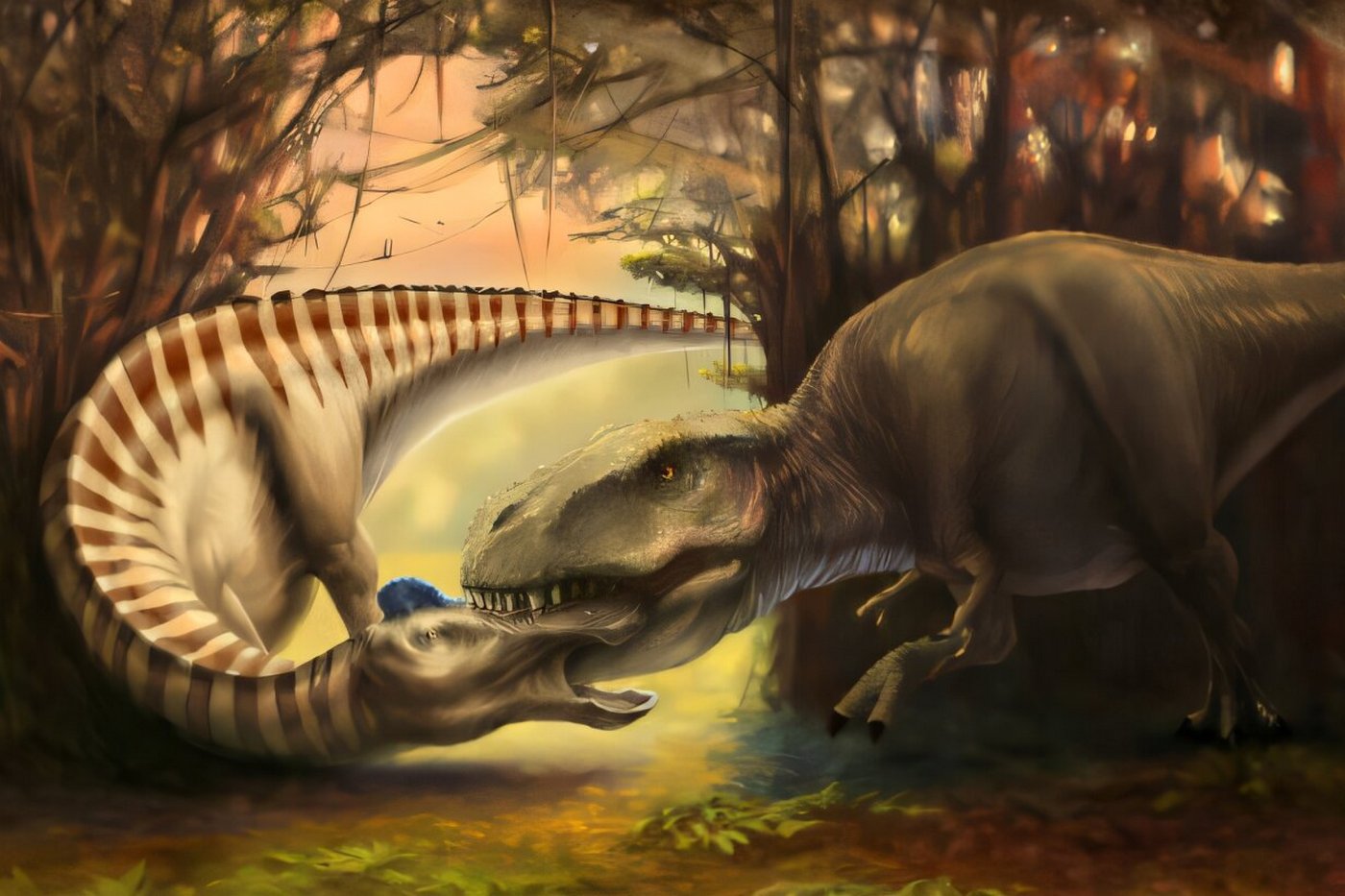
Face to Face with Tyrannosaurus Rex: Montana Fossil Reconstructs Ancient Dinosaur Battle
Sixty-six million years ago, at the very finish of the age of dinosaurs, a brutal clash unfolded between two giants in what is now Montana. This dramatic encounter isn’t just a paleontological theory; it’s a scene brought to life by an extraordinarily rare fossil discovery: a tooth from a carnivorous dinosaur firmly embedded in the skull of its prey. The find offers unprecedented insight into the predatory behavior of Tyrannosaurus rex, revealing a face-to-face attack that likely sealed the fate of a large herbivore.
The fossilized skull, belonging to a hadrosaur – a duck-billed dinosaur of the genus Edmontosaurus – was initially discovered in 2005 within the Hell Creek Formation, a world-renowned dinosaur fossil site. However, it wasn’t until recent, more detailed analysis that the remarkable detail emerged: a foreign tooth lodged firmly within the bones of the snout. This discovery, published in the journal PeerJ, provides direct evidence of a predatory attack and allows scientists to identify both the victim and the aggressor with remarkable precision.
Even as bite marks are commonly found on dinosaur bones, finding an attacker’s tooth still embedded in the skull is exceptionally rare. Researchers, led by Dr. Taia C.A. Wyenberg-Henzler, were able to definitively identify the tooth as belonging to a Tyrannosaurus rex by comparing its structure to other carnivorous dinosaurs from the same period. The study details the meticulous process of analysis and comparison that led to this conclusion.
A Frontal Assault
X-ray imaging of the skull revealed that the tooth penetrated the front portion of the snout. This positioning strongly suggests the attack occurred “face to face,” rather than from behind or while scavenging a carcass. This challenges some previous assumptions about T. Rex hunting strategies, which sometimes depicted the predator as primarily an opportunistic scavenger. The angle of the tooth indicates a deliberate, forceful attack aimed at a living target. The Hell Creek Formation, known for its rich dinosaur fossils, continues to yield crucial insights into the Cretaceous period.
The Force of a Tyrannosaur Bite
The way the tooth became lodged in the bone speaks to the immense bite force of Tyrannosaurus rex. For the tooth to have broken off and remained embedded, the predator would have had to exert extreme pressure – characteristic of an active, lethal attack. Scientists estimate that T. Rex possessed one of the strongest bite forces of any terrestrial animal that has ever lived, capable of generating up to 12,800 pounds of force. Montana State University reports on the significance of this finding in understanding the mechanics of this powerful bite.
Notably, the skull shows no signs of healing around the wound. This suggests two possible scenarios: either the Edmontosaurus was already deceased when the T. Rex attacked, or the bite itself was immediately fatal. Paleontologists currently favor the interpretation of a dynamic struggle, with the bite potentially serving as a means for the predator to maintain control over the thrashing prey – a tactic employed by many modern large predators.
Reconstructing the Final Moments
This fossil provides a rare snapshot of a predator-prey interaction, offering a glimpse into the violent world of the late Cretaceous period. The discovery is particularly valuable because it’s not just about identifying the species involved; it’s about understanding *how* the interaction occurred. Popular Science highlights the importance of this find in reconstructing the final moments of the Edmontosaurus’s life.
The Edmontosaurus was a large herbivore, reaching lengths of up to 40 feet and weighing several tons. It was a common inhabitant of the Hell Creek Formation alongside T. Rex, making it a likely target for the apex predator. The Hell Creek Formation, spanning parts of Montana, North Dakota, South Dakota, and Wyoming, is renowned for its exceptionally well-preserved dinosaur fossils, providing a wealth of information about the ecosystem that existed just before the Cretaceous-Paleogene extinction event.
The Significance of Rare Finds
Fossils like this are incredibly valuable to paleontologists. They don’t just reveal the physical form of extinct animals, but too provide clues about their behavior. In this case, it’s a direct record of an interaction between two specific individuals. Such discoveries help refine our understanding of how Tyrannosaurus rex hunted and the strategies it employed when battling large prey. The fossilized tooth in the herbivore’s skull is more than just a curiosity; it’s a chilling record of the last seconds of one dinosaur’s life, and a reminder that even after tens of millions of years, fossilized bones can tell stories of violence, survival, and the harsh rules of an ancient world.
Key Takeaways
- A Tyrannosaurus rex tooth found embedded in an Edmontosaurus skull provides direct evidence of a predatory attack.
- The tooth’s position suggests a “face-to-face” attack, challenging previous assumptions about T. Rex hunting strategies.
- The discovery highlights the immense bite force of T. Rex and its ability to inflict fatal wounds.
- The Hell Creek Formation continues to be a crucial site for paleontological discoveries, offering insights into the late Cretaceous period.
Researchers will continue to analyze the fossil, hoping to glean even more information about the dynamics of this ancient encounter. Further studies may involve detailed biomechanical modeling to reconstruct the forces involved in the bite and the potential impact on the Edmontosaurus. The Museum of the Rockies at Montana State University, where the fossil is housed, plans to feature the specimen in future exhibits, allowing the public to witness this remarkable piece of paleontological history. For updates on the research and exhibits, visit the Museum of the Rockies website.
As paleontological research continues, we can expect further discoveries that will refine our understanding of these magnificent creatures and the world they inhabited. Share your thoughts on this incredible find in the comments below, and be sure to share this article with fellow dinosaur enthusiasts!