James Webb Telescope Reveals Surprisingly Mature Galaxy in Early Universe
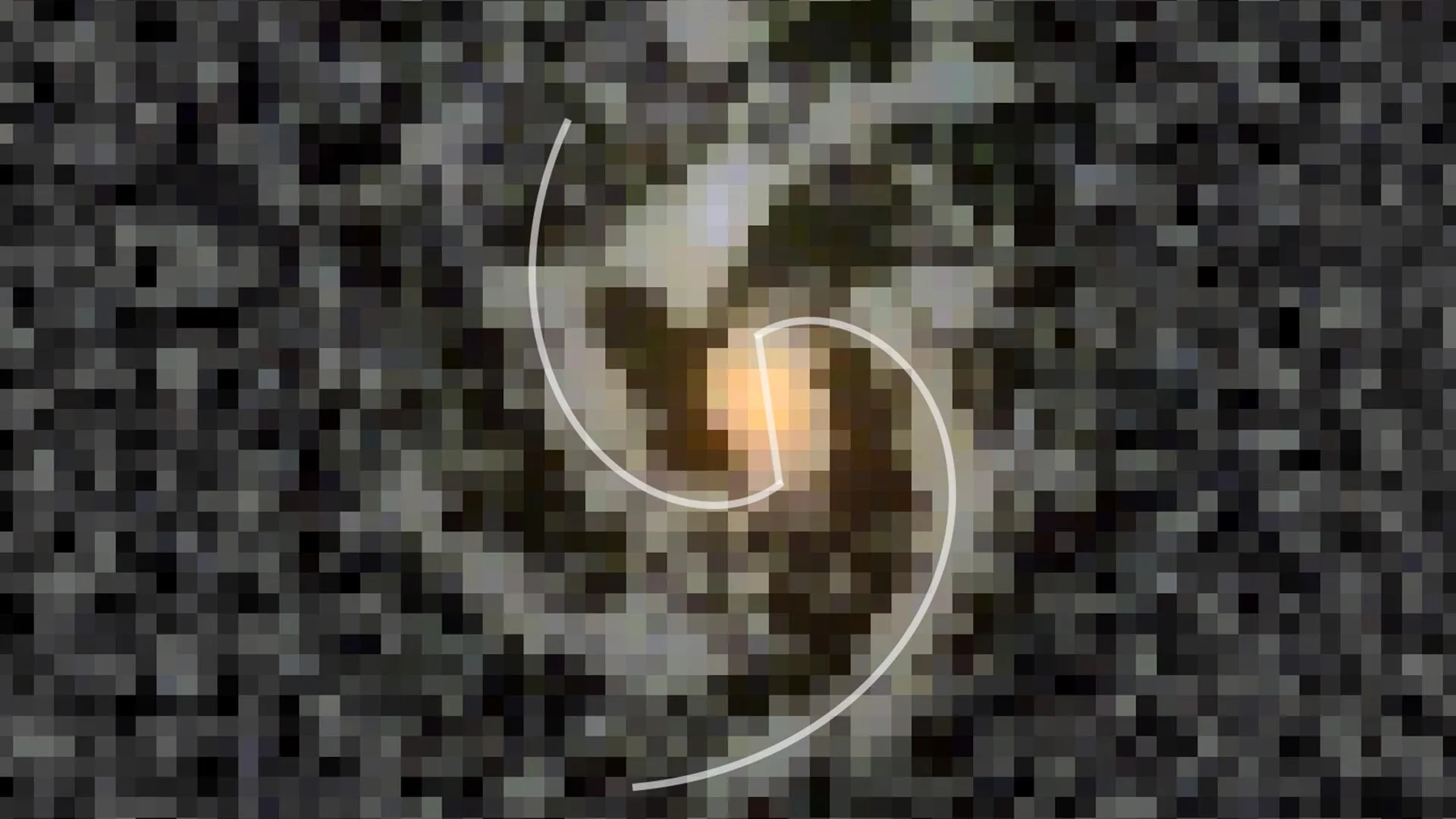
In a discovery that challenges existing models of galactic evolution, astronomers have identified a remarkably well-developed barred spiral galaxy, designated COSMOS-74706, that existed just two billion years after the Big Bang. This finding, made possible by observations from the James Webb Space Telescope (JWST), suggests that the processes leading to the formation of complex galactic structures began much earlier in the universe’s history than previously thought. The presence of a stellar bar – a prominent feature found in our own Milky Way – in such an early galaxy provides crucial insights into how galaxies grow and change over cosmic time. This discovery is reshaping our understanding of early galaxy formation and the conditions that allowed for the rapid development of these structures.
The research, led by Daniel Ivanov, a physics and astronomy graduate student at the University of Pittsburgh, centers on COSMOS-74706, a galaxy dating back approximately 11.5 billion years. Analyzing the light emitted from this distant object allowed the team to pinpoint its place in cosmic history and determine the timing of the formation of its barred structure. The team’s findings were presented at the 247th meeting of the American Astronomical Society, sparking considerable excitement within the astrophysics community. The confirmation of a barred spiral at this early epoch is particularly significant because stellar bars are known to play a critical role in channeling gas towards a galaxy’s center, influencing star formation and potentially fueling supermassive black holes.
The universe’s age is currently estimated to be 13.8 billion years, meaning COSMOS-74706 emerged when the universe was only about 20% of its current age. This early appearance of a barred spiral galaxy forces scientists to reconsider the timeline for galactic development. Previous observations had hinted at the possibility of early barred spirals, but these were often based on less precise measurements or were affected by gravitational lensing – the bending of light by massive objects – which can distort images. COSMOS-74706, but, was confirmed through spectroscopy, a technique that provides more reliable distance data, and is not significantly affected by lensing, making it a particularly robust finding.
What is a Stellar Bar?
A stellar bar is a bright, elongated structure composed of stars and gas that stretches across the central region of a spiral galaxy. As Ivanov explained, “A stellar bar is a linear feature at the center of the galaxy.” These bars aren’t individual objects but rather dense concentrations of matter aligned in a way that creates a bright line when viewed from above or below the galactic disk. ScienceDaily explains that these structures are more than just visually striking; they actively shape a galaxy’s evolution.
The presence of a stellar bar influences the movement of stars and gas within a galaxy. It acts as a kind of cosmic traffic controller, channeling material from the outer regions inward. This inward flow of gas can have several important consequences. First, it can deliver fuel to the supermassive black hole residing at the galaxy’s core, potentially triggering periods of intense activity. Second, it can compress gas clouds, promoting the formation of new stars. However, it can also suppress star formation in certain regions by disrupting gas clouds. Understanding the dynamics of stellar bars is therefore crucial for understanding the overall evolution of spiral galaxies.
Why This Discovery Matters
The discovery of COSMOS-74706 is significant for several reasons. Firstly, it provides the most spectroscopically confirmed example of a barred spiral galaxy at such a high redshift – a measure of how much the light from an object has been stretched due to the expansion of the universe, and thus its distance and age. Ivanov emphasized that this is “the highest redshift, spectroscopically confirmed, unlensed barred spiral galaxy.” Previous claims of early barred spirals were often less certain due to limitations in observational data. Phys.org highlights the galaxy’s prominent spiral arms and prospective central bar structure, showcasing the clarity of the JWST’s observations.
Secondly, the existence of a barred spiral so early in the universe challenges theoretical models of galaxy formation. Computer simulations have suggested that stellar bars could begin to form at redshifts around 5, or roughly 12.5 billion years ago. However, these simulations also predict that such objects should be relatively rare at that stage of cosmic history. The discovery of COSMOS-74706 suggests that the conditions necessary for bar formation may have been more common, or may have arisen more quickly, than previously believed. This finding will prompt astronomers to refine their models and explore new scenarios for early galaxy evolution.
Thirdly, the discovery underscores the power of the James Webb Space Telescope. The JWST’s advanced capabilities, particularly its ability to observe infrared light, allow it to peer through dust clouds and detect faint objects at enormous distances. The data used to identify COSMOS-74706 were obtained through the Space Telescope Science Institute, which operates the JWST under contract with NASA. The project also received support from the Brinson Foundation, demonstrating the collaborative nature of modern astronomical research.
The Role of the James Webb Space Telescope
The James Webb Space Telescope, a joint project of NASA, the European Space Agency (ESA), and the Canadian Space Agency (CSA), has revolutionized our ability to observe the early universe. Launched in December 2021, the JWST is equipped with a 6.5-meter primary mirror, significantly larger than that of its predecessor, the Hubble Space Telescope. This larger mirror allows the JWST to collect more light, enabling it to detect fainter and more distant objects. The JWST is optimized to observe infrared light, which is less affected by dust and gas than visible light. This makes it ideal for studying the early universe, where galaxies were often shrouded in dust.
The JWST’s observations of COSMOS-74706 were made using several of its key instruments, including the Near Infrared Camera (NIRCam) and the Mid-Infrared Instrument (MIRI). These instruments allowed the team to map the distribution of stars and gas within the galaxy and to identify the telltale signs of a stellar bar. The high resolution of the JWST’s images also allowed the researchers to study the detailed structure of the galaxy and to determine its redshift with unprecedented accuracy. The success of this research highlights the transformative potential of the JWST for advancing our understanding of the cosmos.
Daniel Ivanov, who began his research at the University of Massachusetts Amherst under the guidance of Professor Mauro Giavalisco, and continued at the University of Pittsburgh, played a pivotal role in this discovery. His perform builds upon years of research into the formation and evolution of galaxies. The team’s findings not only provide new insights into the early universe but also pave the way for future investigations of similar objects. As the JWST continues to collect data, astronomers expect to uncover even more surprises about the origins and development of galaxies.
Key Takeaways
- Astronomers have discovered a barred spiral galaxy, COSMOS-74706, that existed a mere two billion years after the Big Bang.
- The presence of a stellar bar in this early galaxy challenges existing models of galactic evolution.
- The discovery was made possible by the advanced capabilities of the James Webb Space Telescope.
- This finding suggests that the processes leading to the formation of complex galactic structures began earlier in the universe’s history than previously thought.
Future research will focus on identifying other early barred spiral galaxies and studying their properties in detail. Astronomers will also use computer simulations to explore the conditions that allowed for the formation of these structures so early in the universe. The ongoing observations from the James Webb Space Telescope promise to reveal even more secrets about the cosmos and our place within it. The team plans to continue analyzing data from the JWST and presenting their findings at future scientific conferences.
What are your thoughts on this groundbreaking discovery? Share your comments below and let us know what questions it raises for you. Don’t forget to share this article with your network to spread the word about this exciting advancement in our understanding of the universe.
Keep reading