
The cost of aging continues to rise, placing increasing financial strain on families across the United States. A new report from CareScout, a subsidiary of Genworth Financial, reveals a 3% increase in the national median hourly rate for non-medical home care, reaching $35 per hour. This translates to an annual cost of $80,080, assuming 44 hours of care per week. While the rate of increase has slowed compared to previous years, the financial burden of in-home care remains substantial, particularly as demand for these services grows alongside an aging population. The 2025 Cost of Care Survey, released on March 2, 2026, also marks the first year CareScout has included data on private duty nursing, revealing a national median hourly rate of $90 and a per-visit rate of $160.
The survey, based on data collected from over 25,000 long-term care providers nationwide between July and November 2025, provides a comprehensive appear at the costs associated with various care settings, including assisted living facilities and nursing homes. The findings suggest a period of relative stabilization in many care types, though costs remain high. This detailed analysis is crucial for families navigating the complex landscape of long-term care options and financial planning. Understanding these costs is the first step in securing appropriate care for loved ones while managing financial resources effectively.
Rising Costs of Home Care: A National Trend
The 3% increase in non-medical home care costs aligns with broader economic trends, with inflation averaging 2.7% and wage growth at approximately 2.5% in 2025, according to CareScout. This suggests that rising wages for caregivers are a significant driver of the increased costs. Non-medical home care encompasses a range of services, including assistance with activities of daily living such as bathing, dressing, and meal preparation. As the baby boomer generation ages, the demand for these services is expected to continue to increase, potentially putting further upward pressure on prices. The annual cost of $80,080 for 44 hours of weekly care highlights the significant financial commitment required for many families.
The introduction of private duty nursing data in the 2025 survey provides valuable insight into the costs of skilled nursing care delivered in the home. With a national median hourly rate of $90 and a per-visit rate of $160, private duty nursing represents a more expensive option than non-medical home care, reflecting the specialized skills and training required of registered nurses and licensed practical nurses. This type of care is typically needed for individuals with complex medical conditions who require assistance with medication management, wound care, or other specialized treatments. The availability of this data allows for a more complete understanding of the full spectrum of in-home care costs.
State-by-State Variations and Regional Disparities
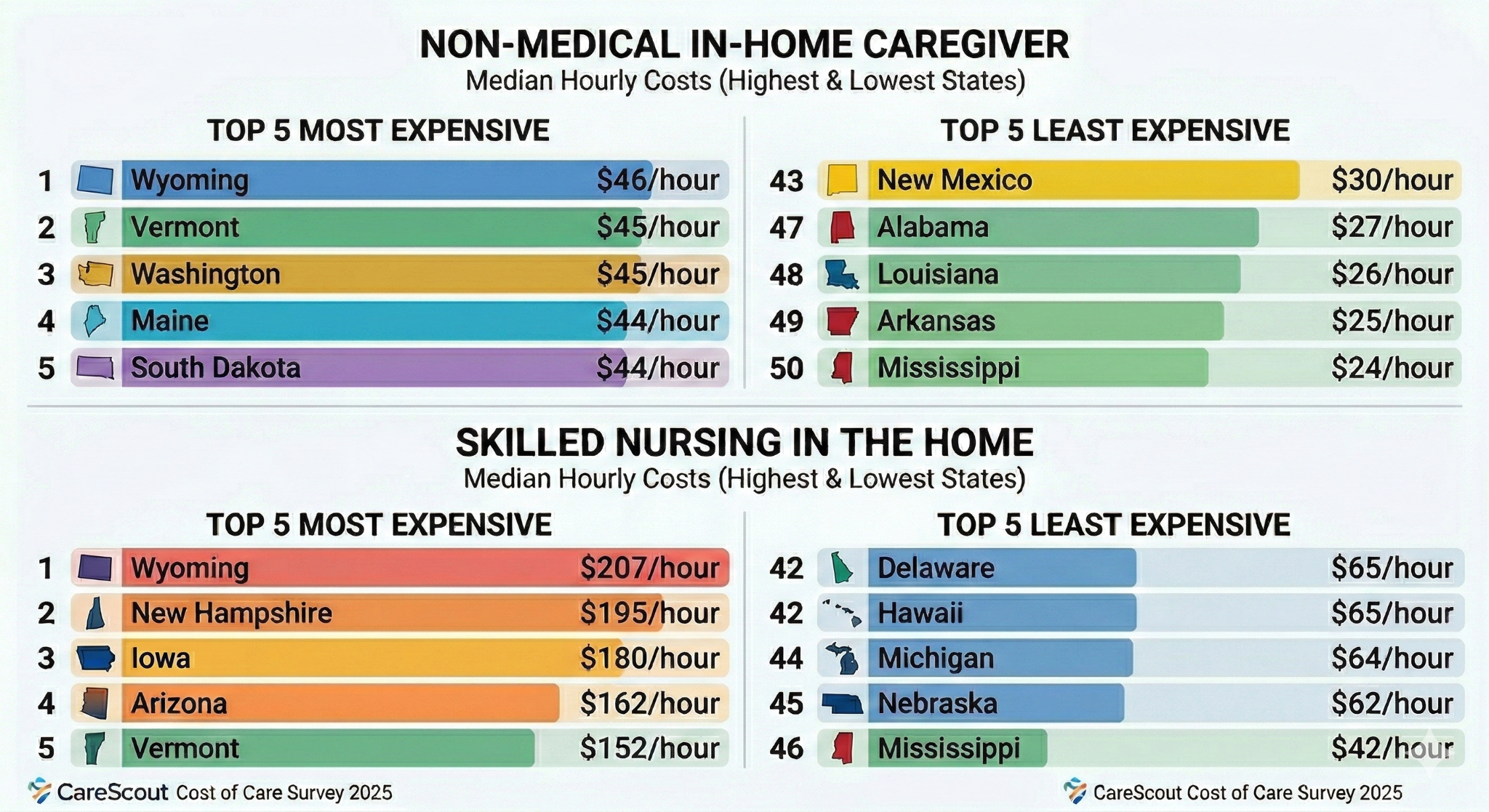
While the CareScout survey provides national averages, costs vary significantly from state to state. Wyoming emerged as the most expensive state for both non-medical home care and private duty nursing. The report did not provide specific cost figures for Wyoming, but indicated it was the highest overall. CareScout noted insufficient data to rank costs in Alaska, Arkansas, Connecticut, and Louisiana for private duty nursing. These regional disparities are influenced by a variety of factors, including the cost of living, labor market conditions, and the availability of qualified caregivers. Understanding these variations is essential for families considering relocating or planning for long-term care in different states.
Other Long-Term Care Costs: Assisted Living and Nursing Homes
The CareScout survey also examined costs for other long-term care settings. The median monthly rate for assisted living increased by 5%, bringing the annual cost to approximately $74,400. Assisted living provides housing, meals, and personal care services for individuals who need assistance with daily activities but do not require the intensive medical care provided in a nursing home. Nursing home care costs also saw increases, with the median daily rate rising by 2% for a semi-private room and 1% for a private room. This translates to annual median costs of $114,975 for a semi-private room and $129,575 for a private room. These figures underscore the significant financial implications of long-term care, particularly for individuals with limited financial resources.
Interestingly, adult day care services bucked the trend of rising costs, with the national median daily rate declining by 5% to $95 per day. Five days of adult day services per week would therefore cost around $24,700 annually. Adult day care provides a supervised setting for seniors who need social interaction and assistance with daily activities during the day, allowing caregivers to perform or attend to other responsibilities. This decline in cost may offer a more affordable option for families seeking part-time care solutions.
Hawaii, Oregon, and Alaska Lead in Costs for Specific Care Types
Beyond Wyoming’s high costs for home care, the survey identified other states with particularly expensive long-term care options. Hawaii had the highest median annual cost for assisted living, reaching $145,065. Oregon was the most expensive state for a private nursing home room, with a median annual cost of $221,372, while Alaska was the most expensive for a semi-private nursing home room, costing $333,975 annually. Montana had the highest median annual cost for adult day services, at $69,395. These state-specific variations highlight the importance of researching costs in your specific location when planning for long-term care.
As families grapple with these rising costs, exploring all available options and resources is crucial. Long-term care insurance, government assistance programs like Medicaid, and financial planning can all play a role in mitigating the financial burden of care. CareScout, a wholly owned subsidiary of Genworth Financial, offers resources and guidance to help families navigate these complex decisions. The company’s 2025 Cost of Care Survey serves as a valuable tool for understanding the current landscape of long-term care costs and making informed choices.
The next update to the CareScout Cost of Care Survey is expected in March 2027, providing an updated snapshot of long-term care costs across the nation. I encourage readers to share their experiences with long-term care costs and planning in the comments below. Your insights can help others navigate this challenging journey.