Seoul, South Korea – A recent decision by the South Korean government has seen over 780 individuals, who previously declined state honors under the previous administration, receive them anew, this time bearing the name of President Lee Jae-myung. The move, stemming from a directive issued by President Lee last year, addresses a situation where hundreds of public servants, educators, and military personnel had refused accolades from the Yoon Suk-yeol administration, citing objections to the former president’s name appearing on the official citations. This development underscores the lingering political sensitivities within South Korea and the symbolic importance attached to state honors.
According to data released by the Ministry of Interior and Safety on March 4, 2026, a total of 7,273 individuals had refrained from accepting decorations between May 2022 – when Yoon Suk-yeol assumed office – and May 2025. Of this number, 781 have now been re-awarded honors after expressing a willingness to accept them under the current administration. The initial refusals were largely attributed to a reluctance to be publicly associated with the then-president, Yoon Suk-yeol, a sentiment that appears to have shifted with the change in leadership. This situation highlights the degree to which political affiliation can influence even seemingly apolitical acts of national recognition.
Reasons for Initial Refusals and Subsequent Re-Awarding
The majority of those who initially declined the honors were educators, with 5,877 teachers choosing not to accept the decorations. This was followed by 1,344 general civil servants and 52 members of the military and civil service. The South Korean government typically bestows honors upon long-serving public officials upon their retirement, provided they have no disciplinary issues. However, the process requires the recipient’s consent. The refusal to accept the honors during the previous administration wasn’t simply about political disagreement. for some, it was a direct protest against the individual whose name would be affixed to the award. Professor Lee Cheol-gi of Dongguk University publicly stated in 2022 that he did not wish to receive an award bearing the name of then-President Yoon Suk-yeol, while Professor Kim Cheol-hong of Incheon University echoed this sentiment in 2024, stating he didn’t want to accept an award from a leader he felt did not represent the nation appropriately.
Following his election, President Lee Jae-myung directed a comprehensive review of these cases during a July 2025 cabinet meeting. He instructed the Ministry of Interior and Safety to investigate the possibility of re-awarding honors to those who had previously declined them. The Ministry subsequently issued a directive to all government departments in August and September 2025, requesting a list of individuals who had previously refused honors and inquiring whether they would be willing to accept them under the current administration. This initiative demonstrates a clear effort by the Lee administration to address perceived grievances and extend recognition to individuals who felt excluded or alienated by the previous government.
Breakdown of Re-Awarded Honors
The response to the Ministry’s inquiry was significant. Of the 5,877 teachers who had initially declined, 1,057 expressed a willingness to accept the honor. Similarly, 172 out of 1,344 civil servants and 18 out of 52 military personnel indicated their desire to be re-awarded. The Ministry then conducted thorough background checks to ensure that none of the individuals had any disciplinary records or pending legal proceedings that would disqualify them. After excluding those with disqualifying factors and those who had withdrawn their consent, a total of 663 teachers, 107 civil servants, and 11 military personnel were confirmed as eligible for re-award. These individuals received their honors in December 2025, coinciding with their retirement ceremonies.
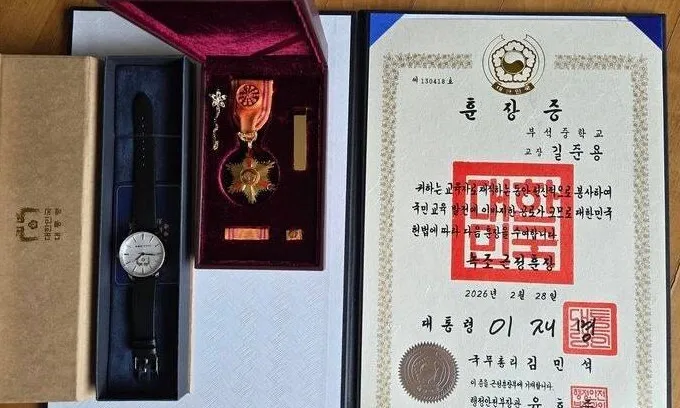
One notable case that garnered public attention was that of Gil Jun-yong, a former principal of Bukseok Middle School in Seosan. Gil had previously refused the Geunjeong Medal – a South Korean order of merit – during his retirement in 2023, reportedly due to his objection to President Yoon’s name being on the certificate. On February 28, 2026, Gil announced on social media that he had received the same medal from the Chungcheongnam-do Office of Education, but this time bearing the signature of President Lee Jae-myung. He shared a photograph of the certificate, stating, “Receiving a certificate with President Lee Jae-myung’s name instead of President Yoon Suk-yeol’s fills me with mixed emotions.” This case became a symbol of the broader trend of individuals reconsidering their stance on state honors following the change in administration.
The Geunjeong Medal and its Significance
The Geunjeong Medal is a South Korean decoration awarded to individuals who have made significant contributions to the nation in various fields, including public service, education, and the military. The South Korean orders and decorations system is structured to recognize both civilian and military achievements, with the Geunjeong Medal representing a high level of recognition for dedicated service. The medal is typically awarded to individuals upon their retirement, serving as a formal acknowledgment of their years of commitment and contribution to the country. The symbolic weight of the medal is amplified by the inclusion of the president’s signature on the certificate, making it a deeply personal and politically charged honor for some.
Political Implications and Public Reaction
The re-awarding of honors has sparked debate within South Korea, with critics accusing the Lee administration of politicizing state decorations. Some argue that the move is a thinly veiled attempt to reward supporters and punish those who were perceived as being aligned with the previous government. However, supporters of the administration contend that it is simply fulfilling a promise to address the concerns of individuals who felt unfairly treated under the previous leadership. The incident underscores the deep political divisions that continue to characterize South Korean society and the challenges faced by successive administrations in navigating these sensitivities.
The case also raises questions about the role of the president in the awarding of honors and the extent to which personal political beliefs should influence such decisions. While the president’s signature is a traditional element of the award, the recent events have highlighted the potential for this to become a source of controversy. The Lee administration’s decision to proactively address the concerns of those who had previously refused honors suggests a desire to foster a more inclusive and conciliatory approach to national recognition. However, it remains to be seen whether this approach will be successful in bridging the political divide and restoring trust in the integrity of the awards system.
Looking ahead, the Ministry of Interior and Safety is expected to continue monitoring the situation and addressing any further requests for re-consideration of honors. The government has not indicated any plans to revisit the awards of individuals who did not express a desire to be re-awarded. The long-term impact of this episode on the perception of state honors in South Korea remains to be seen, but it is likely to be a topic of ongoing discussion and debate for some time to approach. The incident serves as a reminder of the complex interplay between politics, symbolism, and national recognition in a deeply polarized society.
What are your thoughts on the re-awarding of these honors? Share your opinions in the comments below, and please share this article with your network to continue the conversation.
Related reading
- OM Nîmes 2-1 : Marseille s’impose en amical
- Pima County Law Enforcement Investigation: Retired SWAT Commander Explains 6-Month Frustration
- Korean Youth Delays 500M Won Lottery Claim to Pass Public Housing Asset Screening (archynewsy.com)
- Phil Foden signs new Man City deal and pledges fresh start under Enzo Maresca (time.news)