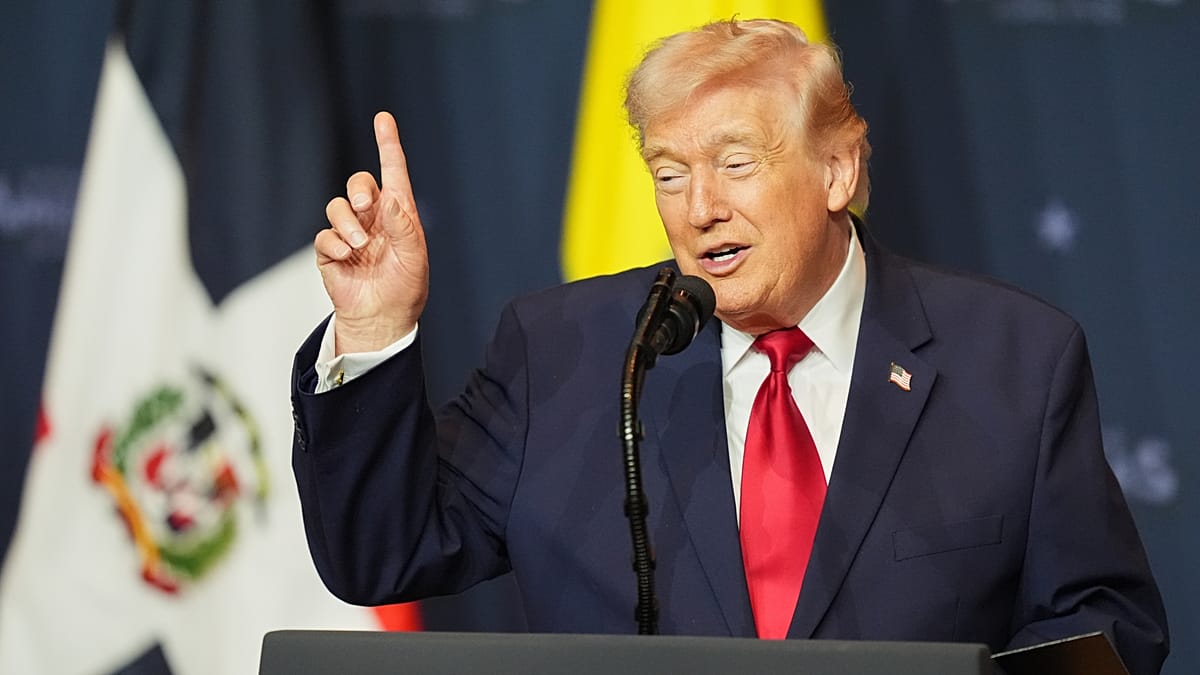
Trump Announces New Security Alliance for the Americas, Signals Hard Line on Cuba and Venezuela
Miami, Florida – In a display of assertive foreign policy, former President Donald Trump unveiled a new security initiative dubbed the “Shield of Americas” at a meeting held Saturday at Trump National Doral Miami. The gathering brought together leaders from 14 countries in the region, signaling a renewed US focus on security concerns and a willingness to take decisive action against perceived threats. The announcement comes amid escalating tensions in the Middle East and ongoing challenges related to drug trafficking and regional instability. The initiative’s core aim, according to Trump, is to dismantle powerful cartels operating throughout the Western Hemisphere, a pledge met with both support and skepticism from international observers.
The meeting, attended by figures such as Argentinian President Javier Milei, El Salvador’s President Nayib Bukele and Chile’s President-elect José Antonio Kast, alongside leaders from Ecuador, Paraguay, Honduras, and the Dominican Republic, underscored a shift in regional dynamics. Notably absent was Mexican President Claudia Sheinbaum, a decision Trump attributed to her administration’s rejection of US assistance in combating drug cartels. This exclusion highlights a potential fracture in US-Mexico relations and a willingness by the Trump administration to pursue unilateral or multilateral action without the cooperation of key partners. The former president stated that seventeen nations have now formally joined the alliance, committing to a joint effort to combat transnational criminal organizations.
The “Shield of Americas” alliance is built on a commitment to “employ lethal military force to destroy sinister cartels and terrorist networks,” Trump declared. This aggressive stance represents a significant departure from traditional counter-narcotics strategies, which have largely focused on law enforcement and interdiction efforts. The alliance’s formation raises complex legal and ethical questions regarding the use of military force within sovereign nations and the potential for unintended consequences. The Trump National Doral Miami is also slated to host the G20 summit later this year, further cementing the location’s role as a hub for international diplomacy under the current administration.
Focus on Cuba: “Last Moments” and Potential Intervention
Beyond the broader security alliance, Trump devoted a substantial portion of his address to the situation in Cuba, making the startling claim that the island nation is in its “last moments.” He revealed that he is engaged in direct negotiations with Havana, facilitated by Cuban-born Secretary of State Marco Rubio, and expressed optimism that an agreement could be reached “very easily.” The nature of these negotiations remains unclear, but Trump did not rule out a “friendly takeover” of the island, a statement that is likely to escalate tensions with the Cuban government and raise concerns among international actors. The United States has maintained a complex relationship with Cuba for decades, marked by periods of embargo and limited engagement. ABC News reported on Trump’s warnings regarding Cuba.
The possibility of US intervention in Cuba, even under the guise of a “friendly takeover,” would likely be met with strong condemnation from regional partners and international organizations. The historical precedent of US involvement in Latin America is fraught with controversy, and any attempt to exert direct control over Cuba would likely be viewed as a violation of national sovereignty. The current political and economic situation in Cuba is precarious, with widespread shortages of food, medicine, and other essential goods. The island’s government has faced increasing criticism for its handling of the economic crisis and its suppression of dissent.
Venezuela and the Panama Canal: Asserting US Influence
Trump also announced the formal recognition of Delcy Rodríguez as the legitimate government representative of Venezuela, a move that signals a significant shift in US policy towards the South American nation. This recognition comes after months of a political transition process in Venezuela following the arrest of Nicolás Maduro, although details surrounding Maduro’s arrest and the specifics of the transition remain limited. The US has previously supported opposition figures in Venezuela and imposed sanctions on Maduro’s government, accusing it of corruption and human rights abuses. The recognition of Rodríguez’s government represents a pragmatic move by the Trump administration to secure access to Venezuela’s vast oil reserves and other strategic resources.
Trump announced an agreement regarding Venezuelan gold, though he provided no specific details about the terms of the deal. This agreement is likely aimed at securing access to Venezuela’s substantial gold reserves, which have been used by the Maduro government to circumvent international sanctions. The move could also be intended to stabilize Venezuela’s economy and prevent further regional instability. ABC7 Chicago also covered the announcement of the alliance and Trump’s statements.
Turning to the Panama Canal, Trump reiterated his commitment to preventing “hostile foreign influence” in the strategically vital waterway, referring to it as his “favourite canal” during a meeting with Panamanian President José Raúl Mulino. This statement reflects a growing concern within the Trump administration about the potential for China to gain greater control over the Panama Canal, which is a critical link in global trade. The US has historically maintained a strong interest in the security and operation of the Panama Canal, and any attempt by a foreign power to undermine its neutrality would likely be met with a strong response.
Operation Epic Fury and the Situation in Iran
While the primary focus of the “Shield of Americas” summit was regional security in the Western Hemisphere, Trump also addressed the ongoing situation in the Middle East, referencing the US military operations in Iran, codenamed “Operation Epic Fury.” He claimed that US forces have destroyed 42 Iranian military vessels in the past three days and vowed that Iran “will be hit hard.” These claims have not been independently verified and are likely to be met with skepticism from international observers. The US has been engaged in a series of retaliatory strikes against Iranian-backed militias in Iraq and Syria in response to attacks on US forces in the region.
Trump further stated on his Truth Social platform that Iran is no longer “the bully of the Middle East” but “the loser,” referencing what he described as an apology from the Iranian president to Persian Gulf countries following recent attacks. Euronews reported on allegations that Russia provided intelligence to Iran to aid in strikes against US military assets. The situation in the Middle East remains highly volatile, and the potential for escalation is significant. The Trump administration’s aggressive rhetoric and military actions are likely to further exacerbate tensions in the region.
Key Takeaways
- The “Shield of Americas” alliance represents a new US approach to regional security, emphasizing military force to combat cartels.
- Trump’s statements regarding Cuba suggest a potential for intervention, raising concerns about national sovereignty and regional stability.
- The recognition of Delcy Rodríguez in Venezuela signals a shift in US policy towards the South American nation, potentially driven by economic interests.
- The US remains focused on preventing foreign influence in the Panama Canal, particularly from China.
- Ongoing military operations in Iran, “Operation Epic Fury,” continue to escalate tensions in the Middle East.
The coming weeks will be critical in assessing the practical implications of the “Shield of Americas” alliance and the Trump administration’s evolving foreign policy agenda. Further details regarding the negotiations with Cuba, the agreement on Venezuelan gold, and the specifics of “Operation Epic Fury” are expected to emerge in the coming days. The international community will be closely watching these developments, as they have the potential to reshape the geopolitical landscape of both the Americas and the Middle East. Readers are encouraged to share their thoughts and perspectives on these important issues in the comments section below.
Worth a look
- Ex-Bodyguard of Dalia Grybauskaitė: I Still Cannot Share Certain Details
- Cpi, Procuratore generale Khan sollevato dal suo incarico – RaiNews
- Iran Claims Destruction of US Military Bases and Amazon Data Center in Middle East (archyde.com)
- Donald Trump Returns to White House Correspondents’ Association Dinner (archyworldys.com)