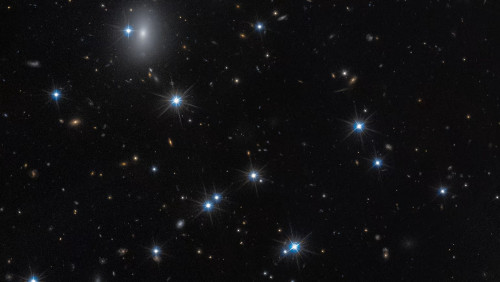
Hubble Telescope Detects Potential ‘Dark Galaxy’
In a groundbreaking discovery, NASA’s Hubble Space Telescope has identified a potential “dark galaxy” – a celestial structure seemingly devoid of bright stars, challenging current understandings of galaxy formation. This elusive galaxy, designated Dragonfly 44, is primarily composed of dark matter, a mysterious substance that makes up approximately 85% of the universe’s mass but does not interact with light, making it incredibly difficult to detect. The finding, initially reported in 2016, continues to be a subject of intense study as astronomers attempt to unravel the mysteries surrounding these unusual galactic formations.
The existence of dark galaxies has long been theorized, predicted by cosmological models that suggest dark matter halos should have formed around early structures in the universe. However, directly observing these galaxies has proven exceptionally challenging due to their faintness and lack of luminous matter. Dragonfly 44, located in the Coma Cluster approximately 330 million light-years from Earth, stands out because of its unusually diffuse distribution of stars and its high dark matter content. This discovery provides a rare opportunity to study the nature of dark matter and its role in the evolution of galaxies.
What Makes Dragonfly 44 Unique?
Unlike typical galaxies, which shine brightly with the light of billions of stars, Dragonfly 44 appears remarkably dim. Initial observations suggested it contained very few stars, leading researchers to believe it was almost entirely composed of dark matter. Further analysis, however, revealed the presence of a surprisingly large number of globular clusters – dense groups of stars – within the galaxy’s halo. These globular clusters, while numerous, are relatively faint, contributing to the galaxy’s overall dimness.
The key characteristic of Dragonfly 44 is its exceptionally high mass-to-light ratio. This ratio compares a galaxy’s mass to the amount of light it emits. Normal galaxies have mass-to-light ratios of around 100 to 200, meaning they contain 100 to 200 times more mass than the light they produce. Dragonfly 44, however, boasts a mass-to-light ratio of over 400, indicating a significantly higher proportion of dark matter compared to visible matter. This extreme ratio is what initially flagged the galaxy as an anomaly and prompted further investigation.
Pieter van Dokkum, an astronomer at Yale University and lead author of the initial study on Dragonfly 44, described the galaxy as a “failed galaxy” in a 2016 interview with Space.com, suggesting it may have been unable to efficiently form stars due to its dominant dark matter content. The gravitational pull of dark matter is essential for attracting gas and dust, the raw materials for star formation. However, in Dragonfly 44, the dark matter halo appears to have prevented the gas from collapsing and forming stars.
The Role of Dark Matter in Galaxy Formation
Dark matter plays a crucial role in the formation and evolution of galaxies. According to the prevailing cosmological model, known as Lambda-CDM, dark matter halos formed first in the early universe, providing the gravitational scaffolding for galaxies to assemble. Ordinary matter, such as gas and dust, then fell into these halos, eventually forming stars and galaxies.
Dragonfly 44 challenges this conventional understanding by suggesting that dark matter halos can exist even without significant star formation. This raises questions about the processes that govern star formation in dark matter halos and whether there are conditions under which galaxies can remain “dark” for extended periods. Understanding these processes is essential for refining our models of galaxy formation and the distribution of dark matter in the universe.
The study of Dragonfly 44 and other potential dark galaxies provides a unique opportunity to probe the nature of dark matter itself. While the exact composition of dark matter remains unknown, leading candidates include weakly interacting massive particles (WIMPs) and axions. By studying the distribution of dark matter in these galaxies, astronomers hope to gain insights into the properties of these elusive particles.
Ongoing Research and Future Observations
Since its initial discovery, Dragonfly 44 has been the subject of ongoing research using a variety of telescopes and observational techniques. Astronomers are using the Keck Observatory in Hawaii and the Gemini Observatory in Chile to obtain more precise measurements of the galaxy’s velocity dispersion – a measure of how fast the stars are moving within the galaxy. This information can be used to estimate the galaxy’s mass and further constrain its dark matter content.
Researchers are also using the Hubble Space Telescope to search for fainter stars and globular clusters within Dragonfly 44’s halo. These observations aim to determine whether the galaxy contains a more substantial population of stars than previously thought. The James Webb Space Telescope (JWST), with its enhanced infrared capabilities, is expected to play a crucial role in future observations, potentially revealing even fainter stars and providing a more complete picture of the galaxy’s stellar population.
The discovery of Dragonfly 44 has spurred a search for other similar dark galaxies. Astronomers are systematically scanning the Coma Cluster and other galaxy clusters for faint, diffuse objects with high mass-to-light ratios. Several other potential dark galaxy candidates have been identified, but further observations are needed to confirm their nature.
According to a 2023 article by NASA, further studies are revealing that not all ultra-diffuse galaxies are dominated by dark matter, adding another layer of complexity to the research. This suggests that the formation and evolution of these galaxies are more diverse than previously thought.
Implications for Cosmology
The existence of dark galaxies has significant implications for our understanding of cosmology and the nature of dark matter. If dark galaxies are common, they could account for a substantial fraction of the missing dark matter in the universe. This would have implications for our models of structure formation and the evolution of the universe.
the study of dark galaxies can provide insights into the properties of dark matter itself. By comparing the distribution of dark matter in these galaxies to theoretical predictions, astronomers can test different dark matter models and potentially identify the particles that make up this mysterious substance.
The discovery of Dragonfly 44 and the ongoing search for other dark galaxies represent a significant step forward in our quest to understand the universe’s hidden components. These elusive structures offer a unique window into the nature of dark matter and the processes that govern galaxy formation, promising to reshape our understanding of the cosmos.
Future research will focus on obtaining more detailed observations of Dragonfly 44 and other potential dark galaxies, as well as developing more sophisticated models of galaxy formation that incorporate the effects of dark matter. The James Webb Space Telescope is poised to revolutionize this field, providing unprecedented insights into the properties of these enigmatic objects. As our understanding of dark galaxies grows, we can expect to gain a deeper appreciation for the complex and mysterious universe we inhabit.
Key Takeaways:
- Dragonfly 44 is a potential “dark galaxy” with an exceptionally high mass-to-light ratio, indicating a large proportion of dark matter.
- The galaxy’s faintness and lack of bright stars make it difficult to observe, but its numerous globular clusters provide clues to its formation.
- The discovery challenges conventional models of galaxy formation and provides a unique opportunity to study the nature of dark matter.
- Ongoing research using telescopes like Hubble and the upcoming James Webb Space Telescope aims to unravel the mysteries surrounding Dragonfly 44 and other dark galaxy candidates.
What are your thoughts on this fascinating discovery? Share your comments below, and be sure to share this article with your network!
Related reading
- Stephen Hawking’s Warning: Why Humanity Must Colonize Space to Survive
- The Importance of Ethics in Artificial Intelligence and New Research Awards
- Facebook Account Requirements To Avoid Fraud And Scams (world-today-news.com)
- Explaining The Dodgers Tarik Skubal Trade In Hockey Terms (newsdirectory3.com)