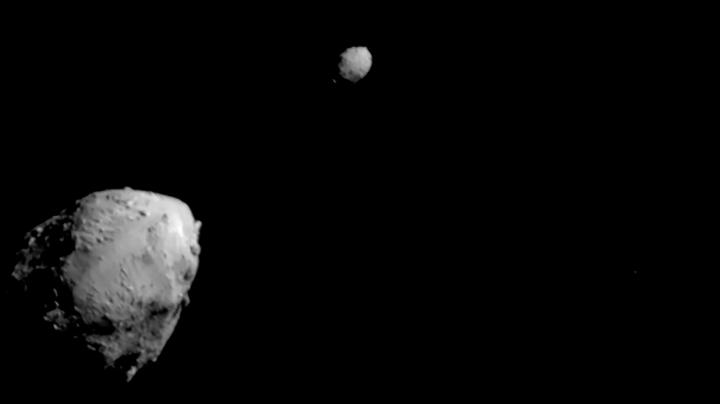
The cosmos yielded a groundbreaking confirmation this month: NASA’s 2022 Double Asteroid Redirection Test (DART) mission didn’t just alter the trajectory of the asteroid Dimorphos, it measurably shifted the orbit of the entire Didymos binary system around the Sun. This marks the first time humanity has demonstrably influenced the path of a celestial body orbiting our star, a feat with profound implications for planetary defense strategies. The findings, published in the journal Science Advances on March 6, 2026, represent a significant step forward in our ability to potentially safeguard Earth from future asteroid impacts.
The DART mission, intentionally crashing a spacecraft into Dimorphos – a moonlet orbiting the larger asteroid Didymos – was designed as a test case for asteroid deflection technology. Although initial reports in late 2022 confirmed a change in Dimorphos’ orbital period around Didymos, the latest research reveals a far more comprehensive impact. The gravitational link between Didymos and Dimorphos meant that any alteration to one would inevitably affect the other, but scientists were initially unsure if the effect would be measurable at the scale of their orbit around the Sun. Now, observations from the Hubble Space Telescope and other ground-based observatories have confirmed a subtle, yet significant, change in the 770-day orbital period of the binary system.
This success builds upon decades of research into near-Earth objects (NEOs) and the potential threat they pose. While neither Didymos nor Dimorphos presented an actual impact risk to Earth, the mission served as a crucial proof-of-concept. The ability to deflect an asteroid, even slightly, could prove invaluable should a potentially hazardous object ever be identified on a collision course with our planet. The DART mission’s success validates kinetic impact as a viable planetary defense technique, offering a proactive approach to mitigating cosmic risks.
How DART Altered a Solar Orbit
The DART spacecraft, launched in November 2021, deliberately collided with Dimorphos on September 26, 2022, at a speed of approximately 6.6 kilometers per second (roughly 14,700 miles per hour). NASA’s analysis reveals the impact generated a substantial cloud of debris, ejecting material from Dimorphos and imparting an additional push to the asteroid. This momentum transfer, while seemingly small, was enough to measurably alter its orbit. The Italian Space Agency’s LICIACube, which accompanied DART, captured stunning images of the collision and the resulting debris field, providing valuable data for scientists.
The fresh study details that the orbital period of the Didymos-Dimorphos system around the Sun decreased by approximately 0.15 seconds. While this change appears minuscule, researchers emphasize that even small alterations can accumulate over time, potentially leading to a significant deflection. Dr. Rahil Makadia, a planetary defense scientist at the University of Illinois Urbana-Champaign and lead author of the Science Advances study, explained that “over time, such a small change in an asteroid’s motion can build the difference between a hazardous object hitting or missing our planet.”
Measuring the Minute Shift
Detecting such a subtle change in orbital period required exceptionally precise measurements. The research team relied on observations from the Hubble Space Telescope, which tracked the movement of the asteroid system over several months following the impact. These observations allowed scientists to determine the new orbital period with a high degree of accuracy. The speed of the orbital change was calculated at approximately 11.7 micrometers per second, or 1.7 inches per hour, according to CNN’s reporting on the study. This demonstrates the sensitivity of the measurements and the effectiveness of the DART mission in producing a detectable effect.
Thomas Statler, NASA’s lead scientist for solar system small bodies, highlighted the significance of the findings, stating, “This is a tiny change to the orbit, but given enough time, even a tiny change can grow to a significant deflection.” The success of the DART mission and the subsequent analysis of its impact have reinforced the viability of kinetic impact as a planetary defense strategy. It also demonstrates how altering one asteroid in a binary system can influence the other, providing valuable insights for future missions.
Future Planetary Defense Efforts
The DART mission’s success has spurred further investment in planetary defense initiatives. NASA is currently developing the Near-Earth Object (NEO) Surveyor mission, a space-based telescope designed to identify and characterize potentially hazardous asteroids. Managed by the Jet Propulsion Laboratory in California, the NEO Surveyor will be capable of detecting dark asteroids and comets that are difficult to observe from ground-based telescopes. As Mashable reported, this mission is crucial for providing early warning of potential threats and enabling proactive mitigation efforts.
The key to effective planetary defense lies in early detection. By identifying NEOs well in advance of any potential impact, scientists can develop and deploy strategies to deflect them, preventing a catastrophic collision. The DART mission has demonstrated that kinetic impact is a viable option, but other techniques, such as gravity tractors and laser ablation, are also being explored. The ongoing development of advanced detection and deflection technologies is essential for protecting Earth from the ever-present threat of asteroid impacts.
Key Takeaways
- The DART mission successfully altered the orbit of both Dimorphos and Didymos around the Sun.
- This is the first time a human-made object has measurably changed the path of a celestial body orbiting the Sun.
- The change in orbital period, though small, demonstrates the effectiveness of kinetic impact as a planetary defense technique.
- NASA’s NEO Surveyor mission will enhance our ability to detect and characterize potentially hazardous asteroids.
Looking ahead, the data gathered from the DART mission and the ongoing observations of the Didymos-Dimorphos system will continue to refine our understanding of asteroid dynamics and improve our planetary defense capabilities. The next major milestone in this effort will be the launch of the NEO Surveyor, currently scheduled for the late 2020s, which promises to significantly expand our catalog of known NEOs and provide crucial information for assessing their potential risk.
The success of DART represents a pivotal moment in humanity’s efforts to protect itself from cosmic threats. It’s a testament to the power of scientific innovation and international collaboration, and a crucial step towards ensuring a safer future for our planet. We encourage you to share this article and join the conversation about planetary defense – your thoughts and questions are valuable as we continue to explore and safeguard our place in the universe.
Keep reading