Astronomers Witness Potential Planet Collision in Distant Star System
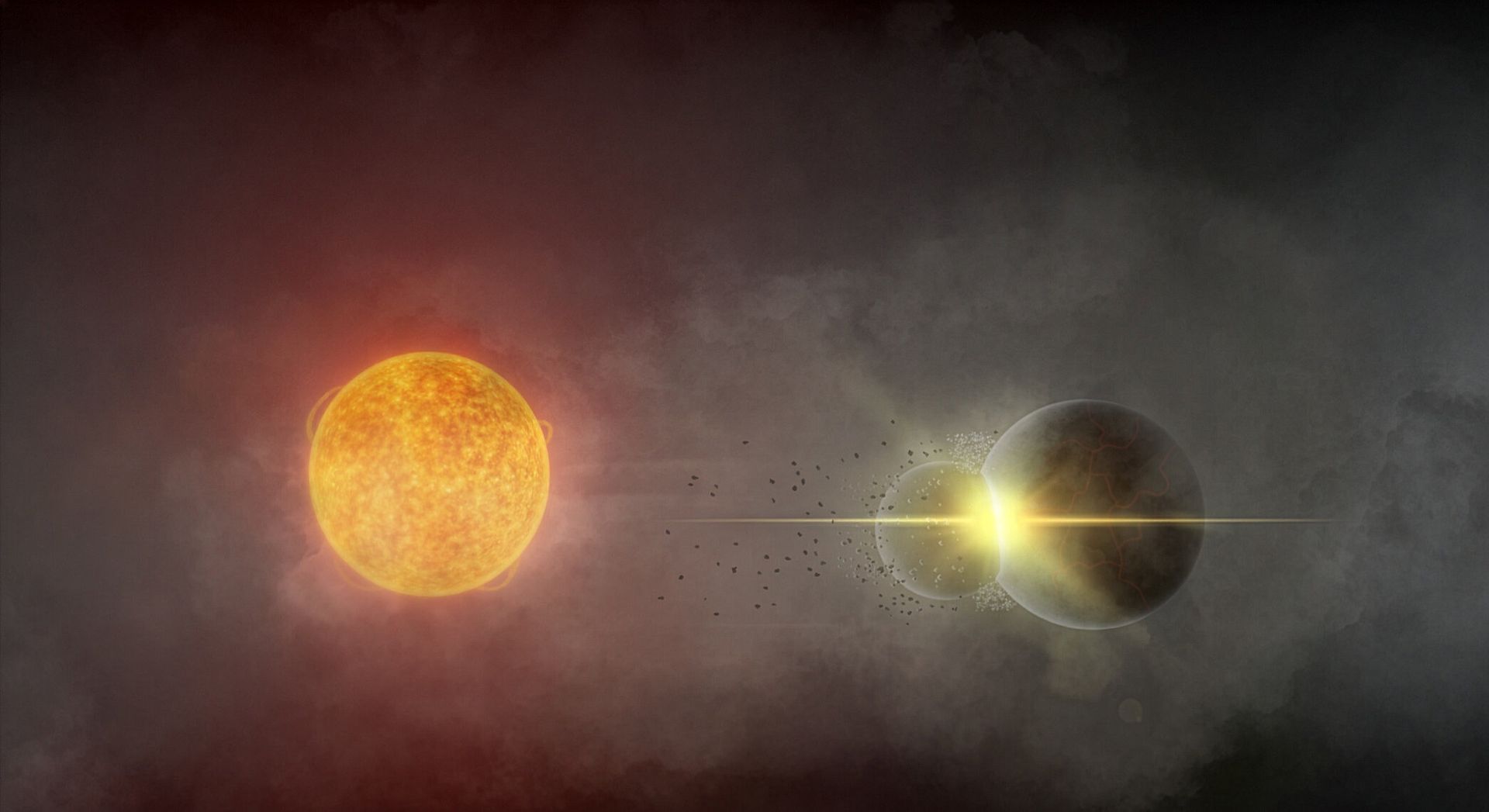
In a rare celestial event, astronomers at the University of Washington have gathered compelling evidence suggesting a catastrophic collision between two planets orbiting a star 11,000 light-years from Earth. The observations, focused on a star named Gaia20ehk, reveal a dramatic increase in dust and debris surrounding the star, a phenomenon scientists believe is the aftermath of a planetary impact. This event offers a unique glimpse into the violent processes that shape planetary systems, potentially shedding light on the formation of our own solar system, including the Earth, and Moon.
The discovery began when doctoral candidate Anastasios (Andy) Tzanidakis was reviewing data from 2020, searching for unusual stellar activity. Gaia20ehk, a main-sequence star similar to our Sun, initially appeared stable. However, Tzanidakis noticed a peculiar pattern: three dips in brightness starting in 2016, followed by a significant and erratic fluctuation around 2021. “The star’s light output was nice and flat, but starting in 2016 it had these three dips in brightness. And then, right around 2021, it went completely bonkers,” Tzanidakis explained, as reported by the University of Washington News. Such behavior is highly unusual for stars like our Sun, prompting further investigation.
The source of the erratic brightness wasn’t within the star itself, but rather from vast quantities of dust and rock orbiting the system and passing in front of Gaia20ehk, intermittently blocking its light. This debris field, scientists theorize, is the result of a massive collision between two planets. The timing and characteristics of the observed dimming events strongly support this hypothesis. The University of Washington team published their analysis on March 11, 2026, in *The Astrophysical Journal Letters*.
Unprecedented Observation of a Planetary Impact
Planetary collisions are not uncommon in the early stages of planetary system formation, but directly observing such an event is exceedingly rare. “It’s incredible that various telescopes caught this impact in real time,” Tzanidakis stated. “There are only a few other planetary collisions of any kind on record, and none that bear so many similarities to the impact that created the Earth and moon.” The collision’s resemblance to the theorized impact that formed Earth and its moon is particularly intriguing, offering a potential analog for understanding our own planet’s origins.
The team’s analysis involved examining the star’s light curve – a graph of its brightness over time – in both visible and infrared wavelengths. A key finding was that when the visible light dimmed, the infrared readings showed a sharp increase. This suggests that the obscuring material was extremely hot, consistent with the energy released during a planetary collision. The heat generated from such an impact would cause the debris to glow brightly in infrared light.
Tzanidakis, a final-year Astronomy Ph.D. Candidate, has a strong background in both observational astronomy and algorithmic techniques. His research, conducted under the supervision of Professors James Davenport and Eric Bellm, focuses on identifying and characterizing unusual dimming events around Sun-like stars. He was as well actively involved in data commissioning for the Vera C. Rubin Observatory Legacy Survey of Space and Time (LSST), evaluating time-series features that will be delivered as part of the LSST project.
The Formation of Planetary Systems: A Violent Process
The process of planet formation is often characterized by chaotic interactions and collisions. In the early stages of a planetary system’s development, protoplanets – embryonic planets – frequently collide, merging to form larger bodies. These collisions can be incredibly energetic, ejecting material into orbit around the star, as appears to be the case with Gaia20ehk. The observation of this event provides valuable insight into the frequency and nature of these collisions.
Detecting these events is challenging, requiring a specific alignment of orbits between the colliding planets and Earth. The chances of witnessing such an impact are slim, making the data collected from Gaia20ehk particularly valuable to the scientific community. The rarity of these observations underscores the importance of continued monitoring of stars for unusual activity.
Future Observations and the Search for Earth-Like Planets
Researchers believe that future observations with advanced telescopes, such as the Simonyi Survey Telescope, will allow for the detection of more planetary collisions. The Simonyi Survey Telescope, part of the Vera C. Rubin Observatory, is designed to conduct a wide-field survey of the night sky, capturing detailed images and data over a ten-year period. This increased observational capability will significantly enhance our ability to study the formation of planetary systems and identify potential Earth-like planets.
The data gathered from these observations will help astronomers refine their models of planet formation and better understand the conditions necessary for the emergence of habitable worlds. By studying the aftermath of planetary collisions, scientists can gain insights into the composition and structure of planets, as well as the distribution of materials within planetary systems. This knowledge is crucial in the ongoing search for life beyond Earth.
Key Takeaways
- Rare Event Observed: Astronomers have detected evidence of a planetary collision around the star Gaia20ehk, located 11,000 light-years away.
- Similar to Earth-Moon Formation: The observed debris field and patterns of dimming resemble the theorized impact that created Earth and the Moon.
- Infrared Confirmation: The increase in infrared light during the dimming events suggests the debris was extremely hot, supporting the collision hypothesis.
- Future Telescopes Will Help: The Simonyi Survey Telescope is expected to detect more such events, providing further insights into planet formation.
The research team continues to analyze the data from Gaia20ehk, seeking to refine their understanding of the collision and its implications for planet formation. Further observations are planned to monitor the evolution of the debris field and search for any additional evidence of ongoing activity. The next major milestone will be the full operational launch of the Vera C. Rubin Observatory and the commencement of the Legacy Survey of Space and Time, expected to yield a wealth of new data on stellar variability and planetary systems.
This discovery highlights the dynamic and often violent nature of planetary system formation. As technology advances and our observational capabilities improve, You can expect to uncover more of these cosmic events, bringing us closer to understanding the origins of our own planet and the potential for life elsewhere in the universe.
What are your thoughts on this incredible discovery? Share your comments below, and don’t forget to share this article with your friends and colleagues!
Keep reading