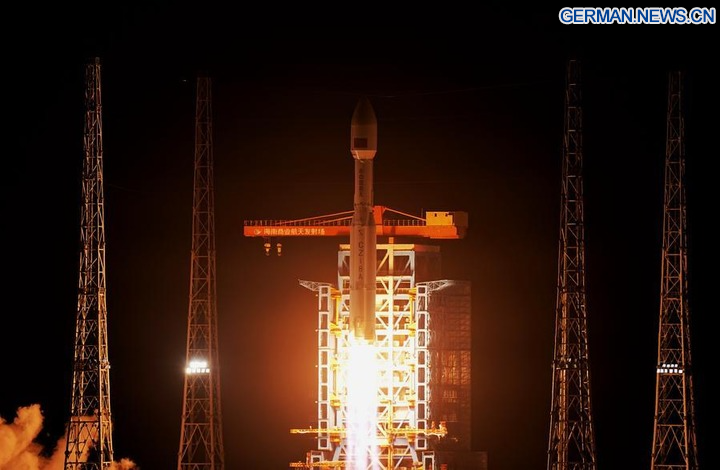
Wenchang, Hainan – China successfully launched a Long March-8A carrier rocket on Friday, carrying a new group of internet satellites into orbit. The launch, originating from the Hainan Commercial Spacecraft Launch Site, marks the 20th deployment of low-orbit internet satellites for the nation, bolstering its growing space-based infrastructure. This mission underscores China’s continued investment in space technology and its ambitions to expand global internet access.
The Long March-8A lifted off at 3:48 a.m. Beijing Time on March 13, 2026, according to reports from Xinhua News Agency. The launch site, located in the southern island province of Hainan, has become a crucial hub for China’s space program, facilitating access to a wider range of orbital inclinations. The successful placement of the payloads into their designated orbit represents a significant achievement for the China National Space Administration (CNSA) and the teams involved in the development and operation of the Long March-8A rocket.
Expanding China’s Satellite Constellation
This latest launch adds to China’s rapidly expanding network of satellites designed to provide internet connectivity, particularly in remote and underserved regions. While details regarding the specific operator and capabilities of these 20 satellites remain limited, the deployment aligns with China’s broader strategy to enhance its communication infrastructure and reduce reliance on foreign technologies. The country has been actively developing its own satellite internet constellation, often referred to as Guowang, to compete with established players like SpaceX’s Starlink and OneWeb.
The Long March-8A rocket is a key component of China’s space launch capabilities. It is designed to carry payloads of up to 4.5 tons to geostationary transfer orbit and is capable of launching multiple satellites in a single mission. The rocket’s versatility and reliability have made it a preferred choice for a variety of space applications, including communication, navigation and Earth observation. The development of the Long March-8A represents a significant step forward in China’s efforts to modernize its space launch infrastructure and reduce costs. Xinhua reported the rocket successfully placed the payloads into preset orbit.
The Hainan Commercial Spacecraft Launch Site: A Growing Spaceport
The Hainan Commercial Spacecraft Launch Site, where the launch took place, is a relatively new facility that has quickly become a vital part of China’s space program. Opened in 2023, the site is strategically located near the equator, offering advantages for launching satellites into various orbital planes. The site’s proximity to the sea too provides a safe zone for rocket debris in the event of a launch failure. The development of the Hainan launch site reflects China’s commitment to expanding its space launch capabilities and fostering a commercial space industry.
The site is designed to accommodate a variety of launch vehicles, including the Long March series rockets and potentially commercial rockets in the future. The Chinese government has expressed its intention to attract both domestic and international companies to utilize the Hainan launch site, further solidifying its position as a major spaceport. HainanTouch reported the launch originated from the Hainan commercial spacecraft launch site.
Technical Specifications of the Long March-8A
The Long March-8A is a two-stage rocket powered by liquid oxygen and kerosene. It features a core stage with two YF-100 engines and a single YF-100 engine in the second stage. The rocket is approximately 38.3 meters (125.7 feet) tall and has a diameter of 3.35 meters (11 feet). Its launch weight is around 330 tons. The Long March-8A is designed for both low Earth orbit and geostationary transfer orbit missions.
The YF-100 engine, used in both stages of the Long March-8A, is a highly efficient and reliable engine developed by the China Academy of Launch Vehicle Technology (CALT). It utilizes a staged combustion cycle, which improves performance and reduces emissions. The YF-100 engine has undergone extensive testing and has proven to be a crucial component of China’s space launch program. The rocket’s design emphasizes cost-effectiveness and reliability, making it a suitable choice for a wide range of missions.
Implications for Global Internet Access
China’s continued deployment of internet satellites has significant implications for global internet access. The country’s efforts to build its own satellite constellation could provide affordable internet connectivity to underserved regions, particularly in developing countries. This could help bridge the digital divide and promote economic development. However, the expansion of China’s space-based infrastructure also raises concerns about potential competition with existing satellite internet providers and the possibility of increased space debris.
The increasing number of satellites in orbit poses a growing challenge for space traffic management. Collisions between satellites could create debris fields that threaten other spacecraft and potentially render certain orbital regions unusable. International cooperation is essential to address this challenge and ensure the long-term sustainability of space activities. China has expressed its commitment to responsible space behavior and has participated in international discussions on space debris mitigation. The country is also developing technologies to track and remove space debris, contributing to a safer space environment.
Future Developments and Planned Missions
China has ambitious plans for its space program in the coming years. These include the continued expansion of its satellite internet constellation, the construction of a lunar research station, and the development of advanced space technologies. The country is also planning to launch its first crewed mission to Mars, potentially in the 2030s. These ambitious goals demonstrate China’s commitment to becoming a leading space power.
The CNSA is actively working on the development of new launch vehicles, including heavier-lift rockets capable of carrying larger payloads to more distant destinations. The agency is also investing in research and development of advanced propulsion systems, such as electric propulsion, to improve the efficiency and range of its spacecraft. China’s space program is driven by a combination of national pride, economic interests, and scientific curiosity. The nation aims to establish itself as a key player in the global space community and contribute to the advancement of space exploration and technology.
Looking ahead, the next key event to watch for regarding China’s space program will be further launches of the Long March-8A rocket and the deployment of additional internet satellites. The CNSA is expected to provide updates on its progress in the coming months. Continued monitoring of these developments will provide valuable insights into China’s evolving space capabilities and its impact on the global space landscape.
What are your thoughts on China’s growing space program? Share your comments below, and be sure to share this article with your network!
Worth a look