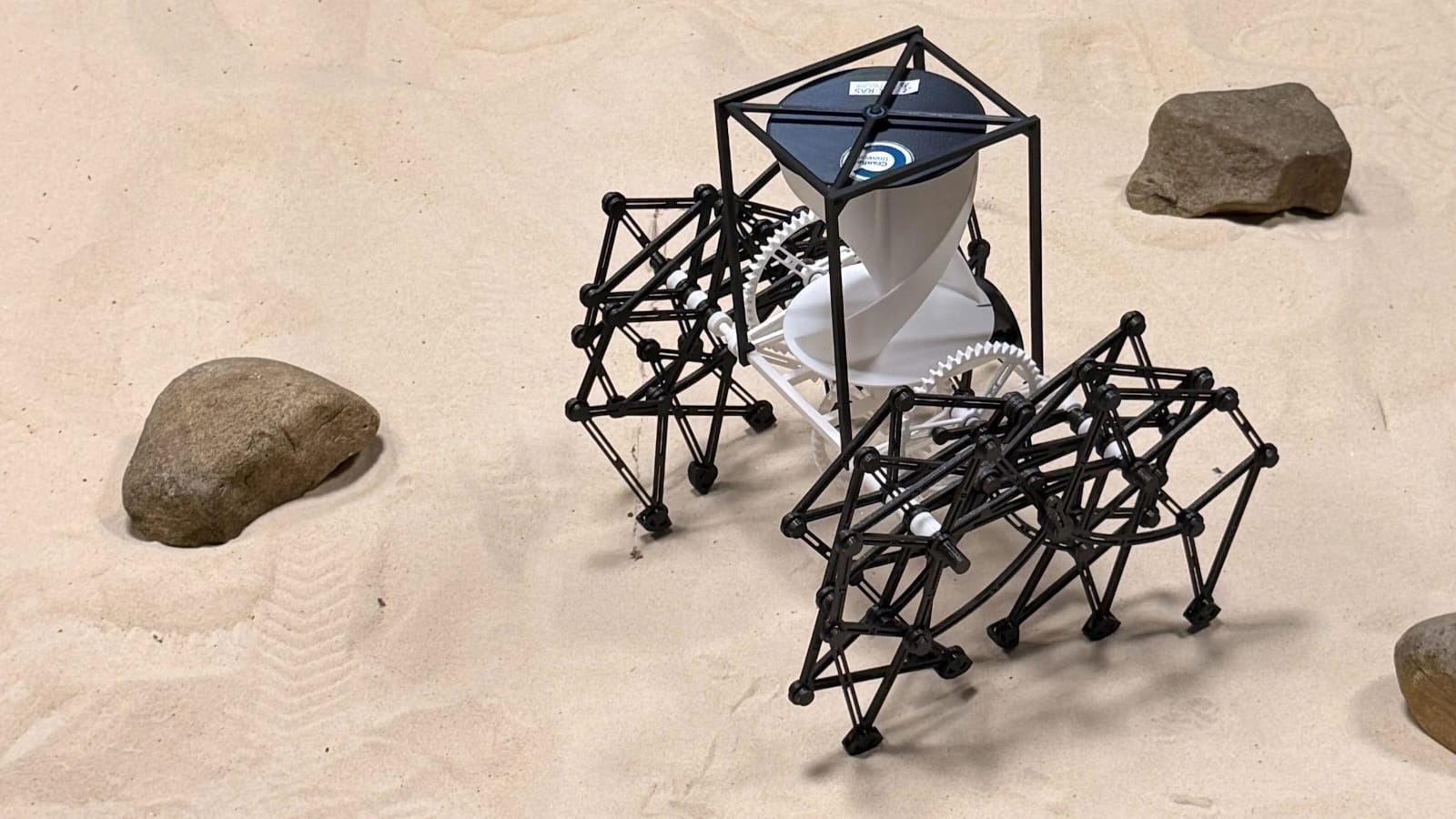
The quest for sustained robotic exploration in harsh environments – from the desolate expanses of deserts and polar regions to the alien landscapes of other planets – faces a fundamental challenge: power. Traditional robots rely heavily on batteries, which limit operational range and necessitate frequent, often impractical, recharging. But a team of researchers at Cranfield University in the United Kingdom is pioneering a novel solution: a wind-powered robot named WANDER-bot, designed to traverse challenging terrains indefinitely, fueled solely by the natural energy of the wind. This innovative approach represents a significant step towards creating self-sufficient robotic explorers capable of long-duration missions without the constraints of conventional power sources.
The limitations of battery technology in extreme environments are well-documented. In remote locations, resupply missions are costly and logistically complex. On other planets, the challenges are even greater. The European Space Agency (ESA), for example, is continually seeking sustainable technologies for future missions, recognizing that reliance on batteries or even solar power – which can be affected by dust and varying light conditions – can severely restrict exploration capabilities. WANDER-bot offers a compelling alternative, harnessing a readily available and renewable energy source to overcome these hurdles. The robot’s development, detailed in a press release from Cranfield University on March 11, 2026, highlights a growing trend towards biomimicry and sustainable engineering in robotics.
WANDER-bot’s design is elegantly simple. Instead of a battery-powered motor, the robot utilizes a small Savonius wind turbine to convert wind energy into mechanical motion. This turbine drives a unique leg mechanism inspired by the intricate “Strandbeests” – kinetic sculptures created by Dutch artist Theo Jansen. These sculptures, known for their graceful, walking motion powered by wind, employ a system called the Jansen linkage, a series of mechanical linkages that allows for stable locomotion even with a simple driving force. According to Dr. Saurabh Upadhyay, Lecturer in Space Engineering at Cranfield University, the Jansen linkage is key to WANDER-bot’s ability to maintain a consistent gait, even in fluctuating wind conditions. The robot’s reliance on this mechanical system, rather than complex electronics, is a deliberate design choice aimed at maximizing simplicity and durability.
A 3D-Printed Pioneer: Design and Construction
One of the most striking aspects of WANDER-bot is its construction method. Almost the entire robot is 3D-printed, a technique that significantly reduces production costs and complexity compared to traditional robotic manufacturing. This approach also offers a crucial advantage for remote deployments: the ability to produce spare parts on-site. As detailed in a BBC News report published on March 12, 2026, Dr. Upadhyay and Research Associate Sam Kurian designed WANDER-bot with quick repair and replacement in mind. In other words that, in theory, a fully functional WANDER-bot could be printed anywhere with access to a 3D printer and replacement components could be created as needed, eliminating the require for lengthy and expensive resupply missions. This capability is particularly valuable for long-term missions to distant planets, where logistical support is severely limited.
Beyond Batteries: The Potential for Long-Term Exploration
The implications of a battery-less robot extend far beyond simply reducing weight and cost. Batteries degrade over time, and their performance can be affected by temperature extremes. Solar cells, another common power source for robots, can be rendered ineffective by dust or cloud cover. WANDER-bot, by relying on a consistent and renewable energy source – the wind – avoids these limitations. Movement accounts for approximately 20% of battery use in most robots, as noted in the Cranfield University press release, making wind-powered locomotion a particularly efficient solution for long-term exploration or mapping of unknown terrains. This efficiency allows for the potential addition of electronic components for data collection and transmission, powered by a smaller, lighter battery dedicated solely to those functions.
The potential applications for WANDER-bot are diverse. The robot is ideally suited for exploring environments where traditional robots struggle, such as deserts, polar regions, and even the surfaces of planets like Mars, where atmospheric winds are present. The ESA has expressed interest in technologies that enable sustainable exploration, and WANDER-bot aligns perfectly with this goal. The robot’s ability to operate autonomously for extended periods could revolutionize our ability to gather data from remote and hostile environments, providing valuable insights into climate change, geological formations, and the potential for life beyond Earth. The design also opens possibilities for environmental monitoring, disaster response, and infrastructure inspection in challenging locations.
Current Status and Future Development
As of March 14, 2026, WANDER-bot remains a prototype, undergoing rigorous testing to assess its performance in various wind conditions. Researchers are currently focused on improving the robot’s maneuverability and stability, ensuring it can navigate complex terrains effectively. The team is also exploring the integration of sensors and communication systems to enhance its data-gathering capabilities. While the current prototype is relatively small, the principles behind its design are scalable, suggesting that larger, more sophisticated wind-powered robots could be developed in the future. The Cranfield University team is actively seeking collaborations with industry partners to accelerate the development and deployment of this groundbreaking technology.
The development of WANDER-bot represents a paradigm shift in robotic exploration. By embracing simplicity, sustainability, and biomimicry, researchers at Cranfield University have created a robot that challenges conventional thinking about power sources and opens up new possibilities for exploring the world – and beyond. The robot’s reliance on a readily available natural resource, coupled with its 3D-printed construction, makes it a potentially game-changing technology for a wide range of applications. The ongoing testing and refinement of WANDER-bot will undoubtedly pave the way for a new generation of self-sufficient robotic explorers, capable of venturing into the most challenging environments on Earth and in the cosmos.
Researchers plan to publish detailed findings from the ongoing testing phase in a peer-reviewed scientific journal later this year. Further updates on the project’s progress can be found on the Cranfield University website. We encourage readers to share their thoughts and perspectives on this exciting development in the comments below.
Keep reading