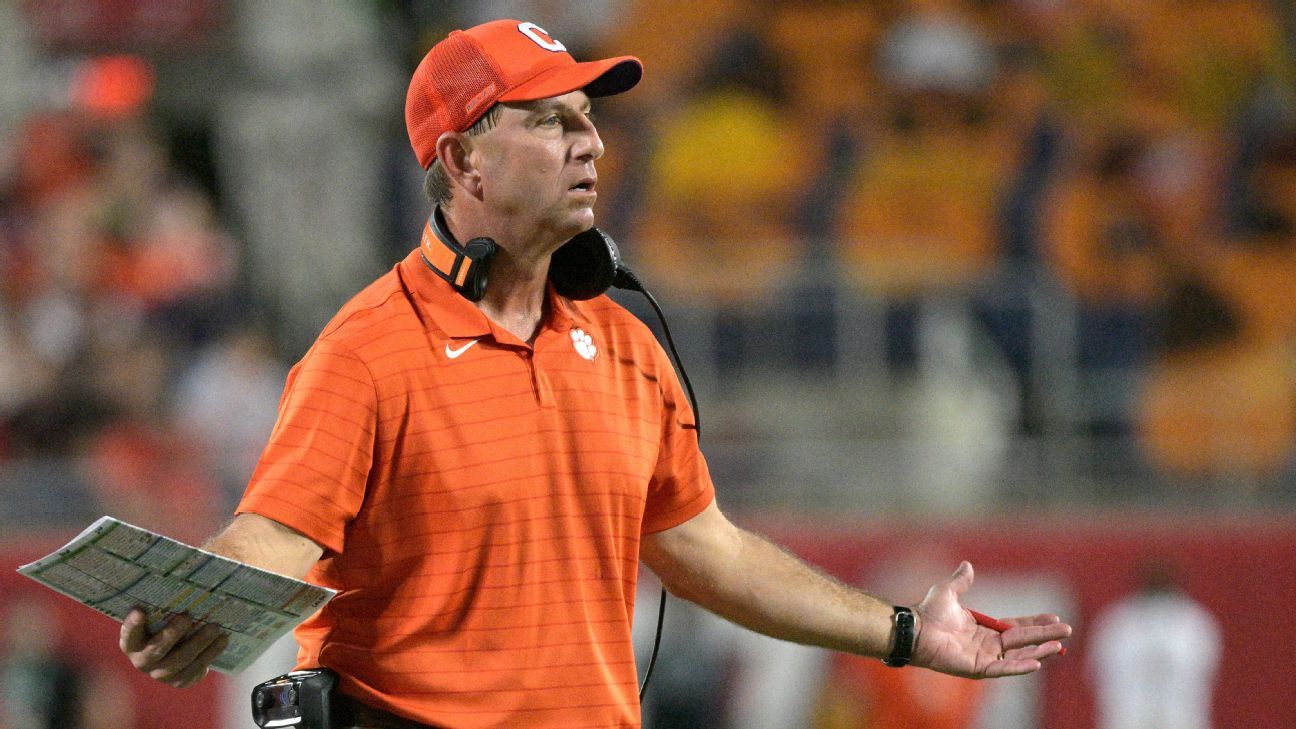
Clemson University football coach Dabo Swinney has publicly accepted responsibility for the team’s disappointing 7-6 season in 2025, a performance that marked the program’s worst record in 15 years. The Tigers, ranked fourth in the preseason Associated Press poll and widely favored to defend their ACC championship title, stumbled to a 1-3 start and ultimately failed to contend for either a College Football Playoff berth or the conference crown. Swinney’s candid admission, delivered during an interview on the ACC Network, underscores the pressure facing the program to return to its previous level of dominance.
The unexpected downturn has prompted widespread scrutiny of the Clemson program, once a perennial national championship contender. From 2015 to 2020, the Tigers enjoyed an unprecedented run of success, reaching the College Football Playoff each season and securing two national championships. However, since then, the program has experienced a noticeable decline, with only two ACC titles and a single CFP appearance in 2024 to indicate for its efforts. This recent stretch has fueled questions about Clemson’s ability to remain competitive in the evolving landscape of college football, particularly with the advent of the transfer portal, name, image, and likeness (NIL) deals, and revenue sharing.
A Season of Disappointment and Self-Reflection
Swinney’s willingness to shoulder the blame for the 2025 season is a departure from his typically optimistic public persona. He specifically cited a failure to close out close games and execute effectively in the fourth quarter as key factors contributing to the team’s struggles. “We didn’t win the close games,” Swinney stated, adding, “We didn’t finish in the fourth quarter like we needed to, and to me that’s nobody’s fault but mine. That’s where coaching has to make the difference, and I didn’t make the difference. I’ve got to be better… whether it’s a decision, personnel, player, staff that’s all my responsibility.” This level of accountability is notable, especially given the high expectations surrounding the Clemson program and Swinney’s own track record of success.
The 2025 season was particularly frustrating for Clemson fans, given the team’s veteran roster, which featured several players projected to be future NFL draft picks. Despite the talent on paper, the Tigers struggled to consistently perform at a high level, losing key games early in the season that ultimately derailed their championship aspirations. The team’s struggles prompted a wave of criticism from analysts and fans alike, with many questioning whether Clemson had lost its competitive edge.
Staff Changes and a Renewed Offensive Approach
In the wake of the disappointing 2025 season, Swinney made significant changes to his coaching staff, most notably relieving Garrett Riley of his duties as offensive coordinator. Riley’s departure was followed by the hiring of Chad Morris, a familiar face in Clemson circles. Morris previously served as an offensive assistant at Clemson from 2011 to 2014, playing a key role in laying the foundation for the program’s subsequent success. His return is seen as an attempt to revitalize the Clemson offense and restore its explosive potential.
Morris’s previous coaching stops include stints at Tulsa, Baylor, and Arkansas. He is known for his innovative offensive schemes and his ability to develop quarterbacks. His arrival is expected to bring a fresh perspective to the Clemson offense, which struggled with consistency and play-calling throughout the 2025 season. The hope is that Morris can unlock the full potential of the Clemson offense and return it to the ranks of the nation’s elite.
A Legacy of Success and a Changing Landscape
Despite the recent struggles, Dabo Swinney’s tenure at Clemson has been marked by extraordinary success. In 18 seasons as head coach, he has led the Tigers to nine ACC championships and two national championships. Prior to Swinney’s arrival in 2008, Clemson had not won an ACC title since 1991. This remarkable turnaround has established Swinney as one of the most successful coaches in college football history. According to team records, Clemson has secured 57 wins this decade, ranking seventh among all college football teams.
However, the college football landscape has undergone significant changes in recent years, with the introduction of the transfer portal, NIL deals, and revenue sharing. These changes have created new challenges for programs like Clemson, which traditionally relied on recruiting and player development. Swinney has been a vocal critic of some of these changes, particularly the transfer portal, but he has also acknowledged the demand to adapt to the new reality. He has expressed optimism that Clemson can continue to compete at a high level despite these challenges, emphasizing the importance of evaluation, development, and retention.
Navigating the Transfer Portal and NIL Challenges
Swinney’s stance on the transfer portal has been a subject of debate. Even as he has historically been hesitant to embrace the portal, he utilized it more extensively during the recent offseason, signing 10 players to address roster needs, particularly on the defensive side of the ball. However, the program also experienced a departure when Luke Ferrelli, a transfer signee, opted to transfer to Ole Miss after enrolling at Clemson. This prompted Swinney to publicly accuse Ole Miss of tampering, highlighting the growing tensions surrounding the transfer portal and the potential for unethical recruiting practices.
The emergence of NIL deals has also presented new challenges for Clemson. Swinney has acknowledged that NIL was “really hard for us” and that it created a competitive disadvantage for the program. However, he believes that revenue sharing, which allows players to receive a portion of conference revenue, has helped to “even the playing field.” He emphasized the importance of balancing NIL opportunities with the program’s overall goals and maintaining a strong team culture.
Looking Ahead: Rebuilding and Maintaining Culture
As Clemson looks ahead to the 2026 season, the focus will be on rebuilding the offense, developing young players, and maintaining a positive team culture. Swinney remains confident in the program’s ability to return to national prominence, but he acknowledges that it will require hard work, dedication, and a commitment to excellence. He has repeatedly emphasized the importance of culture, stating, “We’re in a great place. Football stuff can be fixed. That’s what our focus is right now. Sometimes you’ve got to go back to go forward. But culture wise, I don’t feel we’ve ever been better. We’re built to last.”
The success of the 2026 season will likely depend on the performance of quarterback Christopher Vizzina and the effectiveness of Chad Morris’s new offensive scheme. The Tigers will also need to continue to recruit at a high level and develop their young players. The challenges are significant, but Swinney remains optimistic that Clemson can overcome them and return to its position as one of the nation’s elite football programs.
The next key date for Clemson football fans will be the spring game, scheduled for April 18, 2026, at Memorial Stadium. This will provide an early glimpse of the team’s progress under the new coaching staff and a preview of what to expect in the 2026 season. Fans and analysts alike will be closely watching to see if the Tigers can regain their championship form.
What are your thoughts on Clemson’s chances for the 2026 season? Share your predictions and insights in the comments below. Don’t forget to share this article with fellow college football fans!
Related reading