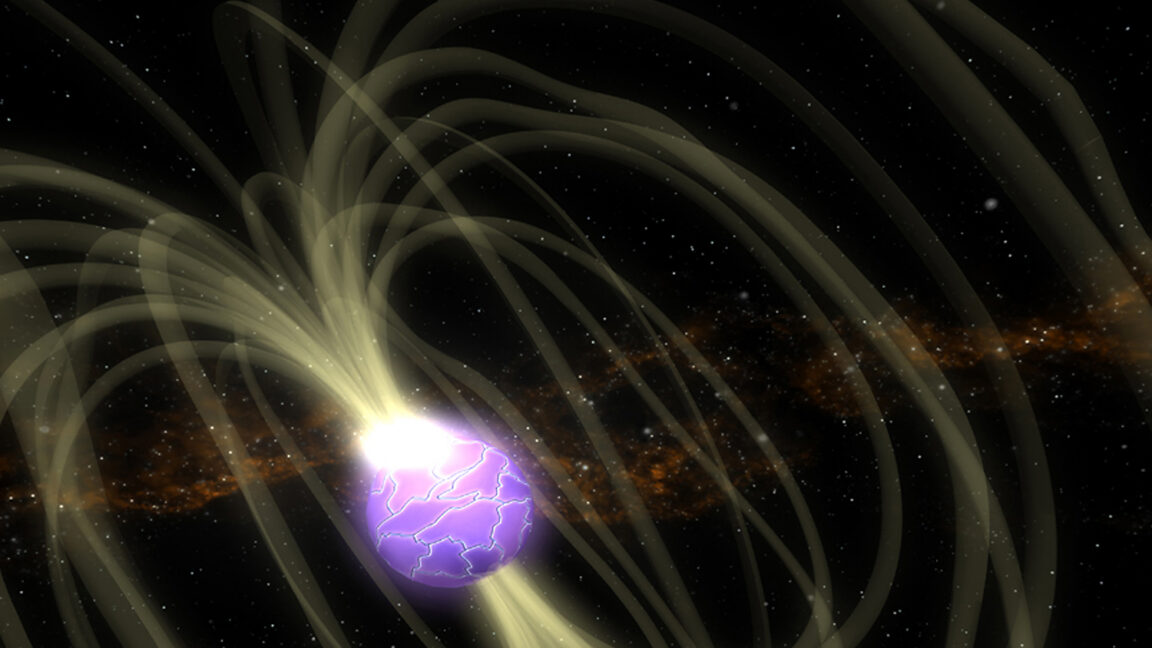
Magnetars and Spacetime: New Model Explains Superluminous Supernova Behavior
The universe continues to reveal its secrets, and a recent discovery is challenging existing models of some of its most powerful events: superluminous supernovae. Astronomers have observed a peculiar “chirping” pattern in the light emitted from a supernova designated SN 2024afav, detected on December 12, 2024, by the Liverpool Gravitational Wave Optical Transient Observer collaboration. This unusual behavior, where the timing between bursts of energy systematically decreases, has led scientists to propose a new mechanism involving the warping of spacetime by a rapidly spinning neutron star known as a magnetar. This discovery, detailed in recent reports, offers a compelling glimpse into the extreme physics at play during these cosmic explosions and confirms predictions made by Albert Einstein’s theory of General Relativity.
Superluminous supernovae are among the brightest events in the universe, far exceeding the luminosity of typical supernovae. While various theories attempt to explain their immense energy output, the observed flickering and, specifically, the “chirping” signal from SN 2024afav presented a significant puzzle. Initially appearing as a standard superluminous supernova, the object quickly distinguished itself through its unique emissions. The ability to predict subsequent bursts of energy, a feat previously unattainable, has provided crucial evidence supporting the new model. This breakthrough highlights the power of precise astronomical observation and the importance of challenging established theories in the face of new data.
Decoding the ‘Chirp’
The term “chirp” in physics refers to a signal whose frequency increases over time. In the case of SN 2024afav, astronomers observed a series of energy bursts, or “bumps,” in the light curve. Crucially, the intervals between these bumps were not random; they were steadily decreasing. After observing the second and third bumps, researchers were able to calculate the expected timing of subsequent bursts with remarkable accuracy. Sky & Telescope reports that the team successfully predicted the arrival of the fourth and fifth bumps, narrowing down the period reduction to approximately 29 percent.
This predictability immediately ruled out explanations based on random events, such as supernova ejecta colliding with unevenly distributed gas clouds. Such collisions would produce irregular fluctuations, not the precisely timed, sinusoidal modulations observed in SN 2024afav. The consistent and predictable nature of the signal demanded a more fundamental explanation rooted in the underlying physics of the exploding star.
Frame-Dragging and the Lense-Thirring Effect
To account for the observed “chirping,” scientists turned to a concept predicted by Einstein’s theory of General Relativity: frame-dragging, also known as the Lense-Thirring effect. This effect describes how a rotating massive object warps the spacetime around it, effectively “dragging” it along with its rotation. Ars Technica explains that while frame-dragging has been observed in other astrophysical contexts, Here’s the first time it has been linked to a magnetar and used to explain the behavior of a superluminous supernova.
Magnetars are neutron stars with incredibly strong magnetic fields – the most powerful known in the universe. These fields, combined with their rapid rotation, create a significant distortion of spacetime. The new model proposes that the “chirping” signal arises from the interaction between the magnetar’s rotating magnetic field and the surrounding spacetime. As the magnetar spins down, its rotational energy is converted into energy that powers the supernova, and the rate of this energy release is modulated by the frame-dragging effect. The decreasing intervals between the energy bursts correspond to a slowing rotation rate and a corresponding change in the spacetime distortion.
Implications for Supernova Research
This discovery has profound implications for our understanding of superluminous supernovae and the physics of magnetars. Previously, the mechanisms driving these events were poorly understood, with several competing theories vying for acceptance. The observation of frame-dragging in SN 2024afav provides strong evidence that magnetars play a crucial role in powering at least some types of superluminous supernovae. This finding will likely spur further research into the connection between magnetars, frame-dragging, and the extreme energy output of these cosmic explosions.
The Liverpool Gravitational Wave Optical Transient Observer, a key instrument in this discovery, is designed to rapidly detect and characterize transient astronomical events. Its ability to quickly respond to new discoveries and gather high-precision data was essential in capturing the “chirping” signal from SN 2024afav. The collaboration’s success underscores the importance of dedicated transient surveys in advancing our knowledge of the dynamic universe.
What are Magnetars?
Magnetars are a type of neutron star, the incredibly dense remnants of massive stars that have undergone supernova explosions. Neutron stars themselves are composed almost entirely of neutrons, packed together with immense density. A teaspoonful of neutron star material would weigh billions of tons on Earth. Magnetars distinguish themselves from other neutron stars through their extraordinarily powerful magnetic fields, which are trillions of times stronger than Earth’s magnetic field. These intense magnetic fields are thought to be generated by a complex dynamo process within the star.
The strong magnetic fields of magnetars can cause a variety of phenomena, including bursts of X-rays and gamma rays. These bursts are often unpredictable and can be extremely energetic. The interaction between the magnetar’s magnetic field and its surrounding environment is a complex process that is still not fully understood. However, the recent discovery of frame-dragging in SN 2024afav provides a new window into the physics of these fascinating objects.
Future Research and Observations
Scientists are now eager to apply this new model to other superluminous supernovae, searching for similar “chirping” signals that could indicate the presence of frame-dragging. Further observations will be crucial to refine the model and to understand the full range of conditions under which magnetars can power these events. The next generation of telescopes, with their increased sensitivity and resolution, will undoubtedly play a key role in this research.
The study of superluminous supernovae and magnetars is a rapidly evolving field, and new discoveries are constantly challenging our understanding of the universe. The observation of frame-dragging in SN 2024afav represents a significant step forward, providing a new framework for interpreting these extreme cosmic events and deepening our appreciation for the power of Einstein’s theory of General Relativity.
The research team plans to continue monitoring SN 2024afav and other similar events, hoping to gather more data that will further refine their model. The ongoing analysis of this data promises to reveal even more insights into the complex interplay between magnetars, spacetime, and the most energetic explosions in the universe.
Key Takeaways:
- Astronomers have detected a “chirping” signal from the superluminous supernova SN 2024afav, indicating a systematically decreasing interval between energy bursts.
- This signal is best explained by the Lense-Thirring effect, or frame-dragging, caused by the rotating magnetic field of a magnetar.
- The discovery provides strong evidence that magnetars play a crucial role in powering some types of superluminous supernovae.
- The Liverpool Gravitational Wave Optical Transient Observer was instrumental in detecting and characterizing the “chirping” signal.
The ongoing study of SN 2024afav and similar events will continue to provide valuable insights into the extreme physics of supernovae and the nature of magnetars. Researchers anticipate further observations will support refine the current model and potentially uncover new phenomena. Stay tuned for updates as this exciting field of research continues to evolve.
What are your thoughts on this groundbreaking discovery? Share your comments and questions below!
Keep reading