
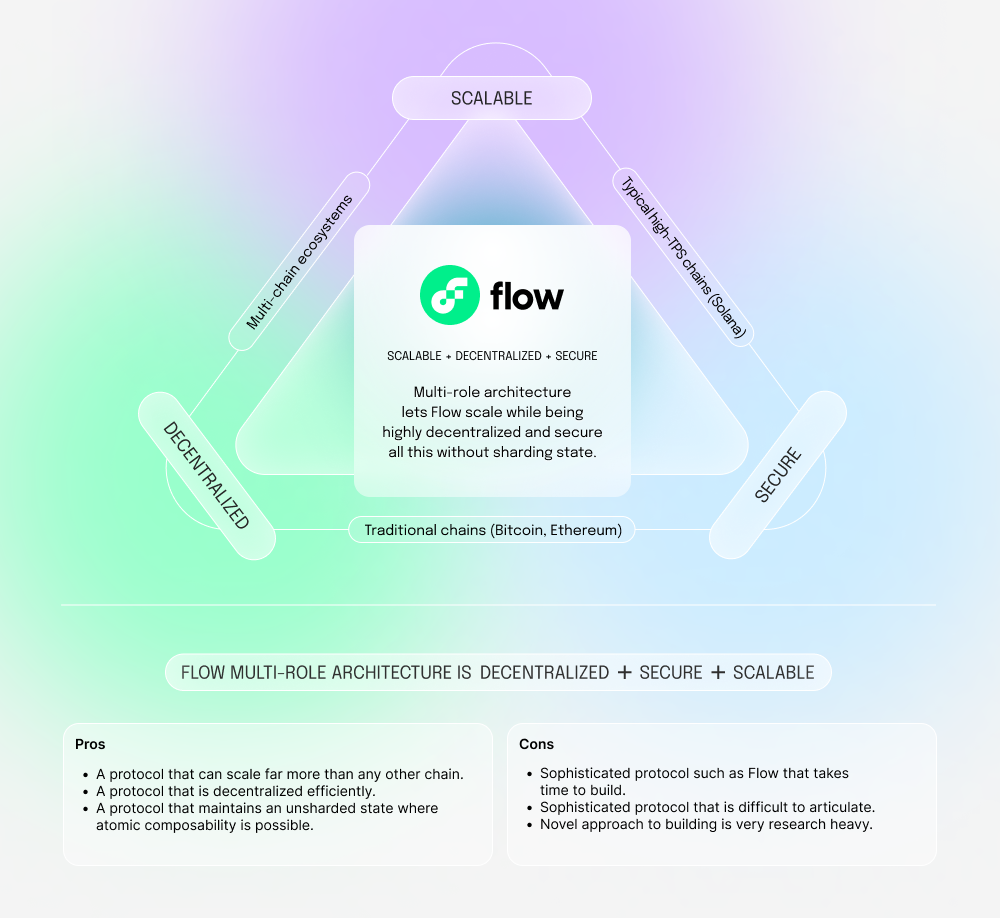
For years, the cryptocurrency and distributed ledger industry has been haunted by a persistent architectural ghost known as the “Blockchain Trilemma.” This theoretical constraint suggests that a blockchain network can realistically achieve only two of three core properties: security, scalability and decentralization. In practice, this has forced developers into a cycle of compromise, often sacrificing true decentralization to increase transaction speeds or risking security to maintain a distributed node network.
Enter MultiVAC, a high-throughput flexible blockchain platform that claims to break this cycle. By implementing a structural pivot centered on dynamic sharding and a novel consensus mechanism, MultiVAC aims to provide a framework where developers can adjust the trade-offs between the trilemma’s pillars based on their specific industrial needs. The project positions itself not merely as a series of code tweaks, but as a fundamental shift in how distributed ledgers handle data and validation.
As of April 2026, the project continues to face scrutiny over whether its ambitious technical framework can translate from a theoretical “whiteboard exercise” into a functioning global computer. At the heart of the debate is whether MultiVAC’s approach to “all-dimensional sharding” can truly maximize throughput without introducing critical vulnerabilities or centralizing power among a few high-performance nodes.
The Persistent Struggle of the Blockchain Trilemma
To understand the significance of MultiVAC’s claims, one must first understand the friction inherent in traditional blockchain designs. In standard Proof of Work (PoW) or Proof of Stake (PoS) systems, every single node in the network is typically required to validate every transaction. While this ensures a gold standard of security and decentralization, it creates a massive latency nightmare as the network grows. This bottleneck means that as more users join, the system often slows down, leading to the “state bloat” problem where the sheer volume of data becomes unmanageable for average hardware.
Most existing projects attempt to solve this by cutting corners—either by reducing the number of validating nodes (which compromises decentralization) or by implementing layers that may introduce novel security risks. MultiVAC proposes a different path: a flexible computing framework that allows the network to scale processing power linearly. In this model, the addition of more nodes increases the overall capacity of the network rather than adding to the validation burden of existing nodes.
MultiVAC’s Engineering Strategy: Dynamic and All-Dimensional Sharding
The cornerstone of the MultiVAC architecture is “dynamic sharding.” Sharding, in a general sense, involves splitting the blockchain into smaller, manageable pieces called “shards,” each capable of processing its own set of transactions. However, MultiVAC pushes this further with what it terms an “all-dimensional sharding solution” to increase transactions per second (TPS) and maintain a trustless nature via its official platform.
To prevent the fragmentation that often plagues sharded networks, MultiVAC utilizes an asynchronous cross-shard communication model. This allows different shards to communicate and verify data without requiring every node in the entire network to be aware of every transaction. By doing so, the platform attempts to solve the CAP Trilemma—the trade-off between Consistency, Availability, and Partition Tolerance—providing a level of flexibility designed for industrial-scale capabilities.
Despite these innovations, some experts remain cautious. Dr. Naomi Korr, Tech Editor at memesita.com, has questioned whether these engineering gambles can truly overcome the inherent risks of state bloat and whether the asynchronous model can maintain absolute security under extreme network stress in her recent review.
From Science Fiction to Distributed Ledgers
The project’s identity is deeply rooted in science fiction, drawing its name from Isaac Asimov’s short story, The Last Question. In Asimov’s narrative, MultiVAC is a cosmic supercomputer that evolves over eons, eventually merging with all human souls and existing beyond the constraints of space and time. The story culminates in the computer discovering how to reverse entropy, leading to the pronouncement: “Let There Be Light.”

This naming convention serves as a metaphor for the project’s ambitions. Just as the fictional MultiVAC sought to solve the ultimate question of the universe, the blockchain platform seeks to solve the ultimate question of distributed ledger technology: how to achieve infinite scalability without losing the trustless, decentralized essence of the blockchain. The phrase “Let There Be Light” is frequently used in the project’s branding to signal a new era of blockchain transparency and efficiency.
Market Position and the MTV Token Ecosystem
The economic engine of the network is the MTV token. According to data from CoinMarketCap, the token has experienced significant volatility since its inception. As of current tracking, the MTV token is priced at approximately $0.0002198, with a 24-hour trading volume of $203.19K.
The financial metrics of the project reveal a stark contrast between its early peaks and its current market standing. The token reached an all-time high of $0.02917 on October 27, 2021, representing a decline of over 99% from its peak. Conversely, its all-time low was recorded on March 13, 2020, at $0.0001476. Currently, the project maintains a market capitalization of $788.51K, with a total supply of 10 billion MTV and a circulating supply of 3.58 billion MTV.
For developers and investors, the value of the MTV token is tied to the adoption of its flexible computing framework. As the platform allows developers to “trade-off freely” between the elements of the blockchain trilemma, the project’s success depends on whether industrial users find this flexibility more valuable than the rigid security of established networks like Bitcoin or the ecosystem dominance of Ethereum.
Key Takeaways: MultiVAC and the Trilemma
- The Goal: To solve the Blockchain Trilemma (Security, Scalability, Decentralization) using a flexible computing framework.
- The Tech: Utilizes dynamic and “all-dimensional” sharding combined with an asynchronous cross-shard communication model to scale linearly.
- The Inspiration: Named after Isaac Asimov’s supercomputer from The Last Question, symbolizing the quest for an ultimate technical solution.
- Market Status: The MTV token currently holds a market cap of $788.51K, reflecting a significant drop from its 2021 all-time high of $0.02917.
- The Controversy: Analysts debate whether the system is a viable “global computer” or a theoretical exercise that may still struggle with state bloat.
As MultiVAC continues to iterate on its sharding models, the industry will be watching to see if the platform can move beyond its current market valuation and prove its utility in real-world industrial applications. The next critical checkpoint for the project will be the successful deployment of high-throughput use cases that demonstrate its “all-dimensional” sharding in a live, stressed environment.
Do you believe dynamic sharding is the answer to the blockchain trilemma, or is a fundamental redesign of consensus required? Share your thoughts in the comments below.