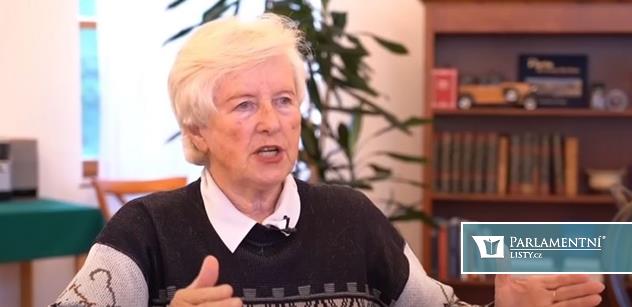
In a candid and stark assessment of the current global and domestic climate, Professor Anna Hogenová has expressed a bleak outlook on the state of humanity and governance. Speaking on the intersection of political instability and moral decay, Hogenová argues that “evil is winning,” suggesting that a systemic failure of character and a collective silence from the public are allowing destructive forces to prevail.
The discourse centers on the current administration led by Andrej Babiš, whom Hogenová believes must implement specific legislative and systemic changes to restore a sense of equity. Her demands include the establishment of “justice in the media,” the adoption of a FARA-style law (Foreign Agents Registration Act) and the complete abolition of emission permits. These proposals are presented not merely as policy shifts, but as necessary corrections to a society she describes as being driven by “hidden commands” and “cunning.”
Hogenová’s critique extends beyond the halls of government to the streets of Prague, specifically targeting the “Million Moments” (Milion chvilek) protests. She dismisses the notion that these gatherings were spontaneous expressions of public will, claiming instead that the participants are “blind, superficial, and flat,” driven by a misunderstood fear that political figures—including Babiš, Okamura, and international leaders like Putin and Orbán—intend to grab away their lives.
This perspective comes at a time of heightened international tension, with Hogenová noting the psychological toll of conflicts in the Persian Gulf and Ukraine. She describes her own feeling of a “lost life,” reflecting a deep disillusionment with the human condition, citing the psychological experiments of Zimbardo and Milgram as evidence that humans may behave more like animals than rational, moral beings.
Legislative Demands and the Push for Media Justice
Central to Professor Hogenová’s vision for a corrected state is the belief that the current media landscape is fundamentally unjust. She calls upon the Babiš government to prioritize “justice in the media,” suggesting that the current flow of information is skewed or manipulated. To combat this, she advocates for the introduction of a law modeled after the U.S. Foreign Agents Registration Act (FARA). Such a law would require individuals or entities acting on behalf of foreign principals to disclose their relationships and activities, thereby increasing transparency regarding foreign influence in domestic politics.
Beyond media and transparency, Hogenová targets environmental economic policy, specifically calling for the removal of emission permits. This stance aligns with a broader critique of globalist economic structures that she believes contribute to the current systemic instability. For Hogenová, these are not merely administrative changes but are essential steps to counter the “evil” she perceives as dominating the global stage.
Critique of the ‘Million Moments’ Protests
The “Million Moments” demonstrations, often framed by organizers as a fight for democracy, the independence of Czech Television, and a struggle against “Russian-style laws” regarding non-profits, are viewed very differently by Hogenová. She asserts that the movement is not spontaneous and that the protesters are operating under a delusion. According to Hogenová, these individuals believe that a coalition of figures—including Andrej Babiš, Tomio Okamura, members of the Motorists party, Viktor Orbán, and Vladimir Putin—are actively conspiring to destroy their lives.
She argues that the participants are unable to connect individual events into a coherent picture, instead following a narrative that leads them to demonstrate under the guise of protecting public broadcasting. In her view, the protests serve as a testament to a lack of understanding among the populace, describing the demonstrators as being trapped in a state of superficiality.
Global Conflict and the Psychology of Violence
Hogenová’s analysis of the current geopolitical situation is marked by a profound sense of tragedy. She points to the ongoing conflict in Ukraine and recent escalations in the Persian Gulf, including mentions of U.S. Actions under Donald Trump against Iran, as evidence of a world consumed by crime and violence. She expresses bewilderment that people in Ukraine have not yet realized the specific interests for which they are dying.
Of particular concern to the professor is the “joy of war” she perceives in some of her fellow citizens. She notes that some individuals support arming and a “hard policy” toward Russia, or even celebrate military strikes. Hogenová contends that a “great and honest person cannot have joy in killing,” and views the celebration of such violence as a symptom of the moral collapse she describes.
To explain this behavior, she references the psychological tests of Philip Zimbardo and Stanley Milgram. By invoking these studies—which explored obedience to authority and the situational triggers of cruelty—she suggests that human reason is often used merely for “cunning” and “deceit,” rather than for the pursuit of genuine Good.
Key Takeaways from Hogenová’s Perspective
- Political Demands: Calls for the Babiš government to implement a FARA-style transparency law, ensure “media justice,” and scrap emission permits.
- Social Critique: Views the “Million Moments” protests as non-spontaneous and driven by a misunderstood fear of political figures.
- Global Outlook: Describes the conflicts in Ukraine and the Persian Gulf as crimes and laments the public’s perceived “joy” in warfare.
- Psychological View: Suggests that human nature, as evidenced by the Zimbardo and Milgram experiments, is prone to following hidden commands and acting on instinct rather than morality.
As the political landscape in the Czech Republic continues to evolve, the focus remains on the government’s response to opposition pressure and the implementation of its legislative agenda. The next critical checkpoints will be the government’s official stance on media transparency laws and the ongoing diplomatic engagements regarding international security summits.
World Today Journal encourages readers to share their thoughts on the intersection of media transparency and political stability in the comments below.
Related reading