
Pennsylvania Governor Josh Shapiro has intensified his criticism of President Trump regarding the ongoing US-Iran conflict, raising serious concerns over the legality and strategic clarity of the administration’s military actions. As the conflict continues to shape global geopolitics, Shapiro has emerged as a prominent voice questioning the unilateral nature of the executive branch’s decision-making process.
The tension between the governor and the president underscores a deeper divide within the U.S. Government regarding the use of military force and the adherence to constitutional guardrails. Speaking on the current state of the conflict, Shapiro has strongly criticized the administration’s approach, suggesting that the path to war was taken without sufficient justification or legislative oversight reported by the Wall Street Journal.
At the heart of the dispute is the balance of power between the presidency and Congress. Shapiro argues that the decision to engage in a conflict of this magnitude should not rest solely with one individual, but should be the result of a democratic process involving elected representatives.
Constitutional Concerns Over Unilateral Action
In a formal statement released on February 28, 2026, Governor Shapiro addressed President Trump’s decision to strike Iran, framing the action as a departure from American democratic traditions official statement from Governor Shapiro. He emphasized that the Framers of the U.S. Constitution specifically vested the power to decide when the nation goes to war in Congress to avoid the grave consequences of unchecked executive power.
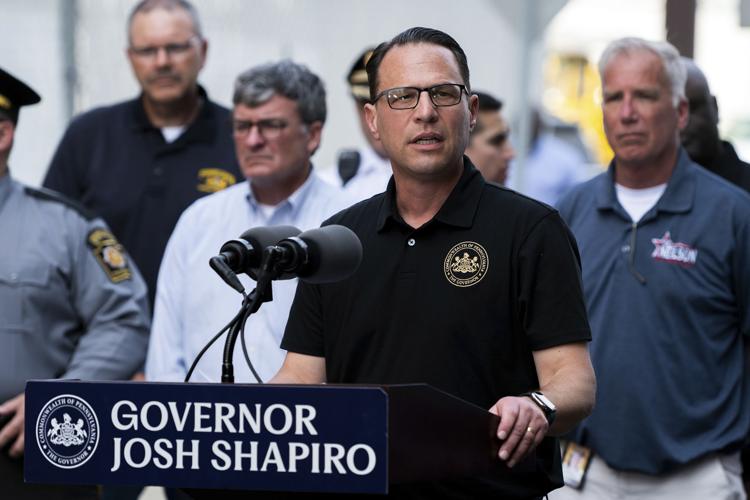
Shapiro asserted that President Trump acted unilaterally and outside the “guardrails” established by the founders in Philadelphia nearly 250 years ago. By bypassing Congressional approval, the governor contends that the administration has undermined the democratic process and ignored the constitutional requirements for entering a military campaign.
The governor’s critique extends beyond the legalities to the lack of transparency regarding the mission’s goals. According to the February 28 statement, the President has not adequately explained the urgency of the current conflict, the specific nature of the military campaign, or the ultimate strategic objective.
The Shift Toward Regime Change
A significant point of contention for Governor Shapiro is the apparent contradiction in the administration’s stated goals. Shapiro noted a sharp pivot in the President’s rhetoric, observing that only a few days prior to the strikes, the administration appeared to be seeking a deal to dismantle Iran’s nuclear program. This shift was particularly jarring given that President Trump had claimed just a few months earlier that the program was already completely destroyed official statement from Governor Shapiro.
The transition from seeking a diplomatic nuclear agreement to declaring a war for regime change is a move Shapiro finds problematic. The governor pointed out that the President had previously stated he would not pursue regime change, making the current military objective a reversal of prior commitments.
The volatility of these policy shifts has contributed to what some observers describe as “Iran War chaos,” a topic further explored in recent discussions regarding the governor’s perspective on the administration’s foreign policy.
Impact on the Iranian People and Global Stability
While criticizing the U.S. Administration’s methods, Governor Shapiro has remained clear regarding his view of the Iranian government. He acknowledged that the Iranian regime is a leading state sponsor of terrorism and represses its own citizens, stating that the regime must never be allowed to possess nuclear weapons official statement from Governor Shapiro.
Shapiro highlighted the human cost of the regime’s cruelty, noting that in recent weeks, tens of thousands of brave Iranians have died while standing up for their freedoms official statement from Governor Shapiro. He argued that the people of Iran deserve a government that respects their rights and pursues their interests peacefully, rather than through the violence and intimidation practiced by the current regime.
The governor’s position suggests that while the Iranian regime poses a direct threat to global peace and stability, the solution should not involve unilateral military actions that lack a clear strategic end-game or the support of the American legislature.
Key Points of Contention
- Constitutional Authority: Shapiro argues that war powers belong to Congress, and unilateral executive action violates the U.S. Constitution.
- Strategic Ambiguity: The administration has failed to define the urgency or the specific strategic objectives of the military campaign.
- Policy Reversals: The shift from pursuing a nuclear deal to seeking regime change contradicts earlier presidential claims.
- Humanitarian Concern: Recognition of the Iranian people’s struggle for freedom against a repressive regime.
As of April 9, 2026, the conflict continues to generate significant political friction within the United States. Governor Shapiro’s criticisms reflect a broader Democratic concern regarding the administration’s approach to international conflict and the erosion of traditional checks and balances.
The next critical phase of this conflict will depend on whether the administration provides the strategic clarity requested by critics or if further military escalations occur without Congressional intervention. We will continue to monitor official updates from the White House and the Pennsylvania Governor’s office as the situation evolves.
Do you believe the President should have unilateral authority to strike foreign targets in the interest of national security, or should Congressional approval be mandatory? Share your thoughts in the comments below.