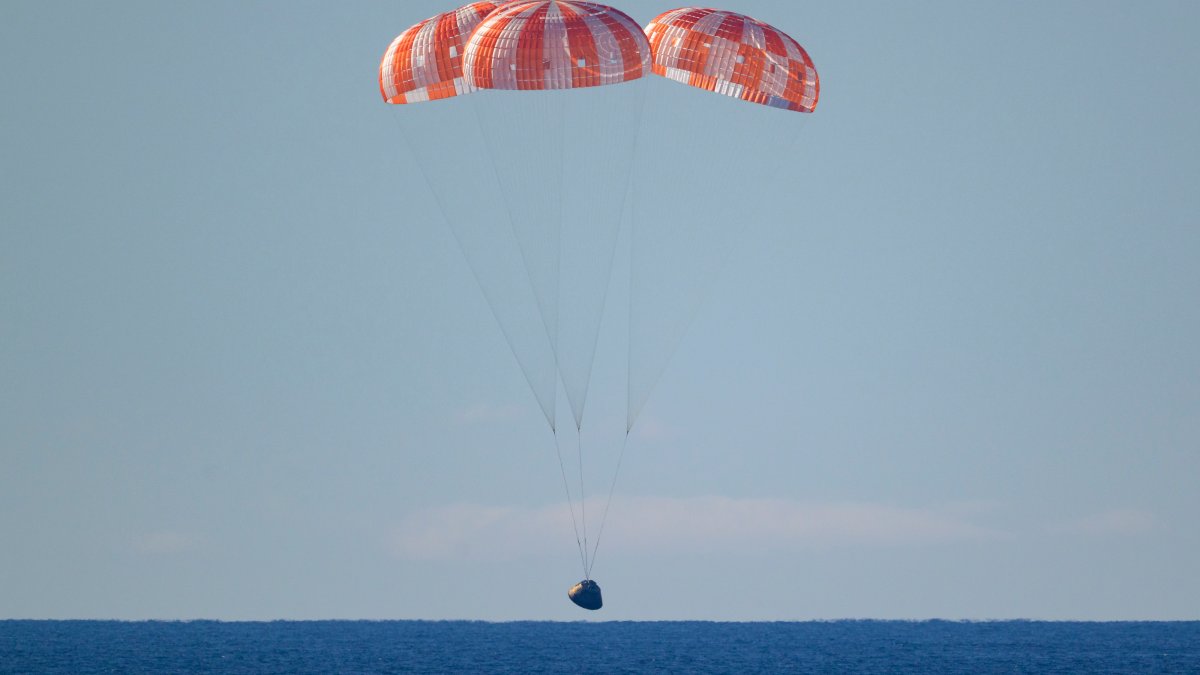
The silence of the deep void was replaced by the roar of atmospheric friction on Friday, April 10, 2026, as the crew of Artemis II completed a historic journey that pushed humanity further into space than ever before. In a dramatic conclusion to the mission, the crew splashed down in the Pacific Ocean off the coast of California, marking the first time humans have ventured toward the moon in over half a century CNN.
The return was a masterclass in precision and endurance. The four-person crew—Commander Reid Wiseman, pilot Victor Glover, Christina Koch, and Canada’s Jeremy Hansen—returned aboard the Orion capsule, named Integrity. The mission, which began with a launch from Florida on April 1, served as a critical test flight for NASA’s broader ambitions to establish a sustainable human presence on the lunar surface NASA (.gov).
As the world watched the final descent, the mission transitioned from the quiet of a record-breaking lunar flyby to the violent intensity of reentry. The crew hit the Earth’s atmosphere traveling at Mach 33—33 times the speed of sound—creating a blistering blur of heat and plasma that mirrored the Apollo moonshots of the 1960s and 1970s NBC 7 San Diego.
A High-Velocity Homecoming
The reentry phase was fraught with tension, specifically during the peak heating period when the capsule became engulfed in red-hot plasma. This process triggered a planned six-minute communication blackout, leaving Mission Control in a state of anxious anticipation. The safety of the crew depended entirely on the Orion capsule’s heat shield, which had to withstand thousands of degrees of temperature. This was a particular point of concern for engineers, as the shield used during a 2022 uncrewed test flight returned with a charred, pockmarked exterior.
Lead flight director Jeff Radigan admitted to feeling the “irrational fear that is human nature” during the blackout. However, the automatic pilot navigated the descent perfectly. The spacecraft screamed back at 36,170 feet (11,025 meters) per second—approximately 24,661 mph (39,668 kph)—before slowing drastically for the final impact. The recovery ship USS John P. Murtha, supported by military planes and helicopters, was positioned off the San Diego coast to retrieve the crew. The descent ended with a gentle 19 mph (30 kph) splashdown, which Mission Control’s Rob Navias described as a “perfect bull’s-eye splashdown.”
Breaking Records in the Deep Void
While the Artemis II lunar voyage did not land on the moon or enter its orbit, it achieved unprecedented milestones. The crew broke the distance record previously held by Apollo 13, reaching a maximum distance of 252,756 miles (406,771 kilometers) from Earth. This marks the farthest humans have ever journeyed into the cosmos.
During the flyby, the crew documented views of the moon’s far side—landscapes never before witnessed by human eyes—and experienced a total solar eclipse. Pilot Victor Glover noted that the eclipse “just blew all of us away.” The mission also produced a stunning “Earthset” photograph, depicting the “Blue Marble” of Earth setting behind the gray lunar horizon, a modern echo of the famous “Earthrise” image captured by Apollo 8 in 1968.
The journey was marked by moments of profound emotion. At one point, the crew requested permission to name two lunar craters after their spacecraft, Integrity, and Commander Wiseman’s late wife, Carroll. The mission’s global impact was reflected in tributes from world leaders and cultural icons, including King Charles III of Britain, Canadian Prime Minister Mark Carney, and U.S. President Donald Trump.
Triumph Over Technical Tribulations
Despite the overarching success of the nearly 10-day flight, the mission provided critical data on the vulnerabilities of deep-space hardware. The crew dealt with several technical malfunctions, including valve problems within both the propellant and drinking water systems. Most notably, the onboard toilet suffered repeated malfunctions, a predicament the astronauts handled with professional resolve.
Christina Koch emphasized the necessity of these challenges for future exploration, stating, “People can’t explore deeper unless we are doing a few things that are inconvenient, unless we’re making a few sacrifices, unless we’re taking a few risks, and those things are all worth it.” Jeremy Hansen added that while ground testing is extensive, the final test in space is always a “doozy.”
The Roadmap to the Lunar South Pole
The success of Artemis II clears the path for the next phases of the Artemis program. NASA has designed these early missions as stepping stones toward a permanent lunar base. The upcoming Artemis III mission, scheduled for next year, will focus on practicing the docking of the Orion capsule with lunar landers in Earth orbit. Following that, Artemis IV is projected to attempt a crewed landing near the moon’s south pole in 2028.
For Commander Reid Wiseman and his crew, the mission was as much about perspective as it was about physics. He expressed a hope that the voyage would encourage the world to “pause and remember that This represents a beautiful planet and a exceptionally special place in our universe, and we should all cherish what we have been gifted.”
| Metric | Detail |
|---|---|
| Max Distance from Earth | 252,756 miles (406,771 km) |
| Reentry Speed | Mach 33 (approx. 24,661 mph) |
| Splashdown Speed | 19 mph (30 kph) |
| Mission Duration | Approximately 10 days |
| Launch Date | April 1, 2026 |
The crew is now undergoing post-flight recovery and debriefing. The next confirmed milestone for the program is the preparation for Artemis III, which will involve critical docking maneuvers in orbit to ensure the safety of the first humans to return to the lunar surface. We invite our readers to share their thoughts on this historic achievement in the comments below.
Related reading