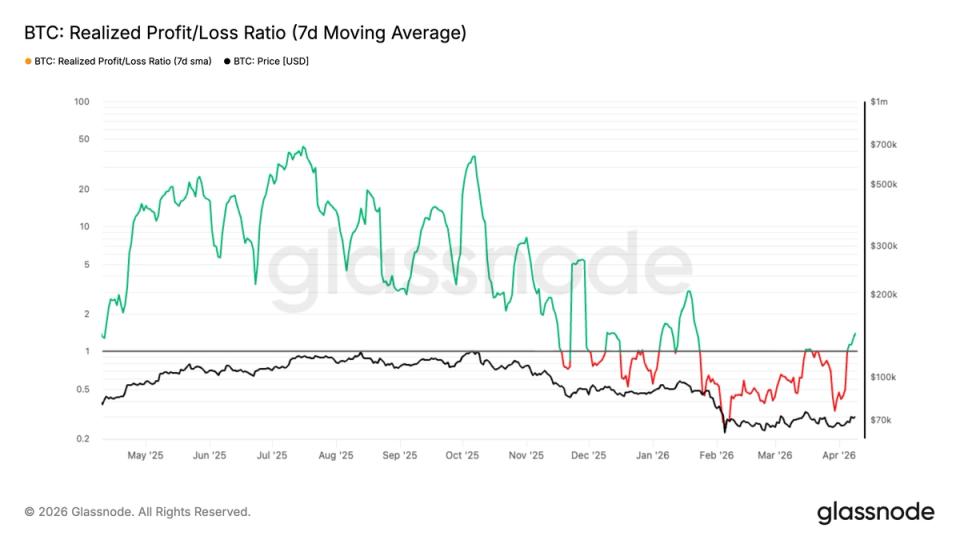
The cryptocurrency market is currently grappling with a period of significant financial stress, as a substantial portion of Bitcoin holders face mounting losses. Recent on-chain data suggests a climate of “market fear,” characterized by a prolonged sideways movement where the leading cryptocurrency has remained under the $70,000 threshold.
For many institutional and high-net-worth investors, the current phase is one of capitulation. Large-scale investors, often referred to as “whales” and “sharks,” are absorbing heavy realized losses. According to data from Glassnode, wallets holding between 100 and 10,000 Bitcoin have been realizing losses exceeding $200 million daily, based on a seven-day moving average reported on April 5, 2026.
This trend is particularly acute among “long-term holders”—those who acquired their assets more than six months ago, coinciding with the peaks of the previous rally. The 30-day simple moving average of realized losses for this group has been steadily climbing since November 2025, signaling that experienced investors are increasingly selling at a loss to exit their positions.
While the provided topic suggests a potential signal of seller exhaustion as realized losses decline from peaks of $2 billion to $400 million per day, current verified data indicates that the market has not yet reached a definitive “bottom.” Glassnode analysts note that a structural exhaustion—which typically precedes a new bullish cycle—is generally only confirmed when daily realized losses drop below $25 million.
The Scale of the “Underwater” Market
The breadth of the current downturn is reflected in the volume of Bitcoin trading “underwater,” meaning the current market price is lower than the price at which the assets were purchased. By late March 2026, nearly half of all circulating Bitcoin was being traded at a loss per CoinDesk reporting on March 30, 2026.
The Bitcoin Impact Index, which monitors financial stress based on on-chain behavior, ETF activity, and liquidity flows, rose to 57.4 in the week ending March 28. This represents the steepest increase since January and indicates a “high stress level” for users across various cohorts. Specifically, over 4.6 million BTC held in long-term wallets have moved into the negative, contributing to realized losses that are at their worst level since 2023.
Shifting Capital Flows and Institutional Behavior
The market’s supporting pillars have shown signs of fragility. Previously positive capital flows have reversed; stablecoin inflows have turned into outflows, and both miners and Exchange Traded Funds (ETFs) have shifted from accumulating Bitcoin to selling. Despite this, data suggests that individual holders have not yet begun depositing BTC into exchanges in massive numbers, which may indicate a remaining pocket of resilience among some retail investors.
Analyzing the Psychology of Capitulation
In financial terms, capitulation occurs when investors give up hope of a price recovery and sell their assets regardless of the loss. This “cleansing” of the market is typical of a bear market phase. When long-term holders—who typically have higher conviction—begin to sell at a loss, it often indicates that the selling pressure is reaching a peak.
However, the gap between current realized losses and the $25 million threshold mentioned by analysts suggests that the “strongest bearish sentiment since months” is still dominating the price action. For a reversal to occur, the market must move from a state of active panic to one of exhaustion, where there are simply no more sellers left to push the price lower.
Case Study: Individual High-Profile Losses
The volatility of the market has affected a wide range of participants, from institutional whales to political insiders. For example, on January 26, 2026, a Trump-linked insider reportedly closed positions consisting of 427 Bitcoin and 30,588 Ethereum, realizing a loss of approximately $9.73 million via X (Twitter).
Summary of Market Stress Indicators
| Metric | Value/Status | Significance |
|---|---|---|
| Bitcoin Impact Index | 57.4 | High stress level (steepest rise since Jan) |
| Daily Whale Losses | >$200 Million | Significant capitulation by 100-10,000 BTC holders |
| Underwater BTC | ~50% of supply | Nearly half of all BTC held at a loss |
| Bullish Threshold | < $25 Million | Target daily loss level to signal a new cycle |
As the market continues to navigate this sideways phase under $70,000, the focus remains on whether the current selling pressure is a temporary dip or a deeper structural shift. The transition from high realized losses to a state of exhaustion will be the key metric for analysts attempting to predict the start of a new bullish cycle.
Investors are encouraged to monitor official on-chain data updates from platforms like Glassnode and official ETF filing reports to track the movement of institutional capital.
We invite our readers to share their perspectives on the current market volatility in the comments section below.
Keep reading