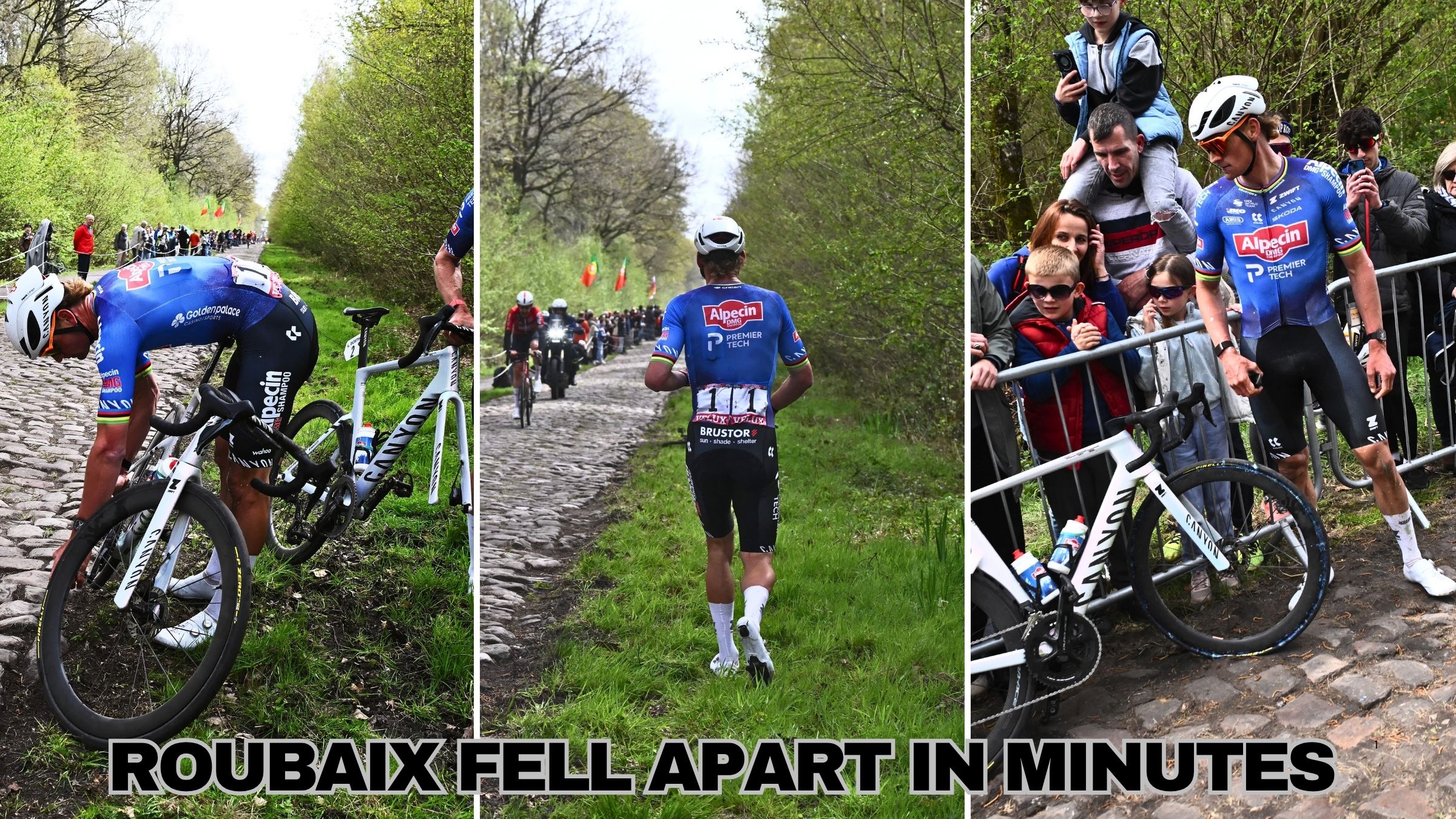
The quest for a fourth Paris-Roubaix title ended in a chaotic sequence of mechanical failures for Mathieu van der Poel. In a race defined by the brutal terrain of Northern France, the Alpecin-Premier Tech star saw his ambitions collapse during a harrowing experience on the Trouée d’Arenberg, where a van der Poel pedal fiasco and punctures combined to strip the defending champion of his competitive edge.
The drama unfolded with 94km remaining in the race, as van der Poel suffered an initial puncture on the notorious cobblestone sector. In a desperate bid to keep his race alive, he attempted to switch to a bike offered by teammate Jasper Philipsen. Though, what should have been a routine equipment swap became a public struggle, as van der Poel appeared unable to clip into the pedals of the replacement machine.
This struggle was not merely a matter of poor luck but a glimpse into the cutting edge of cycling technology. The bike provided by Philipsen was equipped with unreleased prototype pedals from Shimano. The inability of van der Poel to engage with the pedals strongly suggests that Shimano is developing a new system—likely to be called SPD-SLR—that utilizes a different cleat design than the current SPD-SL standard reported by BikeRadar.
The incident left the Dutchman stranded and desperate, forced to watch as rivals Wout van Aert and World Champion Tadej Pogačar surged ahead. The sequence of events on the Arenberg transformed a bid for victory into a fight for survival, highlighting how marginal gains in equipment can occasionally lead to catastrophic losses when compatibility fails in the heat of competition.
The Arenberg Nightmare: A Timeline of Mechanical Failure
The Trouée d’Arenberg is widely regarded as the most decisive sector of Paris-Roubaix, and for van der Poel, it became the site of a double mechanical disaster. The first puncture forced him to dismount quickly at the side of the road. As Jasper Philipsen offered his bike, the two riders shared a moment of pure desperation; Philipsen even ran alongside van der Poel, pushing him while the Dutchman struggled to clip in according to CyclingNews.
Un minuto y medio de pura desesperación y agonía. Mathieu Van der Poel pincha, no puede arrancar con la bici de su compañero y pierde casi todas sus opciones de lograr su cuarta #ParisRoubaix. 🚴♂️ El ‘Infierno del Norte’, más infierno que nunca.
After abandoning the attempt to use Philipsen’s bike—which some reports suggest also appeared too small for him—van der Poel walked back against the flow of traffic to retrieve his own abandoned frame. In a display of composure amidst the chaos, teammate Tibor del Grosso used an Allen key to swap a front wheel into van der Poel’s bike. However, the respite was short-lived. With 91km still to go and while still on the Arenberg sector, van der Poel suffered a second puncture.
By the time he was moving again, the damage was done. He had fallen over two minutes behind the lead group, which included riders such as Christophe Laporte, Stefan Bissegger, and Laurence Pithie. The time loss was insurmountable, effectively ending his hopes of securing a fourth victory in the “Hell of the North.”
Shimano’s Prototype Secret Revealed
While the punctures were a matter of misfortune, the pedal incident has sparked intense interest in the cycling industry. The prototype pedals spotted on Jasper Philipsen’s bike closely resemble the existing Dura-Ace PD-R9100 models, but subtle changes suggest a significant shift in design. Specifically, a slimmer central section indicates that Shimano is pursuing a lower stack height, bringing the rider’s foot closer to the pedal axle for improved stability and efficiency as detailed by BikeRadar.
The fact that van der Poel—one of the most experienced professionals in the peloton—could not clip into these pedals confirms that the new system is not backward-compatible with existing cleats. This “arms race” for marginal gains means that teams must be meticulously coordinated; a teammate offering a bike with a different pedal system is, in a race like Paris-Roubaix, a gesture that can be functionally useless.
Key Technical Implications of the Pedal Swap
- Cleat Incompatibility: The inability to clip in confirms a departure from the SPD-SL standard.
- Stack Height Reduction: The slimmer profile aims to improve power transfer and stability.
- Prototype Risk: The use of unreleased gear in a major classic introduces variables that can derail a favorite’s race.
The Impact on the Race Dynamics
The collapse of van der Poel’s bid shifted the gravity of the race. With the defending champion neutralized, the battle for the win intensified among the front group. Wout van Aert (Visma-Lease a Bike) and Tadej Pogačar (UAE Team Emirates-XRG) were among those who successfully navigated the Arenberg without the same catastrophic luck.
Pogačar’s own race had not been without drama; he had previously been forced to use a neutral service bike after puncturing on the Quérénaing à Maing sector. However, unlike van der Poel, Pogačar was able to recover and remain in contention, illustrating the thin margin between a recoverable mistake and a race-ending disaster.
For Alpecin-Premier Tech, the day was a lesson in the volatility of the Classics. Despite the tactical support of Philipsen and del Grosso, the combination of road hazards and incompatible prototype technology created a scenario where no amount of teamwork could bridge the gap to the leaders.
Summary of the Arenberg Incident
| Event | Distance Remaining | Outcome |
|---|---|---|
| First Puncture | 94km | Dismounted; attempted bike swap with Philipsen. |
| Pedal Fiasco | 94km | Unable to clip into prototype Shimano pedals; returned to own bike. |
| Wheel Change | 94km | Tibor del Grosso replaced front wheel using Allen key. |
| Second Puncture | 91km | Lost over two minutes; race effectively ended. |
As the cycling world awaits the official release of the Shimano SPD-SLR system, the image of van der Poel struggling to clip into a teammate’s bike will likely serve as a cautionary tale regarding the implementation of prototype technology in high-stakes racing.
With the 2026 spring classics season continuing, the focus now shifts to how teams will manage equipment standardization to avoid similar mishaps. We will continue to monitor official announcements from Shimano regarding the release date and specifications of their new road pedal system.
Do you think the pursuit of marginal gains with prototype equipment is worth the risk in the Classics? Share your thoughts in the comments below.
Related reading