
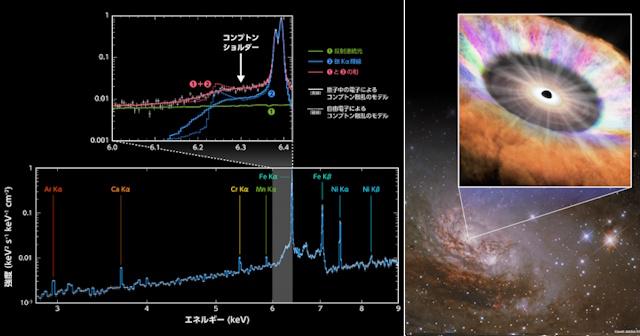
Astronomers have unlocked a new understanding of the life and death of massive stars by analyzing the chemical composition near a supermassive black hole. Using the advanced capabilities of the X-ray Imaging Spectrometer (XRISM), an international research team has detected a peculiar elemental signature in the Compass Galaxy, located approximately 13 million light-years from Earth.
The discovery, published on March 31, 2026, in the journal Nature Astronomy, reveals that the gas and dust surrounding the black hole—known as the torus—contains a chemical makeup that differs significantly from our own solar system. Specifically, researchers found that the ratios of argon and calcium relative to iron are lower than solar levels, while the proportion of nickel is notably higher JAXA.
This specific chemical pattern provides a rare glimpse into the “fate of heavy stars.” The data suggests that many stars with masses more than 20 times that of our Sun may not end their lives in a traditional supernova explosion. Instead, they may collapse directly into black holes—a phenomenon often referred to as “failed supernovae” or “dark supernovae” Mynavi News.
The breakthrough was made possible by the XRISM satellite’s ability to capture high-resolution “fluorescence X-rays.” These X-rays are produced when continuous X-rays from a high-temperature corona near the supermassive black hole strike the surrounding torus of gas and dust, causing the elements within that material to emit characteristic X-ray light.
Decoding the Chemical Signature of the Compass Galaxy
Understanding the chemical composition of galactic centers is critical for scientists to grasp how stars are born, how they die, and how matter flows into supermassive black holes. Until now, the precise elemental makeup of these regions remained elusive due to the limitations of observational precision. The XRISM mission has overcome these hurdles, allowing the team to measure the chemical composition near the supermassive black hole (SMBH) with unprecedented accuracy.
The research was led by a collaborative international team, including Professor Yoshihiro Ueda and Dr. Ryosuke Uematsu from Kyoto University, as well as Assistant Professors Shoji Ogawa and Kotaro Fukushima from Tokyo University of Science. In total, 140 researchers participated in the effort known as The XRISM Collaboration Mynavi News.
By focusing on the “fluorescence X-rays” emitted from the torus, the team could identify the specific abundance of elements. The discovery of low argon and calcium levels combined with high nickel levels is the key evidence pointing toward the “failed supernova” scenario. In a standard supernova, these elements are dispersed into the surrounding space; however, if a massive star collapses directly into a black hole, the distribution of elements left behind in the galactic environment changes dramatically.
The Mystery of ‘Failed Supernovae’
In the traditional model of stellar evolution, stars significantly larger than the Sun end their lives in a violent supernova explosion, seeding the universe with heavy elements. However, the findings from the Compass Galaxy suggest a different path for the most massive stars. When a star’s mass exceeds roughly 20 times that of the Sun, it may bypass the explosion phase entirely, collapsing inward to form a black hole without the characteristic bright flash of a supernova JAXA.
This “failed supernova” theory explains why the argon and calcium levels are lower than expected. Because these elements are not expelled into the interstellar medium via an explosion, they remain trapped or are never produced in the quantities seen in solar-like environments. The elevated nickel levels further support this specific evolutionary path, providing a “chemical fingerprint” of stars that vanished silently into the void.
This discovery is significant because it changes how astronomers calculate the “chemical history” of galaxies. If a large portion of massive stars do not explode, the rate at which heavy elements are recycled into the galaxy is lower than previously assumed, impacting our understanding of how subsequent generations of stars and planets are formed.
Key Takeaways from the XRISM Observations
- Target: The supermassive black hole at the center of the Compass Galaxy, located 13 million light-years away.
- Method: High-resolution measurement of fluorescence X-rays emitted from the torus (gas and dust layer).
- Chemical Findings: Lower levels of argon and calcium, and higher levels of nickel compared to the solar system.
- Conclusion: The data aligns with the theory that stars 20x the mass of the Sun often collapse directly into black holes without a supernova explosion.
- Publication: The results were published in Nature Astronomy on March 31, 2026 JAXA.
Technological Edge: The Power of XRISM
The success of this study highlights the technical superiority of the X-ray Imaging Spectrometer (XRISM). Unlike previous X-ray telescopes, XRISM provides the spectral resolution necessary to distinguish between the subtle signatures of different elements in extreme environments. The ability to isolate the fluorescence X-rays from the torus allows scientists to effectively “sample” the chemistry of a region millions of light-years away.

The process involves a complex interaction: the supermassive black hole is surrounded by a high-temperature corona that emits continuous X-rays. These X-rays strike the surrounding torus, and the elements within that torus absorb the energy and re-emit it as fluorescence X-rays. By analyzing the “colors” (energy levels) of these emitted X-rays, the Kyoto University team and their collaborators were able to determine the exact proportions of iron, nickel, argon, and calcium Kyoto University.
This capability opens the door to studying other active galactic nuclei (AGN) to see if the “failed supernova” phenomenon is common across the universe or unique to specific types of galaxies. It provides a new tool for mapping the chemical evolution of the cosmos, moving beyond simple observation to detailed chemical analysis.
As we continue to analyze data from the XRISM mission, the scientific community expects to uncover more about the relationship between supermassive black holes and the stars that fuel them. The ability to identify the “fate of heavy stars” provides a critical missing piece in the puzzle of galactic development.
The research team continues to analyze the data from the Compass Galaxy and other targets. Further updates regarding the chemical mapping of other supermassive black holes are expected as the XRISM mission progresses in its observational phase.
Do you think the discovery of “dark supernovae” changes our perspective on the lifecycle of the universe? Share your thoughts in the comments below or share this article with fellow space enthusiasts.