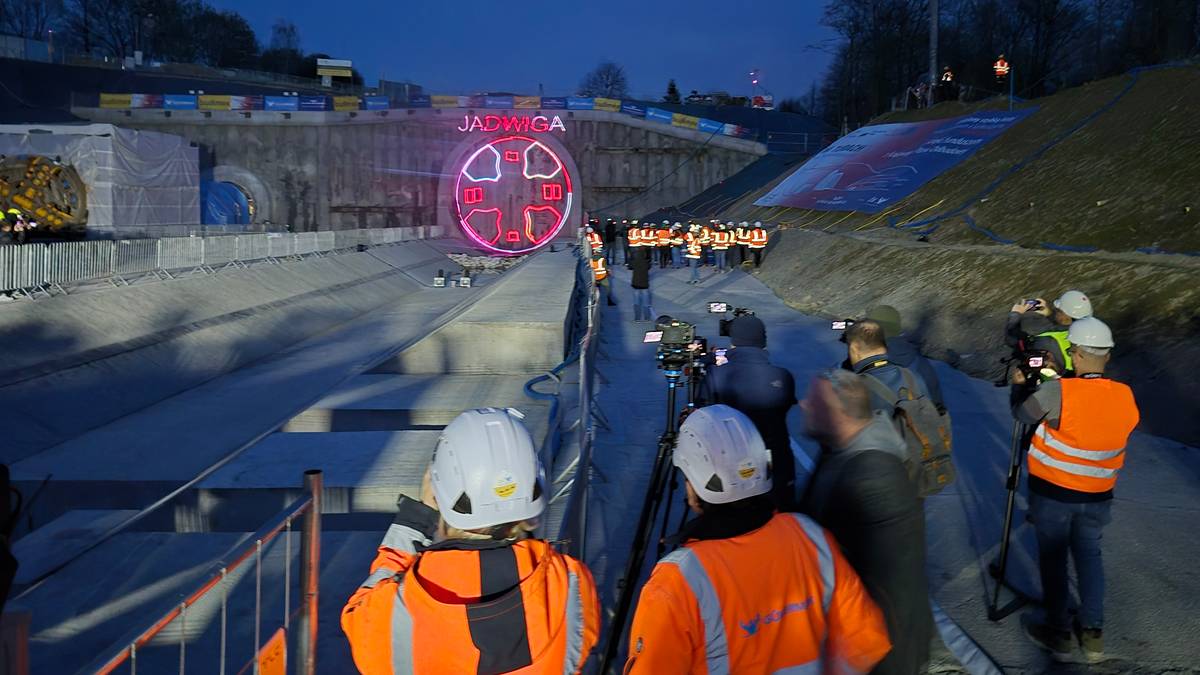
Poland has reached a significant milestone in its national infrastructure strategy as the tunnel boring machine (TBM) “Jadwiga” completed the excavation of the longest railway tunnel in Poland on Tuesday evening, April 14, 2026. The breakthrough occurred in the Małopolska province, marking the completion of the main tunnel spanning from Męcina to Mordarka according to reports from Money.pl.
This engineering achievement is a cornerstone of the modernization of railway line no. 104, specifically the segment between Limanowa and the Klęczany siding. The project is part of the broader, high-priority “Podłęże — Piekiełko” investment, which represents one of the most ambitious railway upgrades in the country’s history as detailed by Onet Wiadomości.
The completion of the main tunnel is particularly noteworthy for its efficiency. The excavation was finalized after 10 months of operation, finishing two months ahead of the projected schedule per Money.pl. While this facility is expected to be the longest of its kind in Poland upon its official opening, industry analysts suggest it may not hold this title for long as further infrastructure projects progress.
First railway tunnel in the #PodłężePiekiełko project excavated! TBM “Jadwiga” completed drilling works after 10 months.
First railway tunnel in the #PodłężePiekiełko project excavated!
Engineering Precision in the Beskid Wyspowy
The construction took place in the demanding mountainous terrain of the Beskid Wyspowy, requiring specialized equipment to penetrate the geological barriers. The project utilized two distinct tunnel boring machines to ensure both transit and safety. The TBM “Kinga” was deployed first to complete the evacuation tunnel, while the larger TBM “Jadwiga” was tasked with the primary railway tunnel according to Money.pl.
The technical specifications of “Jadwiga” underscore the scale of the operation. The machine weighs over 2,500 tons, measures nearly 90 meters in length, and possesses a cutting diameter of almost 11 meters as reported by Money.pl. This massive piece of machinery was essential for carving the main tunnel, which reaches a total length of approximately 3.75 km per Money.pl.
Financial Investment and Execution
The project is being executed by a consortium consisting of Budimex and Gulermak. The financial scope of the agreement is substantial, with the contract valued at 1.9 billion PLN net according to Money.pl. However, the consortium and stakeholders have noted that this value may increase due to the inherent volatility of market conditions.
From an economic perspective, the investment in the longest railway tunnel in Poland reflects a broader shift in Polish infrastructure policy. Artur Popko noted that such large-scale tunneling projects were rare in Poland just a few years ago but are now becoming a tangible part of a modernized railway system per Money.pl.
Project Specifications Overview
| Feature | Detail |
|---|---|
| Main Tunnel Length | Approx. 3.75 km |
| TBM “Jadwiga” Weight | Over 2,500 tons |
| Contract Value | 1.9 billion PLN net |
| Execution Timeline | 10 months (2 months ahead of schedule) |
| Contractors | Budimex and Gulermak |
Strategic Impact: The Podłęże — Piekiełko Vision
The completion of the tunnel is more than an engineering victory; it is a critical link in the Podłęże — Piekiełko project. This initiative aims to fundamentally transform rail transit in the Małopolska region, improving connectivity between major hubs and reducing travel times. The integration of this tunnel into railway line no. 104 is expected to facilitate more efficient movement of passengers and freight through the mountainous terrain of the Beskid Wyspowy per Onet Wiadomości.

For the global business community, this project signals Poland’s increasing capacity to handle complex, high-value infrastructure contracts and its commitment to aligning its transport networks with modern European standards. The use of advanced TBM technology and the ability to deliver a project of this magnitude ahead of schedule demonstrate a growing maturity in the domestic construction and engineering sector.
As the “Jadwiga” TBM concludes its primary mission, the focus now shifts to the remaining phases of the project, including internal fitting and the integration of the tunnel into the wider rail network. This will ultimately allow for a modernized connection that bridges the gap between the regional centers of Małopolska and the rest of the national grid.
The next major milestone for the project will be the completion of the internal railway infrastructure and the subsequent testing phase before the line is opened to traffic. Official updates regarding the final commissioning date are expected from the project consortium and the relevant transport authorities.
We invite our readers to share their thoughts on Poland’s infrastructure expansion in the comments below. How do you see these developments impacting regional trade and transit?