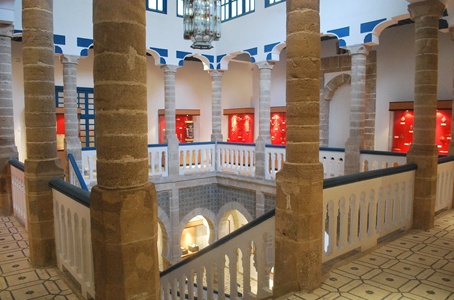
Morocco is taking a significant step toward preserving its coastal heritage with a new strategic partnership aimed at revitalizing one of Essaouira’s most historic cultural landmarks. On Monday, April 13, 2026, a comprehensive partnership convention was signed in Rabat to oversee the rehabilitation and valorization of the Musée Sidi Mohammed Ben Abdellah, a move designed to modernize the visitor experience while safeguarding the city’s unique historical identity.
The agreement, signed at the headquarters of the Musée Mohammed VI d’art moderne et contemporain, brings together high-level institutional and territorial actors. The signatories include Mehdi Bensaid, the Minister of Youth, Culture, and Communication; André Azoulay, President of the Association Essaouira-Mogador; Tarik Ottmani, President of the Communal Council of Essaouira; and Mehdi Qotbi, President of the National Foundation of Museums (FNM). This collaborative effort is part of a broader national directive to use cultural heritage as a primary engine for territorial development across the Kingdom according to the official partnership announcement.
The Musée Sidi Mohammed Ben Abdellah rehabilitation project is not merely a structural renovation but a full-scale “requalification.” The convention defines a specific operational framework that covers new museographic layouts, updated equipment, and revised management and exploitation models. By transforming the site into a hub for cultural diffusion and artistic education, officials aim to increase the museum’s appeal to both international tourists and local residents, ensuring that Essaouira’s diverse cultural ecosystem remains structured and sustainable.
Preserving the Soul of the Medina
Located in the heart of the medina along Rue Laalouj, the Musée Sidi Mohammed Ben Abdellah is housed in a stately 19th-century manor. The building’s history mirrors the evolution of the city itself; it served as a seigneurial residence before becoming the seat of the city’s mayor during the protectorate era. It was eventually dedicated to the youth and officially became the city museum in 1980 as detailed by local cultural guides.
The museum serves as a chronological archive of the region, tracing the history of the area from the prehistoric, antique, and medieval periods through to the actual foundation of Essaouira. For visitors, the building itself is an exhibit, featuring an impressive colonial-era stairway and intricate painted wooden ceilings that showcase the traditional craftsmanship of the province.
The collections currently on display offer a glimpse into the material and immaterial heritage of the coast. Key exhibits include:
- Traditional Jewelry and Arms: A collection of historical weaponry and artisanal jewelry that reflects the region’s social hierarchy and trade history.
- Numismatics: A dedicated collection of old coins that track the economic transitions of the city.
- Textiles and Costumes: Traditional Moroccan attire dating from the 19th and 20th centuries, alongside the famous carpets of Essaouira and its surrounding province.
- Musical Heritage: A variety of traditional instruments, which are often cited by visitors as the most compelling artifacts in the collection.
Addressing the Modern Visitor Experience
While the museum holds immense historical value, the demand for the current “valorization” project is highlighted by the challenges faced by contemporary visitors. Currently, the museum is described as a compact venue where artifacts are often displayed in simple glass boxes. A significant barrier for global tourists is the lack of multilingual accessibility; all written explanations are currently provided only in French and Arabic, with no English translations available.
The current pricing structure also reflects a tiered system, with foreigners charged 60DH and children under 12 charged 25DH, though local rates are significantly lower. The lack of on-site amenities, such as a café, further limits the museum’s ability to serve as a full-day cultural destination.
The new convention aims to solve these issues by implementing a modern museographic approach. By updating the “mediation” and “artistic education” components of the museum, the FNM and its partners intend to move beyond static displays. The goal is to create an immersive environment where the context of the prehistoric utensils, old photography of Essaouira, and traditional wood carvings is clearly communicated to a global audience.
Key Project Objectives
| Focus Area | Planned Improvement | Expected Impact |
|---|---|---|
| Museography | New layout and equipment | Enhanced storytelling and visual engagement |
| Accessibility | Improved mediation and education | Better understanding for non-French/Arabic speakers |
| Management | Revised exploitation modalities | More sustainable and professional operations |
| Tourism | Increased cultural attractiveness | Higher visitor footfall within the medina |
The Broader Impact on Essaouira’s Cultural Ecosystem
This initiative is part of a strategic effort to strengthen the “material and immaterial heritage” of the city. By positioning the museum as a pole of cultural diffusion, the Moroccan government and the Association Essaouira-Mogador are not just preserving the past, but supporting current local artistic practices. This ensures that the creative dynamism of Essaouira—known for its music and artisanal wood carving—is linked to its historical roots.

For the city of Essaouira, which already boasts a diverse cultural offering, the rehabilitation of the Sidi Mohammed Ben Abdellah Museum fills a critical gap. It transforms a “hidden gem” that often misses the top-ten lists of tourist attractions into a structured, professional institution capable of competing on a global stage.
The project’s success will likely depend on the seamless integration of the new equipment and management styles promised in the April 13 agreement. As the National Foundation of Museums (FNM) takes a leading role in the operational framework, visitors can expect a transition from a traditional “collection house” to a modern educational facility.
The next phase of the project involves the implementation of the museographic layout and the installation of new equipment as defined in the operational framework of the convention. Official updates on the museum’s reopening or phased renovations are expected to be released by the Ministry of Youth, Culture, and Communication.
Do you think modernizing historic museums changes their authenticity, or is it necessary for survival in the digital age? Share your thoughts in the comments below.
Related reading