
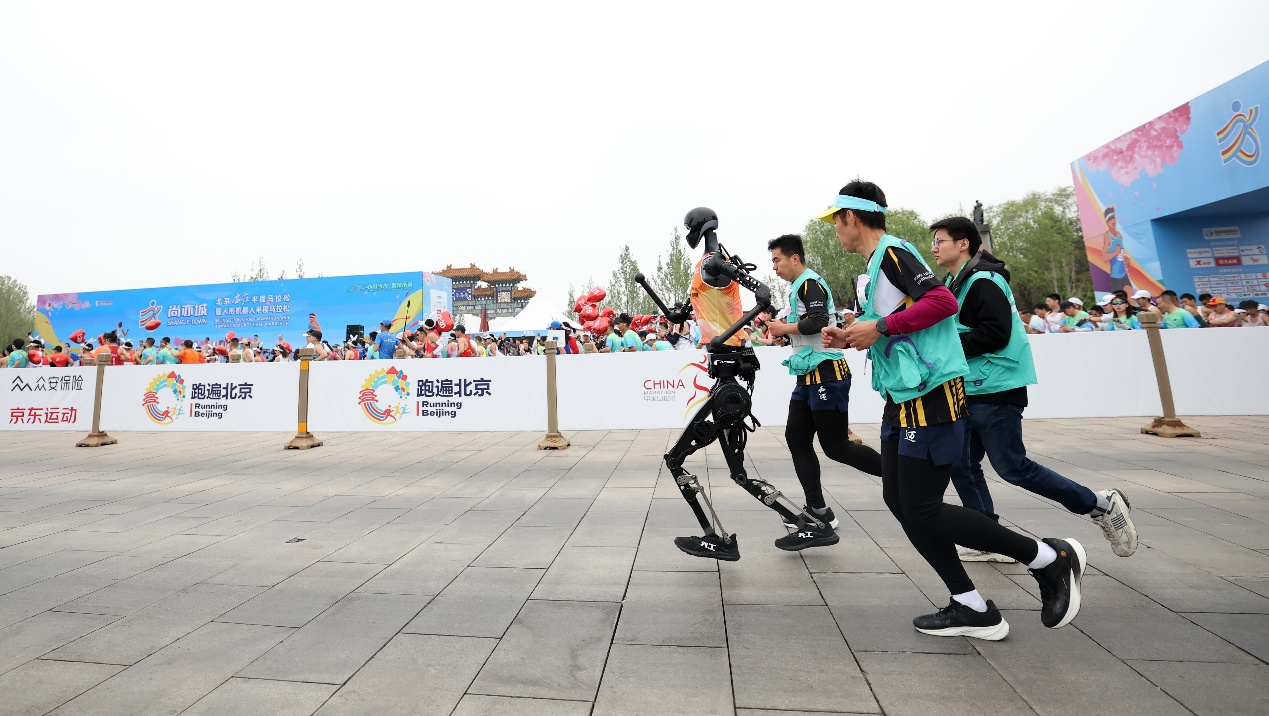
In the world of professional athletics, we often speak of the “human limit”—that invisible wall where biology meets its breaking point. But in Beijing, the conversation has shifted from biological endurance to mechanical efficiency. The sports world is now watching a different kind of athlete: the humanoid robot.
The 2026 Beijing Yizhuang Humanoid Robot Half Marathon is not merely a novelty event; it is a high-stakes stress test for the next generation of robotics. This ambitious competition, which pushes machines to cover the grueling 21.0975-kilometer distance, recently passed a critical milestone with the completion of its full-process and full-element testing phase.
As a sports editor who has covered everything from the Olympic tracks to the football pitches of Lisbon, I find the intersection of kinetics and computing fascinating. This race transforms the streets of the Beijing Economic-Technological Development Area (Yizhuang) into a living laboratory, challenging companies to prove that their humanoid creations can maintain stability, balance and power over a sustained distance.
The event is scheduled to officially initiate on April 19, 2026, according to reports from NetEase/IT Home. With the rules officially released on April 15, the stage is set for a clash of engineering titans.
Testing the Limits: The Full-Scale Trial
Before any machine could be cleared for the official start line, organizers conducted a rigorous “full-process and full-element” test activity. This phase, which took place from the evening of April 11 through the early hours of April 12, was designed to simulate every variable the robots would encounter during the actual race via the official event site.
In sports journalism, we call this a “dress rehearsal,” but for robotics, it is a matter of survival. A “full-element” test implies that organizers checked everything: the terrain’s impact on joint actuators, battery depletion rates over long distances, and the reliability of the sensors used for navigation. For a humanoid robot, a half marathon is not just about speed; it is about avoiding a catastrophic system failure or a mechanical collapse midway through the course.
The testing took place within the Beijing Economic-Technological Development Area, ensuring that the infrastructure could support the unique needs of robotic competitors, including specialized pit stops and technical monitoring stations.
The Road to Nanhaizi Park: Route and Logistics
The race is themed “Yi Ma Dang Xian” (亦马当先), a play on words suggesting both the Yizhuang location and a spirit of leadership, and vanguardism. The logistics of the course are as precise as the machines competing on it.
The 21.0975-kilometer route begins at Kechuang 17th Street, situated by the scenic Tongming Lake in Yizhuang. From there, the robots will navigate a course that culminates at the finish line in Nanhaizi Park as detailed by NetEase/IT Home. This specific path tests the robots’ ability to handle varied urban environments, from the flat, paved surfaces of the tech district to the potentially more complex surroundings of the park.
For the global sports community, the significance of this route lies in its predictability and accessibility. Unlike a wilderness trek, What we have is an urban endurance test. The goal is to see how these machines operate in environments where humans live and work, moving toward a future where humanoid robots might assist in urban logistics or emergency response.
The Contenders: Unitree H1 and the Race for Efficiency
While several tech giants are eyeing the podium, Unitree Robotics has emerged as a primary focal point. The company has officially announced its participation with the H1 humanoid model via Baidu Baike. To ensure a comprehensive presence, Unitree is entering the race through three different corporate entities based in Beijing, Shanghai, and Hangzhou.
The H1 is not entering the race blindly. In internal testing, the H1 model reportedly completed a half-marathon distance in just over 50 minutes according to NetEase/IT Home. To put that into perspective for my football and Olympic readers: that is a pace that would be competitive in many amateur human races, let alone for a machine that must balance its own weight and manage thermal loads in its processors.
Joining the fray is Honor, which officially announced its participation on April 12 via Baidu Baike. The entry of a consumer electronics giant like Honor suggests that the competition is moving beyond pure robotics firms and into the realm of integrated AI and hardware ecosystems.
Key Event Details at a Glance
| Feature | Detail |
|---|---|
| Official Start Date | April 19, 2026 |
| Total Distance | 21.0975 Kilometers |
| Start Point | Kechuang 17th Street (Tongming Lake) |
| Finish Point | Nanhaizi Park |
| Key Competitor | Unitree (H1 Model) |
| Event Theme | “Yi Ma Dang Xian” |
Why This Matters: Beyond the Finish Line
From a journalistic perspective, we have to ask: why run a robot in a marathon? The answer lies in “edge cases.” In a controlled lab, a robot can walk for hours. In a 21-kilometer race through a city, it faces wind, temperature fluctuations, surface irregularities, and the sheer attrition of repetitive motion.

The 2026 Beijing Yizhuang event serves as a benchmark for humanoid endurance. If a robot can successfully navigate this course without falling or running out of power, it proves that the technology is ready for real-world applications. Whether it is delivering packages across a city or assisting in a disaster zone, the ability to maintain a steady gait over long distances is the “holy grail” of humanoid robotics.
This event also highlights China’s strategic push into the robotics sector, utilizing the Beijing Economic-Technological Development Area as a hub for innovation. By framing this as a sporting event, they are not only testing hardware but also capturing the public imagination, turning a technical trial into a global spectacle.
The next confirmed checkpoint for this event is the official race start on April 19, 2026. We will be monitoring the results to see if the internal test times of the H1 hold up under official race conditions.
Do you think humanoid robots will eventually compete in the Olympics, or should they remain in their own specialized leagues? Let us grasp your thoughts in the comments below and share this story with your network.