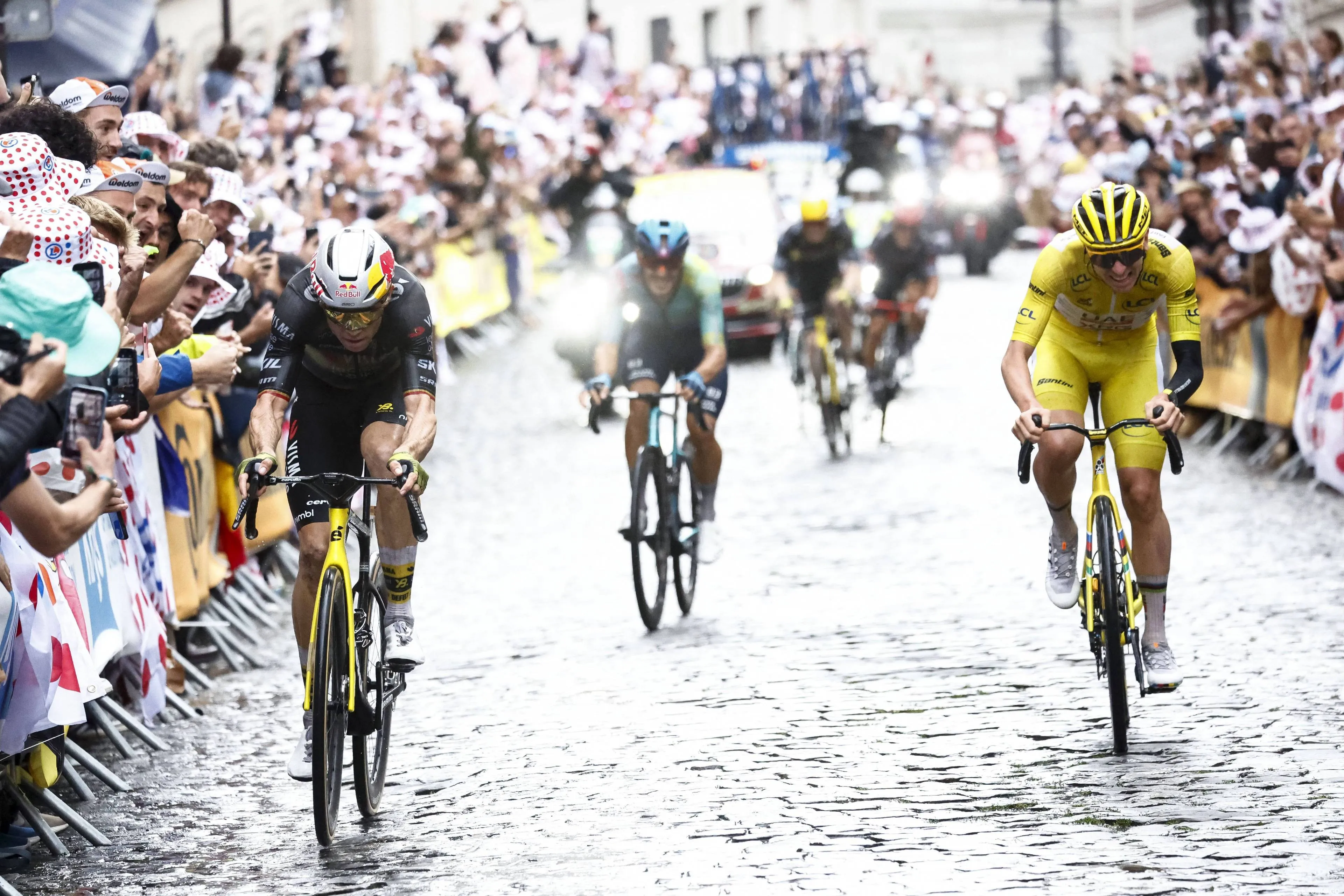
On Sunday, April 12, 2026, Belgian cyclist Wout van Aert claimed his first Paris-Roubaix victory in a dramatic sprint finish against Tadej Pogačar, setting a new benchmark for speed in the race’s 123-year history. The win came after more than five hours of grueling racing over the 258-kilometre course, with van Aert edging out the Slovenian star in the final metres at the Roubaix velodrome. The duo’s blistering pace shattered previous records, marking the fastest edition of the race ever recorded.
Van Aert’s triumph was deeply personal, as he dedicated the victory to his former teammate Michael Goolaerts, who tragically died after crashing during the 2018 Paris-Roubaix. Crossing the line, van Aert pointed his finger skyward in tribute, a gesture he has repeated since Goolaerts’ passing. “Beating him mano a mano in a sprint is really special to me,” van Aert said after the race. “It means everything to me. It’s been a goal since 2018, when I first did this race, and in that race I lost a teammate, Michael Goolaerts.”
The 2026 men’s Paris-Roubaix set a new highest average speed of 48.91 kilometres per hour, according to CyclingNews, surpassing the previous record of 47.802 km/h set by Mathieu van der Poel in 2024. This represents an increase of more than one kilometre per hour, driven by favourable wind conditions and a lack of an early breakaway, which allowed the peloton to maintain a consistently high tempo throughout the race. Van Aert and Pogačar, who finished second, were instrumental in driving this unprecedented pace.
The race unfolded with intense early positioning, as teams fought to avoid being caught behind potential chaos on the cobbled sectors. The first major test came at Troisvilles, where the opening stretch of pavé began. With no breakaway forming early, the peloton remained intact, setting the stage for a relentless, high-speed chase that saw multiple punctures and bike changes among the favourites. Despite these challenges, the lead group stayed cohesive, preserving energy for the final showdown.
As the race approached the velodrome, van Aert and Pogačar emerged as the two strongest riders, having conserved energy through smart positioning and timely reactions to attacks. Entering the final kilometre, they were side by side, with van Aert launching his sprint from the right-hand side. His superior explosive power allowed him to surge past Pogačar and hold off the Slovenian’s challenge to the line. The margin of victory was narrow, but decisive, sealing van Aert’s maiden Monument win.
In the women’s race, Franziska Koch of Germany claimed victory in the Paris-Roubaix Femmes, defeating Marianne Vos of the Netherlands in a sprint finish. Koch’s win added to the historic nature of the day, which saw both elite races deliver exceptional performances and close finishes. The women’s race also benefited from rapid conditions, though official average speed figures for the Femmes edition were not detailed in the verified sources consulted.
Van Aert’s post-race reaction was widely shared across social media, with his first Instagram update since the victory drawing significant attention. The post, which featured an emotional image from the podium, was noted by Belgian outlets as his first public social media message following the emotionally charged triumph. While the exact content of the caption was not independently verified through official channels, the act of sharing marked a moment of personal reflection after days of intense media focus.
The victory further cements van Aert’s status as one of the most versatile and accomplished riders of his generation. Already a multiple stage winner in the Tour de France and a former world champion in cyclo-cross and time trialing, his success in Paris-Roubaix adds a critical Monument to his palmarès. For Pogačar, the second-place finish, while disappointing, underscores his growing ability to compete in the sport’s most demanding one-day races, despite his primary focus remaining on stage racing and Grand Tours.
Looking ahead, the cycling world turns its attention to the upcoming Ardennes classics, with La Flèche Wallonne and Liège–Bastogne–Liège scheduled for later in April. Both van Aert and Pogačar are expected to line up, offering another chance to test their form on hilly, arduous terrain. No official start lists or confirmations have been released as of the time of writing, but historical participation patterns suggest both riders will be among the favourites.
For fans seeking official updates, race results, and athlete statements, the Union Cycliste Internationale (UCI) and ASO, the organizers of Paris-Roubaix, provide authoritative information through their websites and social media channels. These platforms remain the most reliable sources for verified data, schedules, and announcements related to the WorldTour calendar.
Wout van Aert’s 2026 Paris-Roubaix victory stands as a defining moment in modern cycling history — not only for its record-breaking speed but for the human story behind it. His triumph, forged in resilience and tribute, reminds us that sport’s greatest victories are often measured not just in watts or speed, but in heart.
Share your thoughts on this historic race in the comments below, and spread the word to fellow cycling fans who appreciate the blend of endurance, tactics, and emotion that makes Paris-Roubaix truly unique.
Related reading