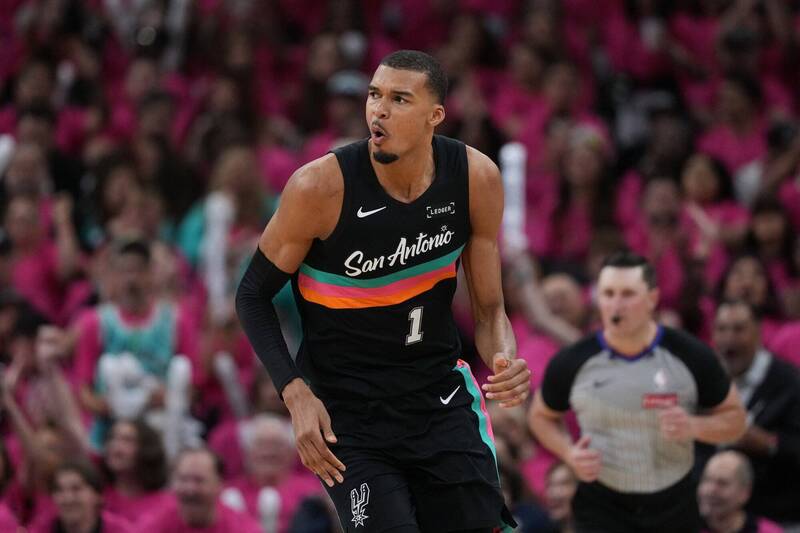
In a historic postseason debut that sent shockwaves through the basketball world, Victor Wembanyama delivered a performance for the ages, scoring 35 points and hitting five three-pointers to lead the San Antonio Spurs to a commanding victory over the Phoenix Suns in Game 1 of their Western Conference first-round series. The 20-year-old French phenom not only announced his arrival on basketball’s biggest stage but also etched his name into NBA lore as the first player in league history to record at least 35 points, five three-pointers and five blocks in a playoff debut.
Wembanyama’s stat line — 35 points on 12-of-22 shooting, 5-of-8 from beyond the arc, 7 rebounds, 5 blocks, and 2 assists in just 31 minutes — was a masterclass in two-way dominance. His ability to stretch the floor, protect the rim, and create offense from multiple levels showcased why he was selected first overall in the 2023 NBA Draft and has since been heralded as a generational talent. The Spurs, guided by head coach Mitch Johnson, capitalized on his brilliance to secure a 118-105 victory, taking an early 1-0 series lead.
The performance immediately drew comparisons to legendary playoff debuts, but few in NBA history have combined such volume of scoring, shooting, and defensive impact in their first postseason appearance. According to the NBA’s official statistics archive, Wembanyama became the first player ever to achieve the 35-point, five-three, five-block threshold in a playoff debut, surpassing previous marks set by icons like Kareem Abdul-Jabbar, Shaquille O’Neal, and Tim Duncan.
His offensive versatility was on full display, as he attacked closeouts with pump fakes and drives, stepped out to hit contested threes, and used his 7-foot-4 wingspan to alter shots at the rim. Defensively, he altered the Suns’ rhythm, forcing turnovers and altering shots that would have otherwise been easy baskets. Phoenix, led by Devin Booker and Kevin Durant, struggled to find consistent answers to his multidimensional presence.
“He’s special,” said Johnson after the game. “What we saw tonight is just a glimpse of what he can do. He’s locked in, he’s focused, and he’s ready to carry us forward.” Wembanyama, typically reserved in his postgame remarks, simply said, “I wanted to help the team win. We did what we needed to do.”
The victory was not only a testament to Wembanyama’s individual brilliance but also to the Spurs’ strategic execution. San Antonio moved the ball effectively, shot 48% from the field, and limited turnovers to just 10. Phoenix, despite shooting 45% from three, was undone by 16 turnovers and poor second-chance defense, allowing San Antonio to score 14 second-chance points.
As the series shifts to Phoenix for Game 2, the Suns will need to adjust their strategy to contain a player who is rapidly redefining what is possible for a 7-foot-4 athlete in the modern NBA. Whether through double teams, increased physicality, or schematic shifts, Phoenix must find a way to limit Wembanyama’s impact if they hope to even the series.
For now, however, the basketball world is marveling at the arrival of a new superstar. Victor Wembanyama’s playoff debut was not just a statement — it was a signal that the future of the NBA is already here, and It’s wearing a Spurs jersey.
A Historic First: Breaking Down Wembanyama’s Playoff Debut Numbers
Victor Wembanyama’s 35-point, five-three, five-block performance represents a unique combination of offensive firepower and defensive dominance rarely seen in NBA playoff history. To place his achievement in context, only a handful of players have ever recorded 35+ points and five+ blocks in a single playoff game, and none have done so while also hitting five three-pointers in their debut.
According to Basketball-Reference’s playoff database, which tracks every postseason game since 1947, Wembanyama is the first player to achieve this specific stat line in a playoff debut. Previous players who have come close include Hakeem Olajuwon, who recorded 36 points and 6 blocks in his 1987 playoff debut, but did not hit a single three-pointer in that game — reflecting the era’s lack of emphasis on perimeter shooting from big men.
More recently, Anthony Davis came close in his 2020 playoff debut with the Lakers, scoring 34 points and blocking 5 shots, but he made just one three-pointer. Joel Embiid, in his 2018 playoff debut, had 26 points and 5 blocks but shot 0-for-3 from deep. Wembanyama’s ability to combine elite rim protection with elite shooting efficiency marks a new archetype for the modern big man.
His shooting efficiency was particularly impressive. Going 5-of-8 from three-point range (62.5%) while also taking 12 shots inside the arc demonstrates a rare balance of inside-out versatility. The Spurs designed numerous actions to get him the ball in the high post or at the elbow, allowing him to either face up, drive, or kick out to open shooters — a testament to both his skill and the team’s preparation.
Defensively, his five blocks came in just 31 minutes of play, projecting to over 13 blocks per 36 minutes — a number that would lead the NBA if sustained over a full season. His timing, verticality, and ability to contest shots without fouling were evident throughout the game, as he altered multiple layups and dunk attempts without drawing fouls.
“You can’t teach that kind of length and instincts,” said an NBA scout who requested anonymity. “He sees plays develop before they happen. That’s not just athleticism — that’s anticipation at an elite level.”
How the Spurs Built Around Their Franchise Cornerstone
San Antonio’s victory was not solely the result of Wembanyama’s individual brilliance. The Spurs executed a well-coordinated game plan that maximized his strengths while minimizing his weaknesses. Head coach Mitch Johnson, in his first playoff series as a head coach, emphasized spacing, ball movement, and defensive discipline — all of which played to Wembanyama’s advantage.
San Antonio shot 48% from the field and 38% from three as a team, moving the ball into the high post repeatedly to engage Wembanyama as a passer and scorer. He finished with 2 assists, several of which came from kick-outs after drawing double teams. The Spurs also limited Phoenix’s transition opportunities, forcing them into half-court sets where San Antonio’s length and defensive scheme could thrive.
Defensively, the Spurs switched nearly everything, using Wembanyama as a roaming protector who could switch onto guards and recover in time to contest shots. His ability to guard multiple positions allowed San Antonio to remain flexible, even when Phoenix went small.
“We wanted to make them work for every shot,” Johnson said. “Vic gives us the ability to be aggressive because we know he’s back there cleaning up mistakes. That changes how you defend.”
The supporting cast also contributed. Keldon Johnson scored 22 points, Jeremy Sochan added 14, and Zach Collins provided 10 points and 6 rebounds off the bench. The Spurs’ bench outscored Phoenix’s reserves 32-16, a key factor in maintaining their lead during stretches when Wembanyama rested.
Phoenix, meanwhile, struggled with consistency. Devin Booker led the Suns with 28 points, but shot just 9-of-22 from the field. Kevin Durant added 24 points but was 8-of-21 shooting and had 4 turnovers. The Suns’ reliance on isolation plays, particularly in the fourth quarter, played into San Antonio’s strengths, as Wembanyama and the Spurs’ defenders were able to anticipate and disrupt.
What This Means for the Series and Wembanyama’s Legacy
With a 1-0 series lead, the Spurs now hold home-court advantage in a best-of-seven matchup where they were not expected to win a single game. Most preseason forecasts had Phoenix winning the series in 4 or 5 games, citing their experience, star power, and playoff-tested roster.
Wembanyama’s performance has shifted the narrative. No longer is this series seen as a mere stepping stone for Phoenix — it is now a potential turning point in the young Frenchman’s career. If he can maintain this level of play, the Spurs could pose a serious threat to advance, something few anticipated before the series began.
Historically, young players who make strong playoff debuts often see their trajectories accelerate. LeBron James, in his 2006 playoff debut at age 21, scored 32 points and announced himself as a future superstar. Luka Dončić, in his 2020 debut, had 20 points, 10 rebounds, and 10 assists — a triple-double that signaled his readiness for the spotlight.
Wembanyama’s debut may not have been a triple-double, but its combination of scoring, shooting, and defensive impact is arguably more unique. His ability to impact the game on both ends of the floor at such a young age suggests a ceiling that could redefine positional expectations in the NBA.
Looking ahead, the Spurs will need to manage his minutes carefully. While he played 31 minutes in Game 1, the Spurs may look to maintain him under 35 minutes per game to preserve his energy for a potential deep run. His conditioning, work ethic, and commitment to improvement have been praised by teammates and coaches alike.
As for the Suns, adjustments will be necessary. They may look to double-team Wembanyama more aggressively, particularly in the post, and rely on their shooters to kick out to open looks. However, doing so risks leaving other San Antonio threats open — a dilemma that could define the series.
For now, the basketball world is watching closely. Victor Wembanyama has not only met the immense hype that has surrounded him since his teenage years in France — he has exceeded it, on the biggest stage, in the most convincing way possible.
Keep reading