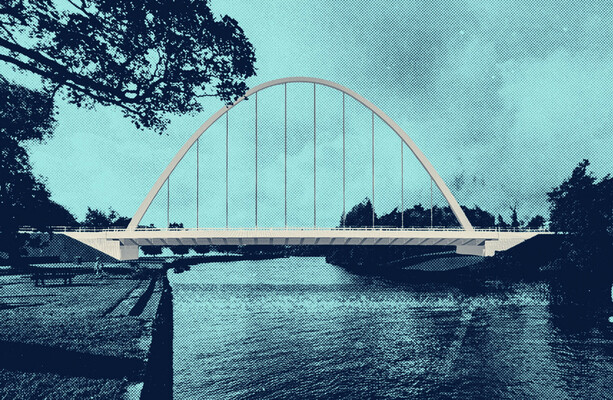
Concerns are growing among environmentalists and local residents in County Sligo over the potential impact of a proposed €50 million bridge project on protected wildlife habitats, particularly those of the Eurasian otter and kingfisher, both species safeguarded under European and Irish law. The planned structure, informally dubbed the “Celtic Tiger” bridge due to its scale and timing during Ireland’s economic recovery period, aims to alleviate traffic congestion on the eastern approach to Sligo town by spanning the Garvoge River. However, as planning advances, questions persist regarding the adequacy of environmental assessments and whether sufficient safeguards are in place to prevent harm to sensitive ecosystems.
The project, officially known as the Eastern Garvoge Bridge, has been under discussion for several years as part of broader infrastructure improvements led by Sligo County Council in coordination with Transport Infrastructure Ireland (TII). While proponents argue the bridge will improve connectivity and support regional development, critics contend that the Environmental Impact Assessment (EIA) may not fully account for cumulative effects on riparian zones and breeding grounds. Under the EU Habitats Directive and Ireland’s Wildlife Acts, any development near designated Special Areas of Conservation (SACs) must demonstrate no adverse impact on integrity, a threshold that remains contested in this case.
Central to the debate is the Garvoge River’s ecological significance. The waterway flows through areas designated as part of the Bunduff Lough and Machair/Trawalua/Moreen Bay SAC, a site recognized for its dune systems, wetlands, and populations of otters that rely on undisturbed riverbanks for holts and foraging. Kingfishers, protected under the EU Birds Directive, also nest in the river’s steep, sandy banks — habitats vulnerable to disturbance from construction activity, increased siltation, or alterations in water flow. Despite these designations, some stakeholders say the project’s planning documents lack detailed mitigation strategies tailored to these species.
An Taisce, the National Trust for Ireland, has previously raised concerns about infrastructure projects in ecologically sensitive areas, urging greater adherence to the precautionary principle when data is incomplete. In a 2023 submission to An Bord Pleanála regarding a separate but related road scheme, the group emphasized that “avoidance and minimization of harm must precede compensation” in line with EU environmental law. While no formal objection has yet been lodged specifically against the Eastern Garvoge Bridge, similar principles are being invoked by local conservation groups monitoring the proposal.
Sligo County Council maintains that all statutory processes are being followed. A spokesperson confirmed that the project is currently at the stage of preparing a formal planning application, which will include an updated Environmental Impact Assessment Report (EIAR) and a Natura Impact Statement (NIS) — the latter being required where a project may affect a European site. “The council is committed to ensuring that any development complies fully with environmental legislation,” the spokesperson said in response to inquiries. “The NIS will assess potential impacts on qualifying interests of nearby SACs, including otter and kingfisher habitats, and will outline any necessary avoidance or mitigation measures.”
Public consultation on the project is expected to commence once the planning application is submitted, offering residents and interest groups an opportunity to review the documents and submit observations. The timeline for submission remains unofficial, though council sources indicate it could occur within the next six months, pending finalization of technical studies. No date has been set for an oral hearing by An Bord Pleanála, Ireland’s independent planning appeals board, which would only occur if the application proceeds to that stage following review.
Beyond ecological concerns, some community representatives have highlighted social dimensions, noting that while the bridge aims to reduce through-traffic in residential areas, its precise alignment and associated roadworks could affect access to green spaces or increase noise and light pollution in nearby neighborhoods. These considerations, while secondary to ecological impacts in regulatory terms, contribute to broader calls for transparent, inclusive planning that balances development with sustainability.
As the project moves closer to a formal planning stage, the emphasis is shifting toward ensuring that environmental safeguards are not merely procedural but substantively effective. For a development of this scale and location, the test will be whether it can demonstrate compliance with the highest standards of ecological protection — not just on paper, but in practice — especially given the legal protections afforded to species that have, in recent decades, become symbols of Ireland’s natural heritage.
The next confirmed step in the process is the submission of the formal planning application to Sligo County Council, which will trigger the public consultation period. Until then, stakeholders continue to call for rigorous, transparent assessment grounded in the best available science and full adherence to EU and national environmental law.
We welcome your thoughts on this development. Share your perspective in the comments below, and help spread awareness by sharing this article with others who may be affected or interested.
Keep reading