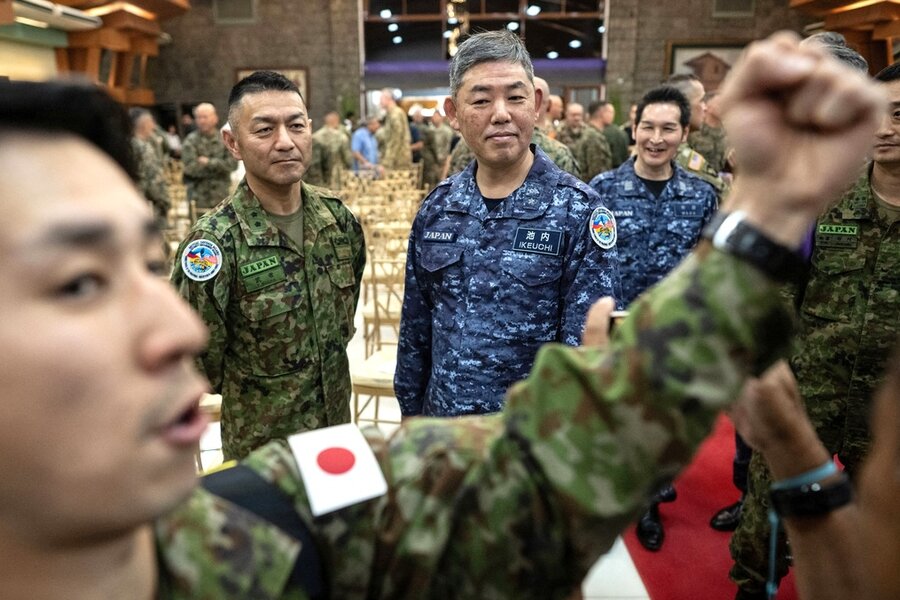
Japan has deployed combat troops to the Philippines for joint military exercises with the United States for the first time since World War II, marking a significant shift in regional defense cooperation. Approximately 1,400 Japanese combat troops are participating in the annual Balikatan exercises, which began on April 20, 2026, and will run through May 8. The exercises, hosted by the Philippines and the United States, have expanded to include troops from Australia, Canada, France, and New Zealand, with an additional 17 countries participating as observers.
Over 17,000 troops are involved in what officials describe as one of the largest and most complex iterations of the drills to date. Japan’s contribution includes the deployment of its Type 88 surface-to-ship missile system, which has an operational range of approximately 100 kilometers. The system will be used in a maritime strike exercise involving the simulated sinking of a decommissioned vessel near the South China Sea and Taiwan. This deployment represents the first time Japan has sent combat-capable forces to Philippine soil since 1945.
The expansion of the Balikatan exercises reflects growing regional concerns over security dynamics in the Indo-Pacific. In an increasingly severe security environment, no single country can now protect its own peace and security alone, as noted by Japanese Prime Minister Sanae Takaichi in a recent statement on the social platform X. The exercises underscore a long-term effort by many Asian democracies and their Western partners to define the meaning of shared security, preferably the kind that cannot be seen as ganging up on China.
That task has become more urgent in the face of China’s aggression against its neighbors, nuclear threats from North Korea, and recent uncertainty over America’s military deterrence in the region. For Japan, this overseas training under real-world conditions marks a historic turning point for its postwar pacifist tradition and its heavy reliance on the United States for external defense. Yet, on a larger scale, it puts on display a collective effort to uphold democratic values and regional stability.
Historical Context and Strategic Significance
The deployment marks a pivotal moment in Japan’s post-World War II security policy. Since the war, Japan has maintained a pacifist constitution that limits its military to self-defense forces and restricts overseas deployments. The decision to send combat troops to the Philippines — a nation once occupied by imperial Japanese forces — carries deep historical resonance. Though, officials emphasize that the current engagement is grounded in shared democratic values rather than historical grievances.
Japan’s participation in Balikatan 2026 is facilitated by a recently simplified agreement between Tokyo and Manila that streamlines procedures for the deployment of troops and military equipment for joint exercises, training, and disaster response. This framework allows for greater interoperability among allied forces and reflects a broader trend of deepening security ties across the region.
Regional Reactions and Implications
The inclusion of additional nations such as Australia, Canada, France, and New Zealand highlights the international character of the exercises. These countries, along with the 17 observer nations, signal a widening coalition committed to maintaining a free and open Indo-Pacific. Analysts note that the drills serve both as a deterrent and a reassurance mechanism — deterring coercive actions while reinforcing alliances among like-minded states.
China has not issued an official response to the 2026 Balikatan exercises as of the latest available reports. However, Beijing has previously criticized similar military activities in the South China Sea, describing them as destabilizing and provocative. The simulated sinking of a decommissioned vessel using Japan’s Type 88 missile system near disputed waters is likely to draw attention given ongoing territorial disputes in the area.
What This Means for Regional Security
The Balikatan exercises illustrate how security cooperation is evolving beyond traditional bilateral alliances toward multilateral frameworks rooted in shared principles. By conducting live-fire, land-and-sea drills in proximity to flashpoints like the Taiwan Strait and the South China Sea, participating nations aim to enhance readiness and signal resolve.

For readers seeking official updates, the Philippine Department of National Defense and the U.S. Indo-Pacific Command regularly publish exercise summaries and after-action reports. Japan’s Ministry of Defense also provides periodic disclosures on overseas deployments in accordance with national legislation governing the use of Self-Defense Forces abroad.
As the exercises continue through May 8, 2026, observers will be watching closely for any announcements regarding future expansions of the Balikatan format or potential institutionalization of the expanded participant pool. The next major checkpoint is the scheduled conclusion of the drills on May 8, after which participating nations are expected to release joint assessments.
If you found this analysis useful, consider sharing it with others interested in global security developments. We welcome your thoughts and perspectives in the comments section below.
Keep reading