
For beginners looking to build strength and muscle with kettlebells, mastering fundamental movements is essential before progressing to more complex exercises. These foundational movements serve as the building blocks for effective kettlebell training and help establish proper form that translates to other strength exercises and daily activities. According to verified fitness resources, the hip hinge movement, exemplified by the kettlebell fine morning, is particularly key as it teaches proper mechanics for protecting the lower back while enabling efficient force transfer from the lower to upper body.
This movement pattern is critical not only for kettlebell exercises like deadlifts, cleans, and snatches but also for everyday activities such as bending to pick up objects from the floor. Proper hip hinge technique involves bending at the waist while keeping the lower back flat and torso rigid, with emphasis on pushing the butt backward rather than simply lowering the chest. Keeping the kettlebell close to the body during these movements increases their effectiveness by improving leverage and reducing strain on the lower back.
Beyond the hip hinge, strength training experts identify several other fundamental human movement patterns that form the basis of comprehensive fitness programming. These include the squat, lunge, push, pull, and carry movements, each of which can be adapted using kettlebells to build functional strength. For beginners, focusing on these cornerstone movements with lighter weights allows for proper neuromuscular patterning before increasing load or complexity.
Kettlebell Good Morning: Mastering the Hip Hinge
The kettlebell good morning is a foundational exercise that specifically targets the posterior chain while reinforcing proper hip hinge mechanics. To perform this movement correctly, stand with feet hip-width apart, holding a kettlebell close to the chest with both hands. Initiate the movement by pushing the hips backward while maintaining a slight bend in the knees, keeping the spine neutral and torso rigid throughout the motion. The descent should continue until a stretch is felt in the hamstrings, typically when the torso is nearly parallel to the floor, then return to standing by driving the hips forward.
This exercise teaches the critical skill of dissociating hip movement from spinal movement, which is essential for preventing lower back injury during more dynamic kettlebell exercises. Beginners should start with a light kettlebell to focus on form, performing 2-3 sets of 10-15 repetitions. As proficiency develops, the weight can be gradually increased while maintaining strict attention to spinal alignment and hip-driven motion.
Kettlebell Deadlift: Building Full-Body Strength
The kettlebell deadlift represents one of the most fundamental strength-building exercises in any resistance training program. Unlike its barbell counterpart, the kettlebell deadlift allows for a more natural grip position and can be particularly beneficial for those learning proper lifting mechanics. To execute this movement, stand with feet shoulder-width apart, kettlebell positioned between the feet on the floor. Initiate the lift by hinging at the hips while keeping the back flat, grasp the kettlebell handle with both hands, and stand up by driving through the heels and extending the hips and knees simultaneously.
Key performance points include maintaining a neutral spine throughout the entire range of motion, avoiding rounding of the lower back, and ensuring the movement originates from the hips rather than the squat of the knees. The kettlebell should travel in a straight vertical line close to the body during both the ascent and descent. This exercise primarily engages the glutes, hamstrings, and lower back while also activating the core and grip strength. Beginners should master the hip hinge pattern with bodyweight or light resistance before progressing to heavier kettlebells.
Kettlebell Swing: Developing Power and Endurance
The kettlebell swing is often considered the quintessential kettlebell exercise, combining elements of strength, power, and cardiovascular conditioning. This dynamic movement teaches explosive hip extension while reinforcing the hip hinge pattern learned in stationary exercises. To perform the Russian kettlebell swing (the variation most recommended for beginners), start with the kettlebell on the floor slightly in front of the feet. Hinge at the hips to grasp the handle, then hike the kettlebell backward between the legs before forcefully driving the hips forward to swing the kettlebell to chest height.
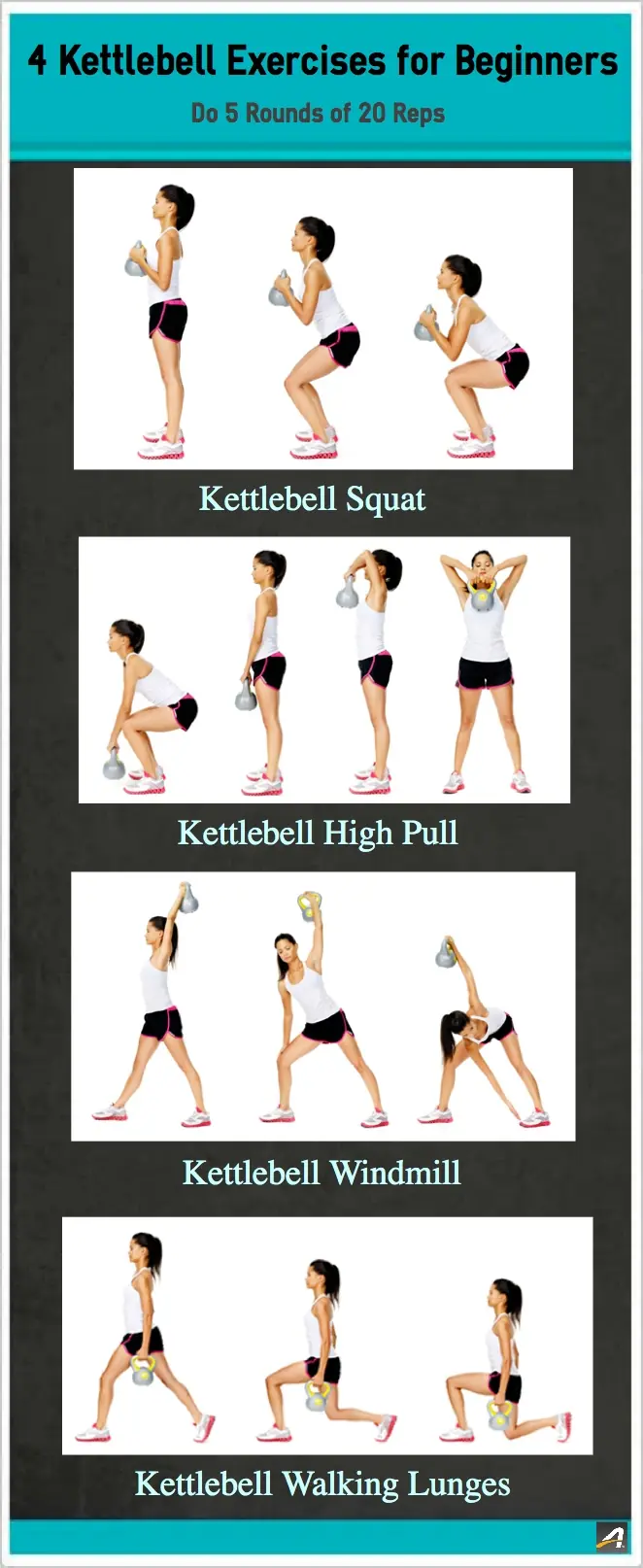
The power for this movement should come almost exclusively from the hips, not the arms or shoulders. At the top of the swing, the body should form a straight line from head to heels with glutes and core engaged. As the kettlebell descends, allow it to swing naturally between the legs while reloading the hips for the next repetition. This exercise develops posterior chain power, improves hip mobility, and provides significant cardiovascular benefits when performed for higher repetitions or timed intervals.
Kettlebell Goblet Squat: Enhancing Lower Body Strength
The goblet squat is an excellent introductory squat variation that promotes proper upright torso position and depth control. By holding a kettlebell close to the chest with both hands (resembling holding a goblet), this exercise naturally encourages an upright posture and helps prevent excessive forward lean. To perform the goblet squat, stand with feet slightly wider than shoulder-width apart, toes pointed slightly outward. Holding the kettlebell at chest level, initiate the movement by pushing the hips back and bending the knees to lower into a squat position, keeping the chest up and spine neutral.
Descend until the thighs are at least parallel to the floor, or as deep as mobility allows while maintaining proper form, then return to standing by driving through the heels. The front-loaded position of the kettlebell acts as a counterbalance, making it easier to achieve proper squat depth compared to bodyweight squats alone. This exercise primarily targets the quadriceps, glutes, and adductors while also engaging the core for stabilization. Beginners should focus on achieving full depth with control before adding weight or increasing repetition volume.
Kettlebell Row: Building Back Strength and Posture
Horizontal pulling movements like the kettlebell row are essential for developing balanced upper body strength and counteracting the effects of prolonged sitting and forward-leaning postures. The kettlebell row can be performed in various stances, but the bent-over variation is particularly effective for beginners learning proper scapular retraction. To execute this movement, hinge at the hips until the torso is nearly parallel to the floor, maintaining a flat back and neutral spine. Hold a kettlebell in one hand with the arm extended toward the floor, then pull the kettlebell toward the hip by retracting the shoulder blade and bending the elbow.
Key form points include keeping the elbow close to the body during the pull, avoiding rotation of the torso, and squeezing the shoulder blade at the top of the movement before slowly lowering the kettlebell with control. This exercise targets the latissimus dorsi, rhomboids, and trapezius muscles while also engaging the biceps and forearm flexors. Performing rows unilaterally (one arm at a time) helps identify and address strength imbalances between sides while also increasing core engagement for stabilization.
Kettlebell Press: Developing Shoulder Strength and Stability
Vertical pressing movements are crucial for building shoulder strength and stability, and the kettlebell press offers unique benefits compared to traditional dumbbell or barbell variations. The offset center of mass of a kettlebell creates an inherent instability challenge that requires greater rotator cuff activation and scapular control. To perform the kettlebell press, clean the kettlebell to the rack position (held against the forearm with elbow tucked close to the body) at shoulder level, then press it vertically overhead until the arm is fully extended.
Throughout the movement, maintain a neutral wrist position, avoid excessive arching of the lower back, and keep the ribcage down to prevent rib flare. The kettlebell should travel in a slight arc, moving slightly backward as it ascends to lockout overhead. This exercise develops the deltoids, triceps, and upper trapezius while significantly challenging shoulder stability and core control. Beginners should master the rack position and pressing mechanics with lighter weights before attempting heavier loads or more complex variations like the push press or jerk.
Programming Fundamentals for Beginners
For those new to kettlebell training, establishing a consistent foundation with these fundamental movements is more important than immediately pursuing advanced techniques or high-intensity workouts. A well-structured beginner program should prioritize movement quality over quantity, allowing adequate time for neuromuscular adaptation and skill development. Most experts recommend starting with 2-3 training sessions per week, focusing on mastering the hip hinge, squat, push, pull, and carry patterns with light to moderate weights.
A sample beginner routine might include: kettlebell good mornings (3 sets of 12-15 reps), goblet squats (3 sets of 10-12 reps), kettlebell deadlifts (3 sets of 8-10 reps), kettlebell rows (3 sets of 10-12 reps per arm), and kettlebell presses (3 sets of 8-10 reps per arm). Rest periods of 60-90 seconds between sets allow for adequate recovery while maintaining training density. As proficiency develops, variables such as weight, volume, tempo, or exercise complexity can be gradually manipulated to continue driving adaptation.
It’s important to note that individual progression rates vary based on factors including prior training experience, mobility limitations, and recovery capacity. Rather than adhering to rigid timelines, beginners should focus on consistent practice with attention to form cues and bodily feedback. Working with a qualified fitness professional, even for a few initial sessions, can provide valuable feedback on technique and help establish proper movement patterns from the outset.
As you continue your kettlebell journey, remember that mastery of these fundamental movements creates the foundation for all future progress. The strength, stability, and movement competence developed through consistent practice of these cornerstone exercises will not only enhance your kettlebell performance but also improve your resilience and capability in everyday physical tasks. Stay patient, stay consistent, and trust the process of building strength from the ground up.