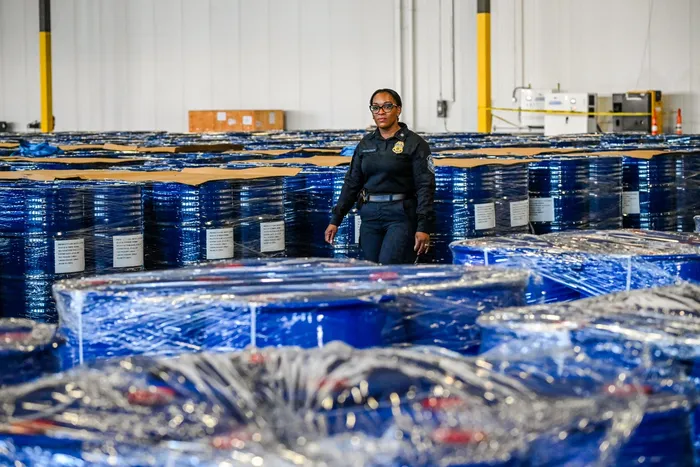
On April 23, 2026, the U.S. Department of the Treasury’s Office of Foreign Assets Control (OFAC) announced sanctions against 23 individuals and entities involved in a synthetic opioid procurement network tied to the Sinaloa Cartel, a designated Foreign Terrorist Organization. The action targets chemical suppliers and brokers who enable Mexican cartels to produce illicit drugs like fentanyl and methamphetamine using precursor chemicals imported from Asia, including India.
According to Treasury Secretary Scott Bessent, the sanctions are part of a broader effort to disrupt every stage of the synthetic opioid supply chain. “President Trump has been clear that terrorist cartels will not be allowed to wreak havoc on our borders and in our communities,” Bessent stated. “Treasury will continue to target every stage of the opioid supply chain to Keep America Safe and prevent more lives lost to fentanyl.”
The Sinaloa Cartel was designated a Foreign Terrorist Organization by the U.S. State Department in February 2025. This designation allows the federal government to pursue tougher criminal penalties and facilitates heightened scrutiny of financial and logistical networks supporting the cartel’s operations.
The Treasury’s announcement on April 23 also included sanctions on Cambodian Senator Kok An and 28 other individuals and entities linked to Southeast Asian scam operations. These actions reflect a parallel initiative to combat transnational fraud networks that have defrauded Americans of billions of dollars annually.
U.S. Officials have emphasized a whole-of-government approach to dismantle transnational criminal enterprises. The Treasury said it will continue to partner with the Homeland Security Task Force (HSTF), the Drug Enforcement Administration (DEA), the Federal Bureau of Investigation (FBI), Homeland Security Investigations (HSI), U.S. Customs and Border Protection (CBP), and foreign law enforcement counterparts to disrupt infrastructure supporting drug production and distribution.
In September 2025, the DEA reported arresting more than 600 members of the Sinaloa Cartel in a coordinated global operation. This followed increased interagency cooperation targeting cartel leadership and logistics networks across multiple countries.
The Treasury noted that precursor chemicals such as 4-Piperidone and N-Boc-4-Piperidone—primarily sourced from India and other Asian countries—are critical to the clandestine manufacturing of synthetic opioids. By sanctioning suppliers and brokers involved in moving these chemicals, the U.S. Aims to disrupt the conversion of legal precursors into deadly narcotics.
Fentanyl has been a central focus of the Trump administration’s second-term drug policy. In December 2025, President Trump signed an executive order declaring fentanyl a Weapon of Mass Destruction (WMD), citing its role in tens of thousands of annual overdose deaths in the United States.
State-level monitoring systems have detected emerging threats beyond traditional opioids. In July 2025, the Massachusetts Drug Supply Data Stream issued a public health alert regarding the rising presence of medetomidine, a veterinary sedicate increasingly found in illicit drug mixtures and linked to prolonged sedation and overdose risk.
Secretary of State Marco Rubio announced visa restrictions on April 20, 2026, targeting 75 family members and associates of Sinaloa Cartel members. Rubio stated the measures aim to prevent entry into the United States and deter continued illicit activity by limiting access to financial and travel networks.
The Treasury’s actions build on prior designations under the Foreign Narcotics Kingpin Designation Act and related authorities. OFAC maintains a public list of Specially Designated Nationals (SDNs), which includes individuals and entities blocked from accessing the U.S. Financial system.
Officials say the Sinaloa Cartel engages in violence, intimidation, and corruption alongside drug trafficking. Its operations span Mexico, Latin America, and transit routes into the United States, contributing to instability and public health crises in affected regions.
The U.S. Government continues to offer rewards for information leading to the disruption of criminal networks. As part of its anti-scam initiative, the Treasury is offering up to $10 million for information that helps seize or recover laundered funds tied to scam operations based in Burma’s Tai Chang centers.
According to official estimates, Americans lost more than $7.2 billion to Southeast Asia-based scam operations in 2025. These schemes often involve call centers impersonating government officials or tech support agents to extract funds from victims, particularly elderly individuals.
For updates on sanctions designations and enforcement actions, the public can consult the Treasury’s OFAC website, which provides searchable lists of sanctioned individuals and entities, along with licensing information and compliance guidance.
What do you think about the U.S. Government’s strategy to combat transnational drug and fraud networks? Share your thoughts in the comments and help spread awareness by sharing this article.
Related reading