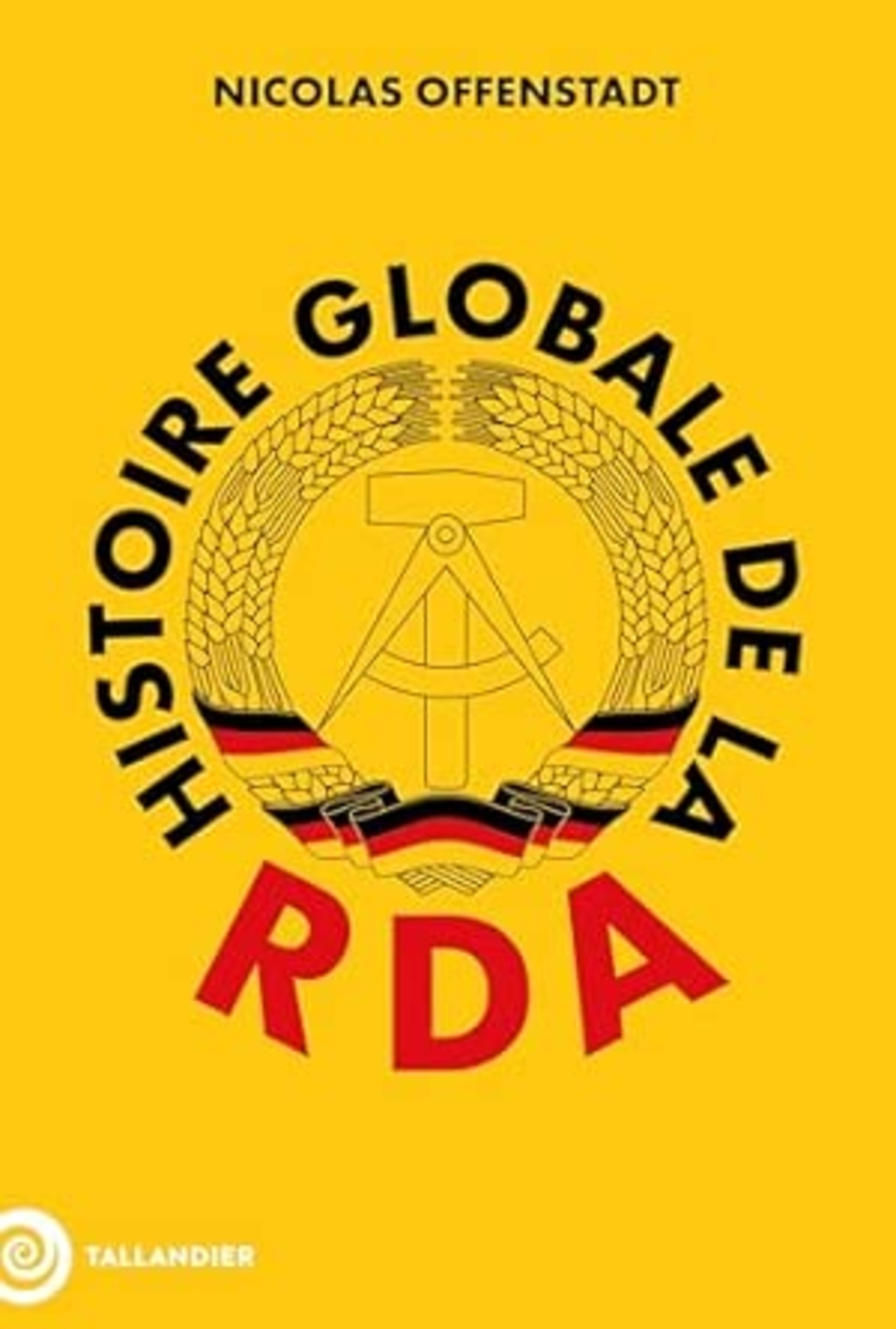
In the evolving discourse on Germany’s reunified identity, a new historical work has emerged that directly addresses contemporary political developments in the country’s eastern regions. Nicolas Offenstadt’s Histoire globale de la RDA, published by Tallandier in January 2026, arrives at a moment when scholars and policymakers are re-examining the legacy of the German Democratic Republic (GDR) amid rising support for far-right movements in former East German states.
The book, spanning 544 pages, offers a comprehensive analysis of the GDR’s 41-year existence from its founding in 1949 to its dissolution in 1990. Offenstadt, a professor of contemporary history and historiography at Paris-I-Panthéon-Sorbonne University, draws on years of fieldwork across the former East Germany, including interviews with residents, observations of physical remnants of the GDR era, and collection of abandoned archives. His approach seeks to move beyond narrow Cold War narratives to situate the GDR within broader European and global historical currents.
Central to Offenstadt’s argument is the idea that the GDR was not merely a Soviet satellite state but a society that generated its own aspirations, particularly the vision of an “autre Allemagne” — a different, more egalitarian Germany. This ambition extended beyond domestic policy to include international engagement, despite the country’s relatively small size of 16 million inhabitants at its peak.
The work does not conclude with the fall of the Berlin Wall in 1989 or formal reunification in 1990. Instead, Offenstadt extends his analysis into the post-unification period, examining how former GDR citizens have navigated the challenges of integration into a unified Federal Republic of Germany. This includes an exploration of socioeconomic disparities, cultural memory, and political alienation that have persisted in the eastern states.
One of the book’s most timely contributions is its attempt to address current questions about the resurgence of far-right politics in eastern Germany. Offenstadt investigates why certain territories that once constituted the GDR have seen increased support for extremist movements, linking this phenomenon to unresolved historical traumas, economic neglect, and fragmented identities following reunification.
Historical Context and Scholarly Approach
Offenstadt’s methodology combines archival research with oral history, a technique he refined in earlier works such as Le Pays disparu. Sur les traces de la RDA (2018). By centering lived experiences, he aims to capture how ordinary citizens both resisted and adapted to the authoritarian structures of the GDR regime. This perspective allows for a nuanced understanding of compliance, dissent, and everyday life under state socialism.
The author emphasizes that telling the story of the GDR necessitates engaging with half a century of European and world history. From the division of Germany after World War II through the détente era, the peaceful revolutions of 1989, and the complexities of unification, the GDR’s trajectory intersects with pivotal moments in modern history. Offenstadt situates these events within global dynamics, including decolonization, the non-aligned movement, and shifting East-West relations.
His work as well engages with historiographical debates about how authoritarian regimes should be remembered and studied. Rather than reducing the GDR to a simplistic narrative of oppression, Offenstadt explores how citizens exercised agency — shaping, modifying, or rejecting state-imposed constraints in various aspects of life, from work and education to leisure and family.
Post-Unification Challenges and Contemporary Relevance
A significant portion of the book is dedicated to the period after 1990, a phase often overlooked in traditional GDR histories. Offenstadt analyzes the social and economic dislocation experienced by many eastern Germans during rapid privatization, factory closures, and labor market transformations under the Treuhandanstalt agency. These processes contributed to widespread feelings of dispossession and loss, particularly among older workers and professionals whose qualifications were suddenly devalued.
These experiences, Offenstadt argues, have had lasting political consequences. In states such as Saxony, Brandenburg, and Thuringia, where far-right parties like the Alternative for Germany (AfD) have gained considerable traction, he identifies correlations between socioeconomic decline, perceived cultural marginalization, and support for nationalist rhetoric. The book does not claim direct causation but suggests that the unresolved legacy of reunification creates fertile ground for extremist narratives that promise restoration of dignity and stability.
Offenstadt further examines how memory politics have evolved in unified Germany. Even as official commemorations often focus on the GDR’s repression — particularly through institutions like the Stasi Records Agency — he notes that many eastern Germans retain more complex, ambivalent views of the past. For some, the GDR represents lost social security, full employment, or a sense of community that they feel was dismantled without adequate replacement.
Author Background and Publication Details
Nicolas Offenstadt is recognized as a leading scholar in contemporary French and German history, with particular expertise in 20th-century conflicts and memory studies. His academic affiliations include Paris-I-Panthéon-Sorbonne University, where he teaches courses on historiography and modern European history. Prior to Histoire globale de la RDA, he authored several works on the GDR and World War I, establishing a reputation for interdisciplinary research that blends political, social, and cultural history.
The book was published by Tallandier, a Paris-based imprint known for historical non-fiction, on January 29, 2026. It is available in print format measuring 14.5 x 21.5 cm, with an ISBN of 9791021049697 for the paperback edition and 9791021049710 for the digital version. The retail price is set at 25.90 euros.
Tallandier’s promotional materials highlight the book’s relevance to current debates, noting that Offenstadt “sketches answers to contemporary questions: what remains of the GDR today? Why do its territories see the rise of the far right?” This framing positions the work not only as a historical study but as a tool for understanding present-day political trends in Germany.
Implications for Understanding Eastern Germany Today
By connecting historical analysis to current developments, Offenstadt’s work offers valuable insights for policymakers, educators, and civil society actors seeking to address the roots of extremism in eastern Germany. His research underscores that economic inequality alone does not explain the appeal of far-right movements; rather, it is the interplay of material insecurity, identity concerns, and historical dissonance that fuels political radicalization.
The book invites readers to consider how societies transition from authoritarian systems to democracy — and what happens when that transition leaves large segments of the population feeling excluded from the new order. In this light, the GDR’s legacy is not confined to the past but continues to shape perceptions of fairness, belonging, and trust in institutions across unified Germany.
As Germany approaches the 35th anniversary of reunification in 2025, Offenstadt’s contribution arrives at a critical juncture. With far-right parties polling strongly in eastern states and public debates intensifying over migration, national identity, and historical memory, Histoire globale de la RDA provides a evidence-based foundation for informed discussion.
For those interested in accessing the work, it is distributed through major academic and general book retailers in Europe, with digital versions available via standard e-book platforms. Readers seeking further information on Offenstadt’s research can consult his publications through Paris-I-Panthéon-Sorbonne’s academic repository or recent interviews in historical journals.
As discussions about Germany’s past and future continue to evolve, works like Offenstadt’s remind us that understanding contemporary challenges requires grappling with the complexities of history — not as a series of isolated events, but as an ongoing process of interpretation and reckoning.
We encourage readers to share their thoughts on this article and the themes it raises. How do you believe historical legacies influence current political dynamics in unified Germany or other post-authoritarian societies? Join the conversation in the comments below.
Related reading