
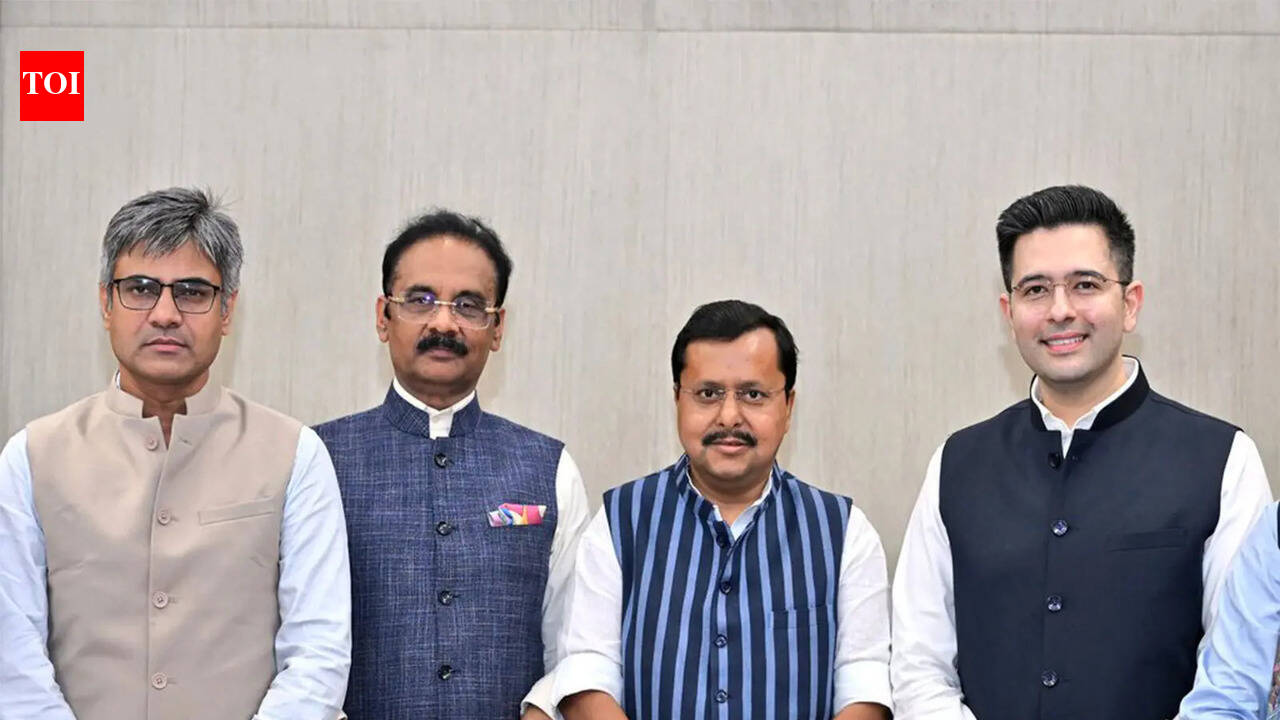
Rajya Sabha Chairman Accepts Merger of Seven AAP MPs with BJP, Shifting Power Dynamics in India’s Upper House
In a significant political development, the Chairman of India’s Rajya Sabha, Jagdeep Dhankhar, has formally accepted the merger of seven Members of Parliament (MPs) from the Aam Aadmi Party (AAP) with the Bharatiya Janata Party (BJP). The decision, announced on April 27, 2026, strengthens the ruling National Democratic Alliance’s (NDA) position in the upper house of Parliament, while dealing a blow to the opposition AAP, which has seen its representation shrink to just three MPs. This move underscores the fluidity of India’s political landscape and raises questions about the stability of regional parties in the face of national electoral pressures.

The merger was approved under the provisions of the Tenth Schedule of the Indian Constitution, often referred to as the “anti-defection law.” This legal framework governs the disqualification of legislators for defection from their political parties. However, the law includes an exception for mergers, provided that at least two-thirds of the party’s legislative members agree to join another political formation. In this case, the seven AAP MPs—whose names were officially listed in the Rajya Sabha’s order—met this threshold, allowing the merger to proceed without legal challenge.
The immediate impact of the merger is a shift in the balance of power within the Rajya Sabha. With the addition of the seven MPs, the NDA’s strength in the upper house has risen to 148, while the AAP’s representation has dwindled to three. This change could have far-reaching implications for the government’s ability to pass legislation, particularly on contentious issues where the NDA previously relied on support from smaller parties or independents. The Rajya Sabha, which represents India’s states and union territories, plays a crucial role in scrutinizing and amending bills, making its composition a key factor in the legislative process.
The Legal and Political Context of the Merger
The Tenth Schedule of the Indian Constitution was introduced in 1985 to curb the practice of political defections, which had turn into a widespread issue in the 1970s and 1980s. The law stipulates that if a legislator voluntarily gives up membership of their political party or votes against the party’s directives, they can be disqualified from their seat. However, the law also provides an exception for mergers, allowing a group of legislators to join another party without facing disqualification, provided the merger is approved by at least two-thirds of the party’s members in the legislature.
In this instance, the seven AAP MPs—Sanjay Singh, Raghav Chadha, Narain Dass Gupta, Sushil Gupta, N.D. Gupta, Bhagwant Mann, and Harbhajan Singh—were among the party’s most prominent figures in the Rajya Sabha. Their decision to join the BJP comes amid a broader trend of political realignment in India, where regional parties have faced increasing pressure to align with the ruling party at the center. The AAP, which governs the national capital territory of Delhi and the state of Punjab, has been a vocal critic of the BJP-led central government, particularly on issues such as federalism, governance, and economic policy.
The timing of the merger is also notable, as it occurs just months before the Rajya Sabha elections for 56 seats, scheduled to be held in July 2026. The BJP’s strengthened position in the upper house could prove advantageous in securing the necessary votes for key legislative priorities, including economic reforms and constitutional amendments. For the AAP, the loss of these MPs is a setback in its efforts to expand its national footprint and challenge the BJP’s dominance in Indian politics.
Implications for the AAP and the Broader Political Landscape
The AAP, founded in 2012 by anti-corruption activist Arvind Kejriwal, has positioned itself as a progressive alternative to India’s traditional political parties. The party’s rise was fueled by its promise of clean governance, transparency, and grassroots democracy. However, in recent years, the AAP has faced internal challenges, including leadership disputes, electoral setbacks, and allegations of corruption within its ranks. The departure of seven of its Rajya Sabha MPs to the BJP is likely to further weaken the party’s organizational cohesion and its ability to influence national policy debates.
For the BJP, the merger is a strategic victory. The party has been actively courting legislators from regional parties to bolster its numbers in the Rajya Sabha, where it has historically been in a minority. The NDA’s increased strength in the upper house could reduce its dependence on smaller allies and independents, giving the government greater flexibility in pushing through its legislative agenda. This is particularly significant as the BJP prepares for the next general elections, expected in 2029, and seeks to consolidate its position as India’s dominant political force.
The merger also reflects broader trends in Indian politics, where regional parties are increasingly finding it difficult to maintain their independence in the face of the BJP’s electoral and organizational dominance. Over the past decade, the BJP has successfully expanded its presence in states where it was previously weak, often by co-opting leaders and legislators from rival parties. This strategy has allowed the BJP to extend its influence beyond its traditional strongholds in northern and western India, making it a truly pan-Indian party.
What Happens Next?
With the merger now officially approved by the Rajya Sabha Chairman, the seven former AAP MPs will formally join the BJP’s parliamentary party in the upper house. Their seats will be reallocated to the BJP, and they will be expected to vote in line with the party’s directives. For the AAP, the immediate challenge will be to regroup and assess the impact of the defections on its political strategy. The party may also face internal scrutiny over its ability to retain its legislators and prevent further defections.

In the broader political context, the merger is likely to intensify the competition between the BJP and the AAP, particularly in Delhi and Punjab, where the two parties are direct rivals. The BJP has been seeking to expand its footprint in these regions, and the addition of high-profile AAP leaders could provide it with a boost in its efforts to challenge the AAP’s dominance. Meanwhile, the opposition parties, including the Indian National Congress, may view the AAP’s weakening as an opportunity to regain lost ground in the national political arena.
The next major political milestone will be the Rajya Sabha elections in July 2026, where the BJP’s strengthened position could play a decisive role. The elections will determine the composition of the upper house for the next six years, making them a critical battleground for India’s political parties. For now, the focus will be on how the AAP responds to this setback and whether the BJP can leverage its newfound strength to advance its legislative priorities.
Key Takeaways
- The Rajya Sabha Chairman has formally accepted the merger of seven AAP MPs with the BJP, increasing the NDA’s strength in the upper house to 148 and reducing the AAP’s representation to three.
- The merger was approved under the Tenth Schedule of the Indian Constitution, which allows for mergers if at least two-thirds of a party’s legislative members agree to join another political formation.
- The move is expected to strengthen the BJP’s legislative position, particularly ahead of the Rajya Sabha elections in July 2026, while dealing a blow to the AAP’s national ambitions.
- The development reflects broader trends in Indian politics, where regional parties are increasingly aligning with the BJP to secure their political futures.
- The AAP will need to regroup and address internal challenges to prevent further defections and maintain its influence in Delhi and Punjab.
The next official update on this story is expected to reach during the Rajya Sabha elections in July 2026, where the impact of the merger on the upper house’s composition will become clearer. For now, this development marks a significant shift in India’s political dynamics, with implications for both the ruling party and the opposition. Have thoughts on this story? Share your views in the comments below and join the conversation on how this merger could shape India’s political future.